Wednesday, 5 June 2019

Up, up and away


It’s fine and dandy for me to go scribbling away about love peace and how Anglicans should link hands and sing from the same hymn sheet - #bettertogether. But let’s get real. What happens when we consider a particular concrete issue. How well do we all, Evangelicals, Catholics and Liberals hang  together then? How far does someone have to go before a judgment is made that they’re outside the Anglican (the Christian) tent?  I know, I know, this is a heavy way to begin a post on a walking blog. Cut to the chase, if you've got a headache already.
 
Before I set off for Brigstock, Sue reminds me it’s Ascension Day. What do you reckon to Jesus’ Ascension? Or do you avoid thinking about it at all, which is what I suspect many clergy do, because I’ve heard very few sermons preached on the subject, though trainee layreader Sarah did a fine job on Sunday at our St. Peter’s. Perhaps, quite understandably, preachers  feel reluctant to share their own anxieties and doubts with their congregations. To be blunt, if Jesus died and rose again, his permanent presence on Earth in physical risen form would have made for an entirely different cosmology of faith, so his ascension is a Biblical and practical necessity, and is absolutely tied to the resurrection. On the other hand, (reverse-engineering our theology) …if there was no physical resurrection…what then? But, seriously, can we really swallow what most people think the gospel writer Luke is telling us at the outset of the Book of Acts, Jesus going heavenwards like a Saturn rocket?
 
Historiographically, some of what we read in the Gospels generally stands up very well against, for example, the writing of the near-contemporary historian Tacitus, whose support of presumed real events by miraculous occurrences is continual. But that isn’t history quite by the supposedly objective standards of the 20th and 21st century, even if we’re very used to interrogating the possible bias of today’s writers. The word ‘myth’, sometimes applied by theologians to New Testament writing, is perhaps more confusing than comforting and helpful. Reading Mark’s Gospel again recently, I’m struck by the insistent drum beat of its argument about who Jesus is. Events are only important for Mark in the context of his evangelism. But this we know. It’s a Gospel, stupid. The modern politician’s summary packaging of Christianity as a moral creed to which we all subscribe, churchgoers and non-churchgoers, is nowhere to be found. The Gospels (and the Book of Acts) always provoke, always challenge, are never comfortable.


The red kites watch and wheel in the skies over Brigstock. Spring colours and scents overflow from cottage gardens. I sneeze. By Wallis and Linnell’s imposing but empty, four-storey factory near New Town, I make a wrong turn into a gentleman’s front garden and am kindly but firmly re-directed. Wallis and Linnell were clothing maunfacturers, whose business made a mid-Victorian transition into bricks and mortar. It was at that nineteenth century time when entrepreneurs realised they could squeeze more from their employees if they stopped them doing piece-work in their cottages, and put them into factories. A first building was erected in Kettering, but W. & L. needed more workers, so second and third plants were added in Cottingham and Brigstock. This wasn’t capitalism without kindness. It seems Wallis in particular took great interest in his employees’ welfare and spiritual needs. One small testimony to this is said to be the windows arrayed along all four storeys in the Brigstock factory, letting light into the workers’ lives. Or was this simply to optimise the quality of the garments? The business finally shut its doors for good in 1979, unable, I suppose, to compete with the Far East, but Wallis and Linnell’s factory remains Brigstock’s most striking building, perhaps even including its distinguished church.


On the diagonal across a horsey field I come to a gate and enter the southernmost part of an extensive tract of woodland. It’s known as Old Dry Bushes. This is somewhat ironic because yesterday it rained (we need it!) and the bushes are anything but dry. Pushing through them on an initially wandery path I’m quickly soaked. I’ve imprudently donned Merrills for the day’s yomp, and as comedian Katie Brand found on Channel 4’s recent Pilgrimage, wet feet blister more easily than dry ones. By the end of today my right sole will be sore. I thought this CTVC (Christian Television Centre) offering a rather good second series. The first one aired last year and purported to take a handful of slightly ill-matched celebs to Santiago di Compostela along the camino. Well, a little bit of it. The narrative ended up rather whingey and unsatisfactory. The follow-up persuaded a more cohesive set of people, including actor Lesley Joseph, comedians Stephen K. Amos and Les Dennis and long-jump hero Greg Rutherford, to walk part of the pilgrim route across the Alps and down to Rome. No one’s converted, but spiritualities are explored and in some cases revived, and some memories are healed. The best thing is that through a reality TV format it did get to some of the reasons you might want to try a pilgrimage, and examine some of the emotions you might encounter while doing so. Astonishingly two of the protagonists found walking through woodland an utterly novel experience. So what had they (and their parents!) been doing all their lives? Duh!
 
The path opens onto a broad, straight north-bound track, and I stride along enjoying the full-on happy surround sound birdie chorus, which today includes that definitive note of summer, a cuckoo, suddenly but elusively very close to my left. As I exit the wood, there’s a thrum of jolly human conversation too, and I find twenty eight Kettering Ramblers taking a breather. I say hello, and of course the person who engages me in conversation is Canon Roger Knight who when he hears I’m from Weston Favell, asks me if I know Richard Pestell, layreader of this parish and one time Diocesan Secretary - which I do. Small world. Later, when I look him up on the Web, I learn that two years ago at this time of the year and on the first anniversary of his wife Ann’s passing, Canon Roger was prayer-walking in aid of MND charities.
 
I push on up a dusty track which brings me to the main road down to Weldon. I’m hoping for a path beside the tarmac, but am disappointed, and spend twenty minutes hopping up and down onto the verge avoiding cars and parcel vans. Thankfully the HGVs seem to have been re-routed. In the distance I can see the industrial plants which I suppose to be the inheritors of Corby’s defunct steel industry. New housing is pushing out from Corby here too, as in Great Oakley, as commuters eye up the trade-off between cheaper Northamptonshire accommodation and lengthier travel distances and times into London.


St Mary the Virgin, Weldon is along a suddenly pastoral lane away from the main road. I sit in its churchyard, and from nowhere, a gust of wind blows grit from a nearby mole-hill over my glasses and into my right eye. For the rest of the afternoon it’s very sore, exacerbated by the high pollen count. I find such trivial physical distractions make my pathetic attempts at concentrated prayer well-nigh impossible. It nags at me, this inability to transcend even the merest hint of suffering. What would I do, were I to find myself on, for example, the wrong end of MND? I suppose I’d have to cling on to a different understanding of the body of Christ, other members upholding me in infirmity, and just do my best.
 
Place names sometimes bring people’s names to mind, and I think of actor Jonny Weldon, who a decade ago was a young adolescent member of some of the numerous teams of talented child singers/performers sent by the Sylvia Young Theatre School to appear in our English Language Teaching audio programmes. Some of them go on to become e.g. accountants, hair-dressers, teachers (or even vicars for all I know), but a few take the risk, stay the distance and progress into adult show biz, as Jonny has done. It’s not the most straightforward or easy of careers, but on the Web there’s a nice snap of Jonny, looking fit and well and about to run the London Marathon. He was suddenly there on the stage of the Royal, a few Christmases ago, a main protagonist of one of those small-cast, happy, all-action children’s shows. Very good he was too.
 
Wikipedia is unusually discreet about all things Weldon i.e. there’s apparently not a lot to be said. However, the activities of the cricket club figure large, and much is made of a ‘famous’ William Hay as one of their number. Just in case, I check him out, but can now confirm this is not the Will Hay of ‘Oh, Mr. Porter’ fame, who’s described elsewhere on the Web as… ‘An English comedian, actor, author, film director and amateur astronomer…’. Nor is this the William Hay who turned out two or three times for the M.C.C. in the Victorian era. I can only assume he’s the current team’s star batsman – and possibly author of the Wikipedia entry. Or married to her.
 
I have to retrace my steps along the main road verges (grr!) and up the dusty track called Bears Lane to where I left the Kettering Ramblers, although they moved off towards a pub lunch an hour and a half ago. Walking the field edge track towards Cockendale Wood, I get thoroughly dazed and confused, and near Bocase Farm actually emulate Pooh and Piglet by walking in a complete circle only to find myself accidentally back where I started. Idiot!  I try the opposite side of a hedge the second time round and am eventually rewarded with a confirming bridleway sign, and distant glimpses of Lower Benefield’s high spire though it takes a long drag along the metalled surface of Causin Way to reach it.
 
St. Mary’s Benefield is described as a ‘Tractarian Church’, and some frills and furbilows of Ninian Comper are to be found inside and out, notably on the crucifixed war memorial. Benefield appears such a rural backwater, that on a sunny summer’s day it’s hard to square the ecclesiological hard-ball of ‘Branch Theory’ (trying to retrospectively justify Anglicanism as a legitimised third way of the True Church) with the surroundings. But maybe this is a twenty-first century city-centric perspective of mine. I still wonder, as I think I’ve done before, if revival could begin, not in our troubled, struggling inner city churches, but in rural locations like Benefield. Isn’t the real passion for Brexit, the unquiet heart of the Tory Party, most active in the countryside?
 
The most famous son of Benefield’s soil is Miles Berkeley, one of the founders of the science of plant pathology. He was an important academic but also a clergyman: vicar at nearby Apethorpe and then at Sibbertoft.  I’m intrigued to read that he was a cryptogamist, thinking for a moment this meant he was unusually secretive about his wives, and that I’d stumbled across a hitherto unsuspected tabloid quirk of Victorian clergy. Alas no, (or perhaps jolly good, no!) – it just means he was an expert on lichens.
 
It’s a long walk back to Fermyn Woods across the fields and along the lane known as Harley Way. There’s an airstrip just there, from which gliders are powered up into the sky, not by being towed behind a plane, but launched from a fixed cable.  I watch as one is reeled in along and then above the runway, climbing at a steep angle until it catches the thermals, at which point the glider detaches, and a parachute is deployed to drop the cable safely to the ground. I watch fascinated, as the chute gently descends, and then turn to see where the glider is. But the cloud’s lowering now, and it has simply vanished from my sight. In my end is my beginning.  ‘Brothers, this Lord Jesus/Shall return again/With his Father’s glory/With his angel train…’


McVey’s McNuggets*: 24 km. 6.8 hours. 22 degrees. Sun and cloud, and a burning breeze, as it turned out. 5 stiles. 4 gates.  2 bridges.  Quite a lot of road walking. The birdsong really was wonderful today.

 
·          It’s Tory Party election time - when their less-than-200,000 members determine who will be Prime Minister for the other 66 million of us. Esther McVey, Saints preserve us, seems to be the favourite female pick of the Daily Telegraph. Other candidates are available. And will be given their shout-out in these pages.

 
Father
When do I take
Reason and Logic
Out of their boxes
For proper employ in your service?
And when should I put them away
Close the lid
Mind my own business
And simply trust
That you have the answers?

 
Father
Expand my faith
And so increase my ability
To do that for which
You have made me.
Amen.


Wednesday, 17 April 2019

Yoo hoo hoo, I want to be like yoo, hoo, hoo...


Would you believe it, there are now wolves in The Netherlands. Apparently they sneaked over the border from Germany near Maastricht when no one was looking. Wolf enthusiasts suggest that the Land of Windmills can sustain twenty two wolf packs. That sounds a lot to me, given how much of The Netherlands is polder. Surely wolves and polders don’t mix? Anyway, please don’t tell Nigel Farage. It won’t be good for his health  - just another reason to fear the perfidious foreigner with his primitive ways and pernicious pets.

 Down in Rockingham Forest, the authorities did their bit for the highly successful reintroduction of the red kite, a bird about which almost no one has a bad word to say, although once I did see a RK go for a chicken in a Wadenhoe garden, and the chicken didn’t think too much of it. The conservationists are trying to get an adder population going in Fineshade, which won’t delight everyone, especially the chap whose dog was allegedly bitten in Northampton’s distinctly urban Lings Wood, although this was an event which has caused considerable puzzlement ever since because of its rarity. Then again, adders aren’t the biggest animals. It would be easy to miss a small survivor population, and I once saw what I think was a shed adder skin near Whiston. I’m not so sure about repopulating Scotland with lynx, but there was an encouraging telly report a few months ago about the recovery of pine martens, and another showing ways to support red squirrels. At a more mundane level there’s work to be done keeping favourite British species like the hedgehog and the kingfisher alive and snuffling/fishing. The latest conservation project in Rockingham forest is the Chequered Skipper butterfly, celebrated in the name of the once excellent Ashton (nr. Oundle) pub. It seems that’s now defunct too, more’s the pity. At this rate we’ll have to start conserving pubs as well, perhaps as community projects.

 Does our love of diversity in the natural world, and our understanding of eco-balance and the sustainability of populations have any light to shine into how we conduct Church life?

 On the subject of diversity (picking up from the previous post) the case of the Samoan Australian rugby star Israel Folau has been much on my mind this week, and perhaps yours too. He tweeted that hell awaited drunks, homosexuals, adulterers, fornicators, liars, thieves, atheists and idolators, and for his pains has had his contract with Rugby Australia terminated. The coach Michael Cheika, not exactly a verbal shrinking violet himself, said at a press conference, ‘Getting out in that disrespectful manner publicly is not what our team’s about. When you play in the gold jersey, we represent everyone in Australia – everyone. We don’t pick and choose…’ No sinners in Australia, then. I thought so. English cricket fans have always known this.

 Is Folau entitled to his view, right or wrong? Of course! Is he entitled to express it on social media  i.e. does this cross into ‘hate speech’? Opinions will differ. Personally, I don’t think there’s necessarily a problem, any more than there’s necessarily a difficulty with the quasi-technical expression ‘Zionist’, though that’s proscribed now if you’re a Labour Party member. Is he entitled to express it in his capacity as a representative of Rugby Australia?  That depends on what it says in his contract. Can most of the public see the boundaries and intermeshing of these issues? Quite possibly not. There was a telling comment by a not-unfriendly commentator on Radio 5 the other evening who said that once upon a time ( 30 years ago?) someone from the mainstream might say defensively ‘Some of my best friends are gay…’ Now they might say, ‘Some of my best friends are Christians…’

 How do you social pariah Christians feel about that? (regardless of whether you agree with Folau). I know I’m repeating myself, but the theme of this blog is that we’re better together as Christians (and society), Evangelicals, Catholics, Fundamentalists, Radicals, Seekers, The Lot. Let a thousand flowers bloom. Judge not, lest ye be judged, Michael Cheika! The subsequent problem, so well instantiated in the Brexit deadlock, is that we can’t remain paralysed, we still have to act.


I study the site map in the Fermyn Woods car park trying to make up my mind whether to stride out or wait ten minutes for the cafĂ© to open. At my shoulder a ten year old girlwoman hovers, throwing some balletic shapes for the benefit of her unimpressed, distracted mum. ‘This is a ‘rond de jambe’, and that’s a ‘pas de chat’’, she says. ‘In a foreign language, then…why’s that?’ Mum asks. ‘They’re like, dance moves, innit,’ replies the daughter.

 I give up on empty-calorie coffee and cake and hit the Lyveden Way for a few hundred metres before branching out across the fields in the direction of Sudborough. Most of today’s walk will be either in woodland or open rolling countryside, but the approach to Sudborough is by the verge of the busy A6116 Corby road. I was an early teenage trainspotter, and picking my way along the narrow strip of grass brings back memories of standing on the draughty platform at Hither Green as the diesel-powered Hastings express hurtled past towards Charing Cross. A forty tonner creates a deal of turbulence in its wake. Verge walking is the most annoying thing. The grass is usually thick, concealing all manner of hidden dangers from broken glass to rabbit holes: ‘And all is seared with trade; bleared, smeared with toil…’ Hub caps, discarded ‘L’ plates, plastic food cartons…

 Sudborough’s very nice though, handsome cottages and pleasant gardens.  All Saints church is open for a bit of psalm reading (please don’t miss out the ‘s’ in that last word!) I muse on the appearance of sheep in Psalms 78,79 and 80, and think how wonderful that Palestine and Northamptonshire are linked by my favourite farm animal. I sometimes worry that instead of the happy, loving, sorrowful relationship between God and his sheep, today’s clergy see only the alleged silly aspects of the animal. Do they view the laity as perpetually going astray or blindly following each other with themselves cast as the put-upon shepherd(esse)s? Is that a fair cop, Reverend Persons?  

 Inside the church, I’m unexpectedly moved by the tiny brass set into the wall dating from 1390 commemorating the West family:  William, Joan his wife, and a quiver full of children. Last Sunday we celebrated forty Aprils to the day since we took a party of thirty young dancers and musicians to the East Coast of the US, performing in the foyer of the ill-fated Twin Towers among other venues. That event has the quality, increasingly familiar with the passing years of seeming at the same time like yesterday and an aeon ago. The Sudborough brass is 630 years old, but the intimacy and love of the West family stretch out towards the viewer, and time collapses as one makes friends with them through their graceful, touching memorial.

 Out of Sudborough I cross the road on a dangerous bend (nb!) and very soon find myself on a wondrous, greening, woodland path fringed with primroses and a few first, uncertain bluebells. It climbs slowly to the top of the rise, culminating in the broadest of views over the Nene valley, the hedges covered in snowy May blossom, the woods to either side shimmering a little in the mid-day sun. I can see one of Aldwincle’s churches and think I’m heading there to pick up the Nene Way, but get confused and end up on my Plan B route which after a green lane takes me across the flat through a friendly, sheepy field to a favourite Northamptonshire spot by Wadenhoe’s St. Michael and All Angels church with its comforting, monasterial, saddleback tower (which is a survivor from an earlier phase of building).
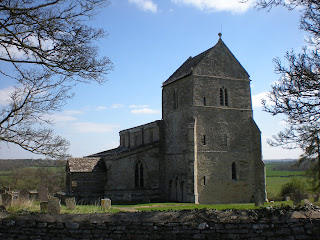
Next to it are the mounds of a once substantial castle. Looking east over the river from the Millennium Sundial, one can see three other churches. It’s Wadenhoe that provoked my earlier solemn melody for the vanishing village pub. The King’s Head here has been a regular haunt for a decade. You’d think it had it all: a pluperfect, picturesque village with river moorings, not so far from the A14 and half an hour’s drive from Peterborough, a nice garden, friendly staff, locally-sourced produce…but now the King’s Head too has shut its doors. Let’s hope for a revival (which is something I’d normally say in a church connection. Perhaps the two kinds of revival go together.)

 From the village I pick up the Lyveden Way along a track past an attractive farm at Wadenhoe Lodge. As often at this time on a walk, I stop noticing and start turning over the refuse in my mind’s dustbin. At the moment I’m reading AJP Taylor’s Origins of the Second World War, a book which excited a great deal of debate when it was published in the early nineteen sixties, including a spat of almost Snow/Leavis proportions between Taylor and Hugh Trevor Roper, another leading historian of the day.  Taylor’s overall thesis was that Hitler wasn’t a madman, but a mainstream German politician pursuing traditional German foreign policy aims, and that what we call the Second World War (in reality a conjunction of at least two, perhaps three, separate conflicts), was largely the result of miscalculations on all sides. Most other people disagreed then, as I think they would even more today. I’m trying to understand the current European dilemmas by looking back, to see what resonances there might be in the past, and what’s different now. One uncomfortable theme is that not only was the pre-New Deal US isolationist in the very early nineteen thirties, but Britain was too, or so Taylor claims (though it was still administering the end of Empire) – and surely those world views mirror current popular sentiment? Clearly Taylor (in 1960 and against the background of the Soviet bloc!) saw Poland as a non-viable political entity, which with some crossing of fingers, seems an outlandish thought now. I’d forgotten that Gdansk, then Danzig, which seemed so irreducibly Polish when we visited fifteen years ago, was once seen as a sine qua non German enclave to the point of being a casus belli in ‘38/39.  The idea that the Italians might think Nice was really theirs, rather than French, came as a shock to me. And what do we make now of a mutual defence pact – which came to nothing – between France and Czecho-slovakia, with or without its hyphen? Can we as ‘Britons’ ever get over our history as an ‘island race’? Like many others, until ten years ago I thought that a thing of the distant past, but am now far more pessimistic. Taylor’s book is uncomfortable reading.


 Down and up, and through Lilford Wood, into the grounds of Lyveden New Bield.  If you’ve not been, it’s a very strange place, a perfectly unfinished seventeenth century house standing on the middle of a wide plain, in its own weird way as evocative a setting as Stonehenge. We’re in Thomas Tresham territory again, he of Rushton Hall and the Triangular Lodge, so all over the shop there’s mystical symbolism with a Catholic slant. On a bright day like today, you half expect a bunch of builders to turn up and begin finishing the job with merry quips and whistles. On a dark winter’s afternoon with the wind blowing, we’re talking Cathy and Heathcliff. I can’t come away from Lyveden at any time of year without a certain emptiness of spirit and sense of foreboding, hopes unfulfilled, plans thwarted, vision overwhelmed.

 
Last words:  19 km 5.7 hrs. 13 deg. C. Pleasant sun and a light breeze. No stiles. 14 gates. 3 bridges. Two churches, one open.  


Lord
Have I got this right?
I find The Truth to be a slippery thing.
I’m no post-modernist.
For instance,
I’m not going to go along with Baudrillard
And say the first Gulf War never happened.
But aren’t there enough grounds for humility
In what we don’t know about the universe,
In understanding that I comprehend the world around me
Only through unreliable sense-data,
In repeatedly being shocked by my foolish misapprehensions
And in confronting the certainties of others?
So how do I ‘preach the Gospel’?
And what do I do about the feeling
That my ‘truthful’ uncertainty
Has never won anybody for
The Kingdom of Heaven?

 
 Lord
Sanctify and bless my doubts.
Give me the simple faith
‘like those who heard beside the Syrian Sea’
To rise up and follow Thee.
Amen.


Tuesday, 26 March 2019

Dun? Certainly have been...


                                                         From the bridge at Geddington
 
CSNY on the car stereo chirping charming, hippy nonsense about Guinevere and the delights of Marrakesh as I thrum past the Samuel Palmer landscape of a sunlit Boughton House. I park near the Ise ford in Geddington, and because the morning’s so nice, turn down the chance for coffee and cake at the village cafĂ©. In Wood Street a cheerful postie is on the last couple of hours of her daily stint. She’s been treading tarmac since half past six. She doesn’t mind the early start, particularly on an energising spring day like today, even though the breeze is brisk, and she’ll be walking this way with her dogs later on, as if she hasn’t worn out enough shoe leather already. Where the tracks divide I find the Old Brickyard community garden and its totem pole. Geddington’s primary school is just back down the lane: the kids clearly use this opportunity well.


I know villages have their faults. There’ll always be backbiting and gossip and petty squabbles. But at their best they provide wonderfully safe, varied and nurturing possibilities for all their residents. It would perhaps be cost-effective in the long run (less crime, less mental illness) if modern housing developments used them as a model. ‘Joined-up thinking’ has dropped out of our current clichĂ©-bank, but the tensions between developers and government, and the necessity of immediate profit margin mean urban villages will rarely materialise, more’s the pity.

 It’s the fourth Spring of my Walk, and 1000 days since the country made its fateful but perhaps not yet final decision to part company with Europe. Three years can pass in a flash, at least when you’re the wrong side of sixty. The span of human history begins to carry a different meaning, and one begins to marvel at the shortness of time since the first motor car appeared, or a King of England was deposed in favour of a Commonwealth, or Normans underlined their power with a wave of new and larger churchbuilding. Assuming that Jesus’ death and resurrection occurred somewhere around AD 32, will the Church celebrate 2000 years since those events? And how? Is anyone in this post-Christian world giving any thought to the matter?

 The stony, easy-walking track leads up towards Brigstock between Geddington Chase on the left and Bright Trees Wood on the right. It’s pretty dry underfoot now, after the abrasive winds of a week or so ago. Precipitation amounts have been annoying rather than functional in the East Midlands. There’s a fuzz of green on the bushes and trees, but the birdsong is sparse. Joyously, it wasn’t so at a quarter past five the other morning. I like to think that the first thing birds do when they wake is praise their Maker with an ornithological Morning Prayer. Why else would they so expand their communication during the morning peak hour?


                                                 Forest management: Geddington Chase

A different and harsher kind of music assails my ears from the top of the rise. As I come up to the crest, a Darth Veda helmet appears above the silhouette of a trials bike. The rider appraises me anxiously as I walk towards him, but as far as I know he and his mate aren’t doing anything wrong. This is a byway, and surely there are no restrictions as to who does what on it? It’s just that they’re, grrr, spoiling my quiet Monday morning walk with their noisome row. They stand aside respectfully as I pass, we say hello, and then they continue their bikers’ yarns in…Polish or Russian or Lithuanian? But here’s the thing. Good old European me, I still find an aggravated bile of resentment rises as I realise they’re not native British.  This isn’t acceptable, of course…it’s unadulterated prejudice, and tribalism, and runs contrary to my ostensible Christian and political beliefs. But to show it for the poor, anachronistic thinking it is requires acknowledgement, analysis and resolution – in short some moral hard work. Nigel Farage has just lost his co-chair of the new is-it-isn’t it ‘Brexit Party’, because she was shown to have a history of poisonous tweeting. Among the more plaintive comments from Catherine Blaiklock’s on-line output was that instead of ‘acid attacks, mobs and mosques’ she wanted ‘seaside donkeys on the beach and little village churches’. The dangerous thing about such rhetoric is the slip from understandable nostalgia to hate by association – a shift that’s easier to make than we like to think. On the other hand, there’s a debate to be had  - and actually we’ve been having it for decades – about how incomers should adapt to the mores of a host nation, whether one is the host or the traveller. I’ll shortly be visiting the Netherlands, as I’ve done lots of times before. I speak no Dutch. All social interaction will probably occur in English. This too is sloppy and regrettable behaviour, isn’t it, suggestive of a British superiority complex?  Last Saturday, the Rev Jun Kim was installed as Rector of St. Peter and St. Paul’s Abington, Northampton. Jun is from South Korea, and his wife Simona’s family are from the Baltic States. The world is getting smaller, and it’s a shock to our ways of thinking, and all of us, including me, will have to get over it. As Bishop Donald apparently mentioned at the installation, parishioners will have difficulty besting Jun in his ability with spoken or written English. Like.

 The line of the Roman Via Devana probably crosses the track somewhere near here, a military and social artery running in zig-zag fashion from Colchester to Chester. It’s now a commonplace that the arrival of the Romans contributed a lot of extremely foreign blood to the native British stock, though perhaps tempting to make too much of this in terms of sheer numbers. Certainly we have evidence of men and women from far-flung places in the Empire, including Africa, but then again, these incomers may have been more highly educated than the general run of woad-wearing Romano-Britons, and so may have been more likely to leave signs of their presence. Anyway the point’s well made. Being British isn’t just a matter of sharing one’s DNA with 7000 year old bones in Cheddar caves.


Despite a population of not much more than a thousand, Brigstock feels quite the town. The parish St. Andrew’s church serves is large, and the round turret which clings to it reveals its important Saxon origins. It’s said that the number of people living here hasn’t changed much since the days of Henry VIII, when Rockingham Forest was a much greater, coherent reality, and folk would come to the local markets from far around. Inside St. Andrew’s I find two ladies who are preparing the flowers for the funeral tomorrow of  93 year old Kathleen Wills. As the ladies tell it to me, Kathleen was a long time resident of the village and a Catholic, so a Catholic priest is coming to take the service here in recognition of her love of the place and people. This is how it should be. I hear rumours of Anglican churches leaving ‘Churches Together’. As the other Real Donald (not the Bishop!) would say ‘Bad. Very bad.’

 St. Andrew’s has lost its large adjoining Rectory where there was also a Parish Room. They hope that soon, with the Diocese’s permission and some financial support, there’ll be a servery and loo in the church. On my way out, I meet the smiley, friendly Rev. Heather who’s been the Rector since 2017. Her husband Alan is the Associate Minister, and a Church Army captain. I wonder to myself how their breezy, possibly evangelical style will sit in Brigstock, particularly since they live in Stanion (and I imagine old habits die hard, and that Brigstock thinks it has more tradition than Stanion…but this is mere supposition!) Mission or marketing? Change or decay? Stick or twist? Yours, mine or ours?


                                             A new take on a Bishop's Throne: Brigstock

A nineteenth century Brigstock vicar, Talbot Keene, who sounds like a B movie actor, was also a jolly soul, and it’s claimed that he was a poet, though versifier might be a more accurate description. Writing about the ‘rules’ for callers at the vicarage, he said:  ‘If he should be in studious sit, shy/In the study he may sit/But if inclined to laugh and talk/Then in the parlour let him walk/And in the wheel of his narration/Put in this spoke of conversation/Let those who thus shall honour me/Be as at home, and just as free…  Time pressures on clergy were less in those days, hence hunting for good rhymes, shooting the breeze, and maybe fishing for compliments.

 A text arrives from Matt to say his friend Giulia has just given birth, and she and Enrico now have a lovely daughter Vittoria. It’s Lady Day today, the feast of the Annunciation. For an Italian family this seems good timing, and if our friends and relations are any measure, Brexit seems to be promoting a baby boom. Actually, the more I think about this, the more likely a proposition it seems…

 I wander out of town to the Fermyn Woods Country Park, enjoy a cup of tea and a piece of Bakewell amid sundry mums and tots, and look at the pictures of butterflies adorning the walls. I’ve never seen a Purple Emperor, but if you go down to Fermyn Woods in June or July apparently there’s a good chance you will. If the actuality matches the publicity, they must be the most exotic and beautiful of all native species.

 I follow the path over the fields towards Stanion, the last section of which passes through a newish plantation of smart, greening birch. On its far side a short field leads up to modern houses in front of St. Peter’s church. At first I don’t see the path which leads into the churchyard on an angle from St. Peter’s close. A Northamptonshire old boy asks me if I’m walking to Geddington (rather wearily, as if he has to deal with a score of people every day for such purposes – which he may well do…) He wants to point out the direct route but adds that if I really want to see Stanion village, I can take the path by the church wall. I assure him I really do but then am disappointed to find the church closed. Disappointed because I know that inside there’s a seven foot whalebone which legend has it came from a ‘dun cow’ so productive and large that it once kept the entire village supplied with milk, until a witch did away with it out of jealousy.  The Dun Cow story (which has lent its name to quite a few pubs) crops up quite a few times through the Midlands, and Stanion isn’t the only church to display a whale-bone as supposed evidence of bovine fecundity. It seems possible the remote origins of the tale may be in the defeat of the Danes (= Duns…whalebones…)


                                                           Birches near Stanion

In 1944 Stanion and its church starred in a short film you can still watch for free on-line courtesy of the BFI called ‘Springtime in an English village’. If you have seven minutes, please input the title to your favourite search engine and be moved. I’m not entirely sure all the footage was actually shot in Stanion – the hills in the opening ploughing sequence don’t immediately seem right. As the BFI’s short description comments, the intentions of the film-makers aren’t clear – it was made for ‘colonial’ use, and the little girl crowned Queen of the May is perhaps rather conveniently Afro-Caribbean, one of two apparently in the school at the time, so maybe there were propaganda purposes in its making. But in its depiction of innocent childhood and a now distant, different time, to this viewer it’s almost unbearably touching, poignant and beautiful. I wonder if any of the children who appeared in it are still alive. It’s quite possible, and it would be wonderful to have their memories of the event.

 The Sprouting Times:  18 km. 5.3 hrs. 13 deg C. Brisk north westerly breeze at first, veering north-easterly and then dying in the afternoon. Two churches, one open. One stile. Nine gates, and three bridges, two over streams and one over a road. Blackbirds, sparrows and tits. One marauding pair of kites. One very handsome hunting buzzard. No woodpeckers despite the woodland walks tho’ Sue saw a yaffle in the garden early in the morning and a team of goldfinches the following day.  

Father
I always thought I knew my tribe
Could recognise the accent of someone from North West Kent
Could depend on a common liking
In Politics
Religion
Food
Sport
Music.
But these days it’s confusing.
Everyone wants to belong
But only to a tribe they design for themselves
Like Groucho Marx said
None of us want to be members of any club that would have us.
It’s sometimes the way I feel about your Church.

 Father, we know we are one people under your care.
Draw the warring tribes together from your many mansions
To sing in glorious agreement and harmony
In your eternal choir.
Amen

Monday, 11 March 2019

Family Business


I think perhaps this posting shouldn't be here. Maybe it’s too personal. It’s not about the Diocese of Peterborough. It has no connection to the Church of England – not directly. But this story finds itself in the long narrative, because I could have been reporting to you from somewhere out in the country near Corby, but instead I’m in what was once called North West Kent. And secondly because today I find myself in a different role. I’m a needy, importuning customer/consumer, like others I come across in the visitor books of Peterborough churches . It’s March 8th, and fifty years ago to the day my mum died of a metastasising breast cancer.  It was a long and arduous road to death. She was forty seven, my dad a few months shy of fifty. I was seventeen, and an only child. Today I want to heal some memories.

 The drive from Northampton to Erith is unpredictable. If the motorway gods are unhappy it can take three or four hours, but I arrive in Northumberland Heath an hour early, and so drive down the narrows of Brook Street to Erith cemetery. I park next to the office in the western part and peer through the windows to see if anyone’s there. Yellow dungaree’d Mick materialises behind me and asks if he can help. I explain I’m looking for the grave of my paternal grandparents. He puts in a call, kindly Jo looks up a ledger and tells me the grave’s number is DD 118. Mick takes me into the middle of the cemetery, and we find William and Isabel. I haven’t been here for nearly sixty years, but the grave is roughly where I imagined. It’s not in great condition. I can just about make out the names on the low surrounding kerb. The concrete on the top is failing, and there’s a small hole in one corner, revealing the void underneath. This state of affairs is a bit near the knuckle.  I’ve recently expressed myself forcibly to fellow-parishioners about the state of the War Memorial in Weston Favell. A couple of years ago it was given Grade 2 status, and there’s been considerable enthusiasm for cleaning it, jacking it up and generally giving it a botox and blow-dry. I’ve taken the opposite view – memorials are what they are, and should be allowed to fall into dignified decay, unless there’s a health and safety issue. But - of course - I don’t feel at all the same about something with the name Cross on it.

 William died before I was born. Isabel knew me briefly as a baby before she too passed away, in 1952. William, so my aunt says, could be a difficult man. So could my dad. So, I’m assured by my family, can I. Isabel was by all accounts kindly and emollient. She gave birth to five sons, so in such a testosterone-filled household, she probably had no choice. I wander the cemetery’s eastern half, and look out towards the just-visible Thames across the old gravel workings, now given over to landfill. I reflect on the rightness of my grandparents being buried together. The ashes of my parents are twenty miles apart, which in retrospect seems a poor reflection of the love they had for each other.

 John meets me outside Northumberland Heath’s Baptist church in Belmont Road. It’s thirties’ red brick looks much the same as it did, just a little more weathered, like all of us. John is sporting a ‘Bob Marley:  Revolutionary!’ baseball cap. He’s a little hard of hearing. I think his wife Grace, who looks after church bookings, has briefed him, but he still carries a faintly puzzled air. I’ve had a bit of difficulty setting this up. An e-mail to the pastor remains unacknowledged after three or four weeks. And Grace and I only made final contact two days ago, after some hiccups. Well, I suppose the request was unusual.

 John lets us in, and I take in the surroundings. The art-deco pews went long ago, to be replaced by nice blue cushioned chairs, ecclesiastical space-for-the-use-of. The communion table has moved forward, and the area over the baptistery is now a concert platform. There’s a drumkit in one corner, and sundry amplifiers, and a keyboard, the usual kind of thing. In the early nineteenth century there were occasional tussles between clergy and gallery bands. The bands would sometimes get out of hand, and the clergy had a job shutting them up: the musicians had come to think of worship as ‘their’ prerogative. And then someone invented automated barrel organs, and the clergy saw a chance to wrestle back the initiative – or so the story goes. It helps to have worked in the pop/rock business to understand the potentially dangerous significance of ‘worship bands’. It’s extremely difficult not to make the music about ‘me, me, me’. Its extroverted nature and the secular model draw attention to the ‘performer’, however hard he/she tries to give God the glory. Choirs and organists aren't by any means immune from this kind of thing, but at least, even in American evangelical churches, we tend to put them in funny furbilowed clothes so they don’t get too uppity. Just like the clergy.
 
Behind the band kit is a grand piano. It doesn’t sound too bad, so I work with that. For my mum, and with John (who has tactfully settled himself two thirds back) as a congregation, I sing. Firstly, ‘O Rest in the Lord’ from Mendelssohn’s ‘Elijah’, which she sang more than once as a solo in services, when she was already quite unwell. I imagine she was very scared and uncertain, and the music was a way of shoring up her faith, as it would be for me too. Another piece Mum sang, though with whom I can’t remember, was the ‘Death, where is thy sting?’ duet from The Messiah. I may even have accompanied that. In private she would sing a ditty from the CSSM chorus book. ‘Why worry when you can pray/Trust Jesus, he’ll find a way/Don’t be a doubting Thomas/Rest solely on his promise/Why worry, worry, worry, worry/When you can pray.’ I do not sing this for her now, but instead ‘Great is thy faithfulness’, which is a hymn which carries great personal meaning, with its triumphant couplet ‘Strength for today and bright hope for tomorrow/Blessings all mine with ten thousand beside...’ I can’t remember whether Mum liked this, or which hymns were sung at her funeral. I was too shell-shocked. But I do know it was sung when we said goodbye to her mother, Ella May.  I read from John 20, describing Mary Magdalene’s encounter with the empty tomb and the gardener, and though I’ve managed to stay focused and dry-eyed through the music, my voice cracks as I read the account of the disciples’ encounter with resurrection. I finish by singing my own version of the Nunc Dimittis.

 
And that’s it. It sounds trivial and grudging to say I’ve done my duty, but I have. I'm so grateful for what my mum gave me: a joy in life, a desire to smile even in adversity, a delight in music and words, and a faith. I wish she could have seen what the last five decades have brought, and that she could have met Sue and Matt. I thank John and bid him and the church goodbye. I was dedicated here as a baby (not christened!). I struggled my way through Sunday School here, kneeling on the dirty boards of the hall floor to crayon pictures of Moses in the bullrushes on the little school chair ( no, no, silly – on sugar paper, on the chair!). I learned to cheat my way around an organ here (electronic, primitive and made by ‘Jennings’ from Dartford, who also more successfully made Vox amplifiers with their never-better-emulated tremolo settings). I was baptised here by full immersion. I was grudgingly admitted to church membership too, although because I couldn’t summon up a real ‘conversion experience’, it was made clear they thought I was a second-class Christian. 'Maybe you'll get there one day, lad...'

I harbour no regrets or resentment but it’s quite possible I’ll never come back. The place has changed, and so have I. The memories are good and bad, painful and healing. Nowhere now will you hear the full-throated sound of a congregation packed to the gunnels roaring out, in the aftermath of the Graham crusades, ‘And can it be, that I should gain an interest in the Saviour’s blood...?’ male voices to the fore. The egos of contemporary drums and guitars are in danger of drowning out the corporate expression of the Church.

 I walk the streets for a bit. The houses crowd round the church now. The old Brook Street school has gone, where the great Alan Knott learned his basic wicket-keeping skills. The Pheasant pub, whose predecessor was the oldest inn on ‘The Heath’ has fallen on hard times. The yeasty smell of the bread factory still hangs in the air – it carries the Hovis name now, though I don’t think it always did. The wide open space of the rec is still available for dog-walkers and footballers. Long ago it was the site of the Workhouse, the ‘Spike’ which gave Northumberland Heath its still remembered nickname of ‘Spike Island’. I stroll up Horsa Rd, where Mum and Dad rented their first house together, and on to Emes Road where in a small council house the Hutchins family was raised. If anything it’s a little more upmarket now under private ownership. I pass the cottage hospital where I was born, and then double back to Bexley Road, where in the fifties there was a Co-op with its funny tin tokens and a Woolworth’s too, piles of knickers and bras in an open cabinet for anyone's fingers to sort through, but where now, in the same buildings, can be found tanning salons, tattoo parlours and betting shops. What’s so striking is how close everything is. The Crosses of Hind Crescent lived a literal stone’s throw from the Hutchins. Hospital, school, shops, church were all within the bare three quarters of a mile length of the community. And without television, or cinema, life revolved around the church for many, three or four nights a week, and twice or three times on Sundays. Even the pubs came under the eye of the Church. My dad once told me that he used to hang around their entrances as a young man, not gasping for a pint, but carrying a bible and singing hymns with the Band of Hope.
 
I leave by way of passing the first house my parents owned, at the unfashionable end of Parkside Avenue down towards Slades Green. They didn’t stay there long. They always had leafier places in mind. The place is scrappier now than it was then. Other communities are moving through, aware their sojourn by the railway embankment is temporary. All things must pass.
 
As I drive back up the A2, through Blackwall and round the M25 towards ‘my’ chosen patch I ponder how we can better serve those whose memories and needs draw them back to the places they and their families knew in the past. I’m not sure we’re doing a great job. How many churches have alumni associations, to keep in touch with students as they move away from home?

 And more generally, as all humanity flees from its centre, like a universe exploding from its first nucleus, increasingly isolated in our own individual worlds, yet receiving a confusing multiplicity of messages from those disappearing into the infinite distance around us, I wonder yet again how we can ‘do church’ more effectively. Same old stuff. My mum and dad were for ever asking the same thing, six decades ago.
 
Next time, back in Northamptonshire...
 
In memory: Betty May Cross nee Hutchins: 1921 -1969.