Monday, 6 September 2021

FOUR FROM HOME


There are now just four more small circles to be described on the landscape of the Diocese before this Big Walk is complete. I suppose under any circumstances it’s hard for the pilgrim not to associate the ending of the pilgrimage with arrival at the Heavenly City, or to put it in a blank and humanistic way, with Death. All the more difficult in Covid Times, and particularly when a friend is bravely planning her own imminent and untimely end to earthly life. And for me personally, autumn, rather than winter has always had that overtone – the bringing in of the harvest, the obvious decay of flower and leaf, the drawing in of the darkness.

Walking up from Castor though, away from the river, and onto the low plateau above the village, as flat as the fens but at about a hundred rather than zero feet, the harvest is still to be gathered – or at least the late-sown wheat is. I’m on the ancient, straight track known as Cow Lane, probably for the most obvious of reasons. There are odd kerbstones in places, traces of a now lost importance. Perhaps there was a villa set back here in Roman times. The top half of St. Kyneburga’s spire is clearly visible where the track right-angles, so the top half of the Praetorian Palace would have been too. On the way I have to cross the dualled A47. It’s not the best of crossings, nor the worst, but fellow-walkers please beware. The traffic is fast, and one has to dodge between bits of Armco and guess at the opening for the path on the road’s far side, all of which can be a bit stressful.

A mile further on, before I gain first sight of St. Mary’s Marholm, I’m wincing from an incipient blister on the back of my right heel, despite the strapping I always apply when I’m wearing boots. This has caught me out: it’s a few weeks since I’ve worn my Berghaus. Maybe they’ve stiffened up, or my feet have broadened a little. The ground is very dry at present and the field paths are quite corrugated, so perhaps my feet have been pivoting and rotating more than they would on flat surfaces. Ouch, there’s the rub.

There are cars parked all over the field in front of St. Mary’s: there’s a wedding in progress, and it’s good to see the church being used for a proper purpose. Everyone else is inside but a suitably and smartly dressed young gent, probably an usher, is entertaining a small boy on the church path. As I open the gate, heading towards the bench on the far side of the churchyard, I detect the slight reservation in his eyes. He’s thinking ‘What’s this old tramp doing? Is he a gatecrasher? Will I have to intervene?’ I say a sotto voce how-do in my best RP to allay his fears. At least he now knows the tramp is posh. Up in Marholm village I enjoy a restorative ginger beer in the Fitzwilliam Arms, then retrace my steps across the church field to go Torpeling in the direction of Peterborough. The field is rufty tufty. It’s been the scene of animal husbandry for some while, but in its middle is twenty two yards of concrete underlay for an artificial cricket pitch, awaiting a resurrection in some future decade, when/if eleven men or women can be mustered from the village’s a hundred and fifty souls. The outfield will need a bit of attention though…cow pats at ‘cow corner’ aka mid wicket.

Marholm is such a Danish name. Or Norwegian? (I’m thinking of Norway’s extraordinary four hundred metre hurdler Karsten Warholm!) Whatever its origins, for centuries Marholm has been a village under the patronage of the Fitzwilliam family, as the pub name implies, and the sixteenth century’s Sir William Fitzwilliam is still writ large in the fabric of St. Mary’s by the splendid Perpendicular of the chancel, which balances the strong, squat tower at the far end of the building’s exterior.  

I follow one of Peterborough’s ‘Green wheel’ waymarkers along a broad track towards the suburb of Bretton. While things are still rural, I meet Irmintas taking a walk with his pretty-as-a-picture giggling daughter Melita. They’re obviously hugely enjoying each other’s company. Irmintas is wearing bright green shorts, and has a strong eastern European accent (Latvian?) As I walk on, I can’t see any sign of a motor vehicle or house, so who knows where they came from.

 It’s been a long time since I walked in an urban environment – was Corby the previous one? – and I’ve forgotten how much extra heat is engendered by the hard surfaces on only a moderately warm day, and how easily one can be confused about road lay-outs when one isn’t familiar with the ‘hood. I know the Church of the Holy Spirit is somewhere in the Cresset complex (theatre/shopping centre/library/etc.) but after the nice big road signs telling me the general direction, it takes a bit of wandering about before I find the entrance, tucked away just past the Fayre Spot pub. In some ways the church is a clone of Emmanuel Church, Weston Favell, but slightly neater and more well-formed. Inside I find Jenny who’s flower arranging and Pete who’s the churchwarden. We talk with pleasure of the gradual opening up of churches, and about Helena the vicar and former curate.

These kinds of churches are gifts to the wider Church. They’re where the people are, but like the modern chapels in hospitals and airports (which have the additional problem that they’re sometimes shared between two or three religions) they can be mundane places, emphasising that people of faith are just like everyone else really, rather than stressing that God is totally ‘other’. Both truths of course, but which would be the most attractive to people of no faith – a place you might find someone to listen to you or give you food, or somewhere you could weep in the presence of an almighty God? And must these things be mutually exclusive?  But hey, back in the early seventies, when both the Church of the Holy Spirit and Emmanuel were built, at least allowance was made by the developers for their necessity. Nowadays, they’d be seen as an unprofitable luxury, so all that’s left to us is to be ‘street church’. In all senses of the word, there’s still a feeling of ‘sanctuary’ at Holy Spirit in front of the altar and the appealing statuary.

Outside again, I try to orientate myself and then tread the mean streets of the city in the direction of Longthorpe, repeatedly selecting wrong options and having to double back, because my city map is decades out of date in random ways (It still has an extra ‘e’ attached to Marholm’s village name).  At the Copeland Local Centre, I’m struck by its familiarity to anyone who worked in the peripheral parts of Milton Keynes. When our recording studio there was relocated to a purpose built environment in Willen at the end of the eighties, the stipulated style of architecture was ‘pavilion’ and here it is again at Copeland’s pub - ‘Cooper’s’ Its broad eaves, and smaller first floor suggest Japanese culture or Adamski-era forties’ flying saucers, depending on your interpretive frameworks. In Neath Hill, Milton Keynes, where our first studio was, the pub in the square opposite was called ‘The Eager Poet’ (a not-so-subtle joke…Milton…Keynes…geddit?) Which makes Peterborough’s ‘The Fayre Spot’ seem not such a bad moniker.

Longthorpe is an ancient village on the city edge, cut off from the Nene and greenery by the Ring Road. A medieval tower stands behind St. Botolph’s church, managed by English Heritage who would charge me a fiver for entry, which at first I think a bit steep, until I read that on its rather special domestic wall paintings I could spot ‘kings, musicians, saints and animals…including a mythological beast armed with projectile flaming excrement (sic)’. 

However my blister is now really hurting, so from the outside I admire the re-ordering of St. Botolph’s, and undertake running repairs, re-strapping the ankle and removing one of my two socks. For a moment or two, knowing it’s maybe two and a half miles back to the car, I wonder how I’m going to manage this.

The flyer for the St. Botolph’s financial appeal has as its strapline, ‘Honouring our past: looking to our future’ – which seems pretty good to me. The bullet points are worth recording in full: 

·       To undertake urgent renovations to preserve significant historical features… 

·       Allow for more inclusive and flexible worship

·       Become an intimate venue for musical events and concerts and support the development of young musicians from the area (smiley face from VC!!)

·       Grow our role as a health and well-being hub for the parish and extended community

·       Celebrate our history, educate visitors and tell the stories of local families past and present

·       Improve the parish church layout for key life events of our villagers and enable access for all.

I have to dig in for those last two or three miles. I struggle, limping, past Thorpe Wood, over the Ring Road, and search for access to the river, which necessitates an annoying half a mile back-pedal towards the City Centre. I’m pleasantly distracted by the joys of Bluebell Wood and Nene Park, where on this warm Saturday afternoon people of all ethnicities are cycling, walking and bathing. Then there’s a long slog up the car park past the Milton ferry to the old road back to Castor and the top of Love’s Hill. Above the river there are a number of gracious properties, whose beautifully kept gardens engender a mix of emotions. Who are these people? Where/how did they make their dosh? Inherited or earned? By fair means or foul? With or without exploitation? And are they just successors of the Romano-British middle class, who probably also enjoyed their long views over the wide river valley where the peasants subsistence-farmed and smelted?  I gaze over a field to the north where unattributed by the OS map, lies what looks like a burial mound. It could of course just be a spoil heap from road building. At any rate it’ll do as a memento mori on this early autumn day. One fence negotiated, three to jump…

Giraffe in grounds of care home: Longthorpe

Horses in the race:  20.5 km. 6 hours. 23 degrees C. Two stiles. Six gates. Two bridges. Three churches, two of them open.

 Father God

Free will and determinism.

I’m still struggling with this one

After all these years.


I get the endless questing

Boundless improvising

Restless enterprising

Drive of humans

And praise you

That you made us that way

And in the words of Otway

‘Cor baby, that’s really free’.


And then I see us stuck

In old habits

Addicted

To money

Consumption

Drugs

And inanity

And that looks anything but really free.


Can I be both?

Am I destined to be redeemed

Or condemned to nothingness?

It’s a real worry Lord.

Not something that ought to be pushed

To the back of the mind.

But to function, I have to.

Have mercy on me, O Lord.

Amen.

Saturday, 21 August 2021

AFGHANISTAN


It was completely unexpected of course, but by accident this journal has charted a strange passage of British and world history through the last five years.

 Last week, for the first time in eighteen months Sue and I ventured into a more or less crowded public space by visiting the Tate Modern gallery. It was an enjoyable but nerve-jangling afternoon. Maybe you identify with this mixture of emotions?  We’d come to see art, but our gaze was as much on our fellow-travellers. (Even for this routine scan of the regular exhibition the tickets were timed, and we had to follow a pre-determined route through the rooms, masked throughout). My thoughts went to that Gospel story where Jesus restores the sight of a blind man who then in amazement describes the people he now sees as tall trees – ‘but they’re walking around!’  Many of us are learning public life all over again. For a while at least, new meanings attach to everything we encounter.

There were three works of art which caught my eye. The most monumental and memorable was a piece by Cildo Meireles called ‘Babel’. It’s a tower of hundreds and hundreds of pre-digital radios in varying shapes and sizes, rising ten metres above the viewer as she walks around it. It occupies a room of its own. A randomised soundtrack plays simultaneously as if from a thousand speakers, music pop and classical, speech English and not, animated and calming. It’s both funny and provoking – and easily interpreted by someone with the slightest Bible knowledge. Even so, I wonder how many visitors to the Tate ‘get it’.

Away from Helpston, on what will inevitably be something of a John Clare Crawl, I cross the various railways at the Maxey crossing, where no less than six tracks must be traversed at one go, and the red lights frequently flash to halt drivers, cyclists and pedestrians as the LNER express trains whoosh past. St. Peter’s Maxey is a little way from its village, set on a shallow bump which is noticeable mostly because the surrounding countryside is much flatter now. The grass is mown, the churchyard tidy, but the church and even the loo in the churchyard’s far corner are firmly shut.  The name ‘Maxey’ is familiar to me, and for a moment I can’t think why. Later I remember. Looking up the name in the index of archaeologist Francis Pryor’s comprehensive book, ‘Britain BC’, the reader sees:  ‘cursus pp. 183-5; Great Henge pp 184-6; ritual landscape, 207, 305; barrows 344’. I’m going to quote Francis Pryor at unusual length:


           ‘Over the years, I’ve been excavating parts of a long (2.5 km) cursus near Maxey…(it) cuts a diagonal swathe across a low gravel ‘island’ in the heart of the floodplain of the river Welland. Near the centre of the island it passes beneath a huge ceremonial site, known as the Maxey Great Henge. In fact it isn’t a henge in the strict meaning of the word, because it’s rather too early in date (about 3500 BC), but we do know that it was constructed when the cursus ditches were still open….At Maxey the alignment of the cursus takes you from one of the lowest spots in the landscape (where we find Etton:  ed. the neighbouring village) to one of the highest (the site of the Great Henge, and near to the church). It ends at another low spot on the north-west ‘shore’ of the island. We know that conditions at Etton were becoming progressively wetter, and I wonder whether the cursus was constructed to conduct the magic and mystery of that special place to a new ceremonial centre, the Great Henge, on higher and dryer ground… I would imagine that such a place would involve many communities, and would have been very time-consuming…’

 On the OS, just to the east of a diagonal footpath, it simply says ‘settlement’.

I find the above extraordinarily moving and humbling. Think about it. More than three millennia before Jesus, near enough on the same ground where St. Peter’s now stands, crowds of people with hand tools laboured tirelessly together through their presumably short lives over many generations in a way that bound faith and community together. As a worshipping Christian with a pre-made church building, written scriptures and all the blessings of contemporary life I am in awe, and have as much difficulty in reconciling their experience with our account of salvation history, as if I were confronting little grey men stepping from a flying saucer.

I walk through Maxey, past the quarry entrance, dodging up onto the kerb at frequent intervals to avoid the HGVs, cross the busy A15, and enter Northborough, which seems a workaday sort of place. I’m only a mile or so from Market Deeping in South Kesteven. Mindlessly, I turn right into Lincoln road, thinking about Abraham Lincoln or my friends in the Lincoln family from Northampton, or I don’t know what. It’s only later in the day, when I briefly walk back along a more southerly stretch of the same road that I twig. It’s not any old Lincoln road, it’s the Lincoln Road, at least just here – the road to Lincoln. Northborough may seem workaday, but like so many villages, at the core of the quotidian expansion, there’s loveliness. On the corner, where I turn towards the church, is the dignified gatehouse of Northborough Manor House, where Oliver Cromwell’s wife ended her days. St. Andrew’s church looks fascinating in its own right, with an intriguing collection of angles presenting to the worshipper arriving at its north door, but I’m out of luck today. It too is locked. The road which passes the church betrays its age by the amount it twists and turns (this is a reliable guide to medieval origins even in London – contrast Marylebone High Street with its more linear neighbours). In a little while I turn right onto Paradise Lane, which passes beside Paradise Cottage. The description is slightly hyperbolic, but it’s still a pretty nice place to live…


The track crosses the Maxey Cut, and I’m aware that I’m on the very edge of true fenland country for the first time, before ever I see that I’m emerging on ‘North Fen Road’ into Glinton. I cross an unremarkable bridge across a drain where the needle spire of St.Benedict’s rises dramatically from the trees. At this bridge it’s said that John Clare and his possibly unrequited love Mary Joyce were wont to stop and talk. They never married. She died a spinster at 41, and is buried in Glinton’s churchyard. Clare wrote of the church:

 Glinton! Thy taper spire predominates

Over the level landscape, and the mind

Musing the pleasing picture contemplates

What elegance of beauty, much refined

By taste, effects. It almost elevates

One’s admiration: making common things

Around it glow with beauties not their own.

Thus in this landscape, earth superior springs;

Those straggling trees, though lonely, seem not lone

But in thy presence wear a conscious power,

Even these tombs of melancholy stone

Gleaning cold memories round Oblivion’s bower

Types of eternity appear, and hire

A lease from Fame by thy enchanting spire.

Oh dear. Am I getting old? I’m acquiring a taste for Clare… I wish people wouldn’t call him ‘The peasant poet’. Nothing peasant about those lines.

In Glinton and Northborough one can sense the closeness of Peterborough. Allegedly there are three thousand people living in Glinton, though on this acquaintance I can’t say where. But there are kids on the grassy corner by the pub, opposite the church, gratuitously blasting rap from their ghetto rig, hoping I’ll complain, and the traffic is moving just that little faster. Places to go, people to see.

I cross a field to Etton and its church of St. Stephen, which is more shut than most, and then walk the long way back to Helpston. Overhead the RAF or some other foreign power plays war games with Wittering in their sights. At Woodcroft I cross the mainline with the help of a youngish woman in a safety vest whose job is to manually open and close the gates on what must therefore be the most dangerous level crossing in the UK – it’s years since I’ve seen this necessity – and never where there are six sets of rails and trains doing a ton or more. When I arrive back in Helpston, I hope for tea and cake in the John Clare Centre, but they’re closing. I’m Hooked on Clareics now. I’ll definitely be back.

Towers of Babel? Afghanistan?  Oh, all of us with any kind of conscience are this week perplexed by the events in that country, and those who reckon it the most shameful moment in foreign policy since Suez in my view have it absolutely right. The MP Tom Tugendhat made the most remarkable speech in the House, encapsulating from an informed personal perspective what a lot of us feel who’ve been lucky enough to live at a safe distance from any real engagement with the issues morally or militarily.

We feel, many of us, that something has gone badly wrong, that our country at the instigation of the US has done something badly wrong (and though Tugendhat didn’t spell it out, as a result of Brexit, we’re now left with no real influence among any of our former allies, transatlantic or European, whatever the Johnsonian bluster may be). But we don’t know what could have been done to avoid this tragedy, and above the chorus of competing voices, heard only partially, none of them truly comprehending or listening to what anyone else is saying, we can’t make any sense of any of it. Our moral compass is deranged.

This is partly because of the incessant media chatter – which I take to be the point of Meireles’ ‘Babel’ sculpture – there’s simply too much noise. And even in Church matters, this is true. We can read the Church Times, and even through that single source of information, have the greatest difficulty in seeing the wood for the trees. Who are all these people, and what right do they have to their opinions?  What axes are they grinding? What do the words they use mean, and what are they signalling to those better in the know? Is our Church in dire trouble, as many of us suspect? And where is God in this? - the same God possibly, who was in the minds of those shoving earth and gravel around at Maxey fen so long ago. Though with the curtains of history in the way, we won’t get a perspective on that until the surprises of heaven.

Flies in the ointment:  16.5 km. 5.5 hrs. 21 deg. C. Mostly sunny but moments of cloud and breeze: promised later showers never materialising. 1 stile. 5 gates. 6 bridges. Numerous drains and water courses. Four churches. One open (St.Benedict’s). The offer of a ploughman’s lunch the following day care of Gill, Jane and Polly in Church St. Northborough. The harvest in progress – wheat still to be cut, everything else down to stubble. Snooty pigeons everywhere.

 Heavenly Father

Lord God of St Benedict

And Joe Biden

St. Paul

And Vlad Putin

Mary Joyce and John Clare

Maxey fen and Mini beasts

We stretch our hands to you

And implore you

To come to our aid.

We know we are feeble and frail

But sense your greatness within us.

Help us be the best we can

Wherever we are

With whomever we meet.

And never to give up on the struggle.

Amen.


Thursday, 29 July 2021

RATTLESNAKES


Some walks look promising on the OS map and turn out not to deliver. Others look potentially dull, and because of the time of year or the weather or the arrival of the unexpected are wonderful. The stroll from Barnack to Bainton today is one of those. Now pastoral, now sylvan, with the temperature already in the twenties just after nine o’clock and the crops shimmering in the heat haze, I’m delighted by the butterflies dancing around me as I walk the oft right-angling path.

Christopher, our priest at Welland Fosse, recently introduced a session on intercessory prayer with a George Herbert sonnet. Sometimes I find Herbert difficult, but this is marvellous – you probably know it…

 Prayer the Churches banquet, Angels age,

God’s breath in man returning to his birth

The soul in paraphrase, heart in pilgrimage,

The Christian plummet sounding heav’n and earth;


Engine against th’Almightie, sinners towre,

Reversed thunder, Christ-side-piercing spear,

The six daies – world transposing in an houre

A kinde of tune, which all things heare and fear;


Softnesse, and peace, and joy, and love, and blisse,

Exalted Manna, gladnesse of the best,

Heaven in ordinarie, man well drest,

The milkie may, the bird of Paradise,

Church-bels beyond the starres heard, the souls bloud,

The land of spices; something understood.

Reversed thunder’ – wow! - such an astoundingly modern thing. Feel those commas. Countless people have fed off the poem’s resounding, meaning-rich phrases. The pay off line became the title for a long running Radio 4 programme which, going out just before midnight on a Sunday, has been one of the more innovative pieces of religious/spiritual broadcasting over the years IMO. The hook for today’s walk is without question: ‘Heaven in ordinarie…’, because the mile or so into Bainton points up the mystic beauty of small and usually unconsidered things - the perfection of a creamy-white convolvulus flower, the insect-like tops of a field of fast-ripening barley, the cool respite offered by a woodland
glade. The unfairly maligned R.C.Zaehner’s classic book on mysticism goes large on Wordsworth. I don’t know where Mr. Daffodil’s nature-ecstasy sits with the Church of England, so laden with earth-bound doctrine and practice, synods and PCCs, genuflection and processions, sometimes so short on wonder, but it’s where my faith begins and ends, and has done since childhood. Everything else that’s theory-laden hangs around it, like a set of clothes. In that sense maybe I am a ‘a man well drest’.  Apparently Herbert was a dapper sort of chap. What jumps out of the sonnet for you?

The name of the village of Bainton also carries mystical associations, though spurious. The composer Edgar Bainton wasn’t born in the village, had nothing to do with it subsequently, and went off to Australia for the second half of his career, but his most famous choral work, regularly cropping up in posh Anglican evensongs is ‘And I saw a new heaven’.

Isn’t the making and handing down of ‘art’ a strange thing?  Bainton was celebrated in his day, particularly when he was young, but his music isn’t much played now - his good friend Rutland Boughton (there’s a first name for you!) even less so. They both wrote music with a generous, dramatic sweep, and Boughton even founded a Glastonbury Festival which ran for a score of years until the mid-twenties (the nineteen twenties!) before the Eavis’s were ever newsworthy. Boughton’s intellectual landscape was wide-ranging and peculiarly of its time, encompassing Arthurian legend and the Communist Party. These composers’ output was as great as anyone’s, and technically assured. Yet now they’re scarcely remembered - except in Bainton’s case for one celebrated church anthem. Weird. And for someone like me whose career has consisted in dithering around the edges of the media, it’s both humbling and strangely consoling. Their technical ‘chops’ were on a different planet to mine.

I visit St. Mary’s church, but don’t take in much, except that it’s open and I’m glad to be there. I do see an A4 report on its fabric loitering by the desk near the door. The summary at its conclusion is: ‘The church is in need of a lot of tlc’ and a second look around me confirms the assessment.

There’s been discussion at General Synod and in the pages of the Church Times about the need to create ‘10,000 lay-led churches’. Leaving aside that this is a hugely ambitious target, and that as someone about to embark on certification as a diocesan ‘lay worship leader’ some church bureaucrat somewhere might in future identify me as one of the ten thousand called to lead, this begs so many questions about the relationship between clergy, laity and the C. of E. What happens to the fabric of the St. Mary’s of this world in the meantime? Is being ‘mission-shaped’ the alpha and omega of ‘doing church’? Secular society may be making their choice not to listen. (Mission Praise 651…)

I move on through the sunshine to the hamlet of Ashton (the third village of that name I’ve encountered on the Big Walk). Ashton is a single straight lane. The first house I come to, restored to pristine condition amidst extensive grounds, is called ‘First House’. Now this may be an ancient name for all I know, but with the property looking as expensive as it does, is my mild harrumph justified? Unimpeachable in the truth of its geographical position (except that if you were coming the other way it could equally well be entitled ‘Last House’) am I crabby to suggest the name implies ‘I look down on him because…’ cf. Messrs. Barker, Corbett and Cleese in ‘The Frost Report’?  What do the people who live in the humbler cottages along the lane think? Do they tug their forelocks as they pass?

From Ashton I go torpeling. The Torpel Way is named after Sir Roger de Torpel, the remains of whose Manor I eventually come to at the end of the straight road which leads into Helpston. There were many Sir Rogers (hard not to avoid a smirk), and one of them built a great deer park, which the Crown in the person of Henry VIII eventually decided should become its own. On the other hand the Torpels probably owed their estate to the Crown in the first place, so one can’t shed too many tears. Read an entertaining and present-tense child-friendly account of all things Torpel at http://langdyke.org.uk

St. Botolph’s Helpston is closed. This is the place where John Clare was born and so I can eat my sandwiches beside his multi-flowered memorial in the churchyard. Another day I could visit the museum in Helpston’s Woodgate: it sounds like an hour or so well spent. On the memorial stone by my feet the John Clare Society declares that ‘A poet is born, not made’. I think this is probably true, but puzzle how it can be so. Determinism sits uncomfortably with a sixties’ education.

On from the village towards Helpston Heath, and then by tracks zig-zagging to Ufford where the White Hart welcomes the parched, weary traveller with a ginger beer in its commodious bar. The church of St. Andrew is conserved, and very tidily too. It stands on a promontory, looking towards the distant, invisible sea from its height of forty odd metres, and above a settlement so precise and delicate. Nothing jars, nothing is out of place in Ufford. Certainly not at The Hall, which the National Trust had to sell on, because the cost of refurbishment was too great. Whoever owns it now has done a bang-up job. What an extraordinary thing to live in such a house – I’m presuming the internals must be as pristine as the outside. I’m tickled to see that the organ in St. Andrew’s, small and baroque, was the third ever made by the late Ken Tickell from Northampton. His work has graced many places of worship.

Next Monday is the day the British press have christened ‘Freedom Day’ when, begone dull care, we shall all be allowed to cast our masks aside to hug and kiss, and order drinks at the bar unhindered by unwelcome social disapproval. Except that the risk of catching the Virus remains astonishingly high, even though we may not now die from it because of the amazing science that has been done. (As I write this, the daily count of infections is hovering around 50,000.) Except that the P.M. is self-isolating again after his new Health Secretary has tested positive. Except that the whole world is watching stupefied as the UK conducts a massive experiment on its own population. And the Church? Where is the Church on this?

As throughout the pandemic, we are quiet, even in the person of Her Majesty, who one would have thought might have passed on some word of wisdom and common sense to her subjects. Whereas all we have is Prince Charles, allowing it to be known that he’d rather die than wear a mask. (Not his words, but you know that’s what he means, and he’s had the Virus already, so that’s OK then…) No word from Justin that I’ve heard or that has been printed.  We do not know what to say, and we are ourselves divided between those who wish to throw caution to the wind in worship and those like me who are just simply windy. There are those, and I hope their voices do not become too strident, who see the continued taking of anti-Covid precautions as a lack of faith. But surely, we should never, ever, score points from each other as Christians because we think we have greater faith than another? That way lies the country religion of Texas, and handling rattlesnakes. The theme of this blog has been ‘Better Together’. The resonances of ‘being together’ now provoke fear and grief among many. We are bereft, desperate for reassurance, craving a real sharing of the Peace, the sense that we really are One Body, experiencing the Eucharist as half a meal. Are we all Catholics now? Or are we all Evangelicals, for whom sometimes, communion seems a necessary evil interrupting high-handed praise and worship? No. Better together. Better in colour. Better believe it.

Torpels and corbels:  14 km. 4.7 hrs. 26 degrees. No stiles. Ten gates. One bridge. Three churches (one conserved).  Like flowers and bugs and you and me, is the Virus part of God’s creation?  How does this relate to the Muslim’s ‘Insha’allah’?

 A prayer for our time:

 O Lord, increase our faith

Strengthen us and confirm us

In thy true faith.

Endue us with wisdom

Charity, chastity and patience.

In all our adversities

Sweet Jesus say amen.

Amen.

 Henry Loosemore ( died 1670).


Saturday, 10 July 2021

ON THE LEVEL

 (Sounds like the ghosted autobiography of a National Hunt jockey).


There’s something going on at Sutton church, but I can’t quite make out what. A lady is carrying what could be a large yoga mat into St. Michael’s, and she looks healthy and glowing like a yoga teacher person should, so I think maybe that’s it, but then someone else arrives with a couple of armchairs, so maybe not. A posh jumble sale? But that doesn’t seem plausible for a Thursday morning in July. Another woman is busy on her mobile: something or someone hasn’t turned up.  Usually I’d go and ask, as Yorkshire and England fast bowler turned cricket pundit Fred Trueman very often did, ‘what’s going off owt ther’ but it’s too early in the day for casual curiosity from an incomer.

 It might seem like groundhog day to be back in Sutton yet again, and indeed even at nine a.m. the day has a steamy, dreamy listless heat to it. Soon I’m at the field with the cows again, but this time they’re enjoying breakfast on the far distant side: the direct route down to the Nene is unimpeded. I tramp through the long grass beside the river towards Wansford railway bridge, watched by the fishermen on the opposite bank.  I’m probably breaching their peace. They’ve come for total undisturbed tranquillity, and here I am swishing and stumbling noisily through the undergrowth. A footbridge takes me over the river. A coach load of primary children are being rounded up in the forecourt, but there are no signs of imminent train arrivals. I hope their day isn’t going to go wrong.  I looked up the Nene Valley Railway the other day, to see what motive power they retain. Many years ago, walking the Nene Way, I remember being astonished at the number and variety of discarded locomotives they kept at Wansford. Now the number seems much reduced, though from looking at the website their craftsmen and women have clearly reconstructed and restored a huge amount of stock destined for heritage homes elsewhere.

I walk the field to Stibbington, whose St. John the Baptist church I very nearly missed from these peregrinations. The territory of Ely and Peterborough dioceses gets very confused round here. The church is flanked by gracious houses: The Old Rectory, and The Old Castle Farmhouse. There’s also a Hall and a Manor. It should be a very peaceful place, but the truth is that no peace is to be had here: the noise from the adjacent A1 is very intrusive.

Retracing my steps to Wansford, this time I follow the railway on the path I failed to find on a previous occasion until I can right-angle away to cross one half of the Nene beside a weir, walking on through thigh-high grass to Water Newton, whose St. Remigius’ church eventually shows on the far side of the river’s other branch. There’s great domestic beauty about Water Newton’s riverside; gracious houses with lawns sloping to the water, a Mill, and picturesque cottages beyond. I have to walk round the village to the church and am disappointed to find its south side covered in scaffolding with entrance impossible. Hard hats must be worn, ear defenders deployed.

One of the things I’ll do when this Walk is complete is to count the Saints’ dedications from the churches I’ve visited around Peterborough Diocese. There are tons of St. Mary’s, and lots of St. Peter’s, but I don’t think we’ve had a Remigius yet. He’s perfectly suited as the patron saint of Water Newton. The Latin word remigius means rower, so is just right for a riverside church, particularly when that church sits in a Roman town (Durobrivae) where evidence has been found of Christian worship reaching back into the fourth century AD. For Christians, brought up with images of the Sea of Galilee, and the fisher-disciples rowing Jesus across it through days of sun and storm, the name has additional resonance. Even more than that, a remigius might have worked in a galley, and therefore been a slave, so the name also carries the connotation of being a servant of Christ. Some folk see a link to the word remedium - hence overtones of healing - but maybe that’s a bit of a philological stretch, though this nuance adds suitable lustre and bottom to the c.v. of a saint-bishop. The historical Remigius was a young nobleman who became Bishop of Reims at the age of 21, convertiing Clovis, King of the Franks, and baptising him somewhere around 496 A.D.

At this point in today’s walk, I had it in mind to cross the A1 and stroll on down to Elton, which is a village you pass on the left if you’re driving from Northampton to Peterborough. In Water Newton a fingerpost points across a narrow field from the now sparsely-trafficked remains of the Great North Road  (complete with old milestones showing the distances from Stamford and London) to the fifties’ by-passing dual carriageway. I follow the path to a gap in the hedge and find myself within a foot or so of thundering traffic. The OS tells me there’s a continuing path slightly offset on the other side, but to reach it, I’d have to scale the armco barrier and risk my life avoiding the northbound traffic.  Inwardly seething, I decline the challenge, and re-group. 

I can understand why no pasaran.  This is an ancient bit of dualled road, built in gentler times when avoiding HGVs might have been easier than it is now, and one could have crossed without doing an imitation of Usain Bolt. Had it been constructed more recently, no doubt underpasses for badgers, toads and even humans would have been provided.  The scandal is that the approaching footpath and its sign, beckoning the wayfarer on to destruction, have been left in place. Nul points, Cambridgeshire County Council, and come to think of it, nul points for the citizens of Water Newton too.

(Later I recollect what I’d already dimly perceived: that in fact Elton is superfluous to my current requirements, lovely village though it is - and possessed of a useful hostelry for lunchtime refuelling. It’s one of the churches in the Stilton Benefice, which is Ely’s patch. As I say, the borders get tangled in these parts.)

In the course of all these walks at present, its hard not to dwell on the current situation, with a government which as far as I can see, has plumbed new depths in telling its people half-truths and downright lies, sometimes but not invariably because it believes that’s what’s best for us. Some of the time however, it seems simply to be acting to preserve its grip on power. Has the Church shown itself as sufficiently distanced from such strategies, and offering a distinctive alternative? Insofar as we speak – when we speak - with a confused babble of voices, perhaps yes. Insofar as our voices are increasingly unheard, perhaps no.  Are we a truthful Church?  As I’ve said before, just asking…

I return to Sutton by a zigzag route, avoiding the paths and lanes I’ve used before. The highlight is a short section along a largely undisturbed part of Ermine Street, where the old road still sits six or seven foot above the surrounding fields, its ditches swathed in bushes. I bet every inch has been metal-detectored by the Nighthawks, the thrill of the chase, the promise of riches and fame.

Back in Sutton, through the open church door, I solve the mystery. What’s going on is furniture-repairing, either as a class, or possibly for profit. This is good. For whatever reason, provided it's moral and legal, use the church and get with the people. That’s service. That’s evangelism.

                                                            Ermine Street near Sutton

Rowlocks on a trireme: 11 km. 3.5 hrs. 21 degrees C.  Two churches. Three stiles. Eighteen gates. Five bridges. Butterfly season (Sue and I saw a grizzled skipper in Wakerley Woods the other day, but nothing so exotic here – not that I could identify anyway). Confusion among the paths of ‘Nene Park’ – what the OS suggests doesn’t always seem to be matched on the ground.

 Lord

I’m so fed up with football.

I like the game

And believe that like everything else

It’s a gift from you -

A recreation –

A celebration of the marvellous human body.

And yes, sometimes I even find beauty there

In a long pass or in elegant footwork .

What I can’t stand is the idolatry

The substitution of sport for faith

The worship of human talent

Rather than an acknowledgement of the Creator.

Help us explain the true meanings of

Redemption and salvation

To those who don’t recognise you.

Amen.


Wednesday, 7 July 2021

REPRISE

Once upon a time part of my recording work was to produce ‘sound-alikes’ of well-known pop/rock tunes. Before a session with one of my favourite singers (let’s call him ‘Mick’) who was especially good at early rock n’roll and ‘rat pack’ swing, I used to brief the sound engineer: ‘Make sure you’re well organised. He will be.  We may get his best take first time round, if not it’ll be Take 2, and after that he’ll just be bored...’

The first section of today’s walk is a ‘Take 2’ of last week’s wander along the Nene from Sutton.  As I park up, there’s serious gardening going on opposite the church, and judging from the bleeps and burps emerging from a car that’s stationary by the church wall, its occupant is resting between appointments by playing an absorbing game of ‘Psycho-killer’ on his I-phone.

The now familiar walk back towards Wansford of course seems shorter than the first iteration – one of those strange phenomena which I suppose are a subset of ‘time passes more quickly as you get older’. I enjoy it slightly more too - because I’m watching my feet very slightly less? – the rat is learning the maze!  But noticeably, even in a week, some things have changed.   Here an oak branch has crashed down across the path, rather inexplicably because it doesn’t seem rotten, and there haven’t been any recent unusually high winds. There I see fresh earthworks. Mr. Mole and his pals have been busy. A plank across a boggy section has been removed. I’d noticed it was a bit wonky last week. Maybe a warden thought there was a health and safety issue, and wet feet were preferable to a broken ankle.

It interests me how unobservant or forgetful I can be – particularly when it comes to reading text, including Scripture. You’d think at my time of life every inch of the Gospels would be thoroughly explored territory, and that like ‘Mick’ I too would be bored after the umpteenth re-reading…but it’s not so.  I notice things I’ve not seen before. Different nuances of inflection read themselves into the dialogue. New puzzles present themselves. Occasionally I’ll come across a whole section I’d swear wasn’t there before. It can be even worse in my episodic readings of mildly academic history books. I’ll read a few pages, confident this is text that’s new to me, and then come across some small familiar detail which makes me realise I’ve already ‘read’ this section. The words have just passed straight through my brain and out the other side. Is it just me, or do you find this too?  Please say you do…

Before I get to Wansford, I cross the A47 with care (and some difficulty) and yomp up the drive towards Sacrewell Farm. It seems to be a thriving business. You can camp, and members of a local sixth form are doing so. There are country crafts to learn, including blacksmithing. A poster illustrating this is displayed on the verge of the tarmac, an earnest middle aged lady being taught by a plentifully black-bearded chap who was perhaps an early member of ZZ Top. I imagine there’s tea and coffee on offer in
the café, but it’s a quarter to four and the farm closes to the public at the top of the hour, so I eschew temptation and press on till I reach the working farm buildings at which point the metalling gives way to a field path. 

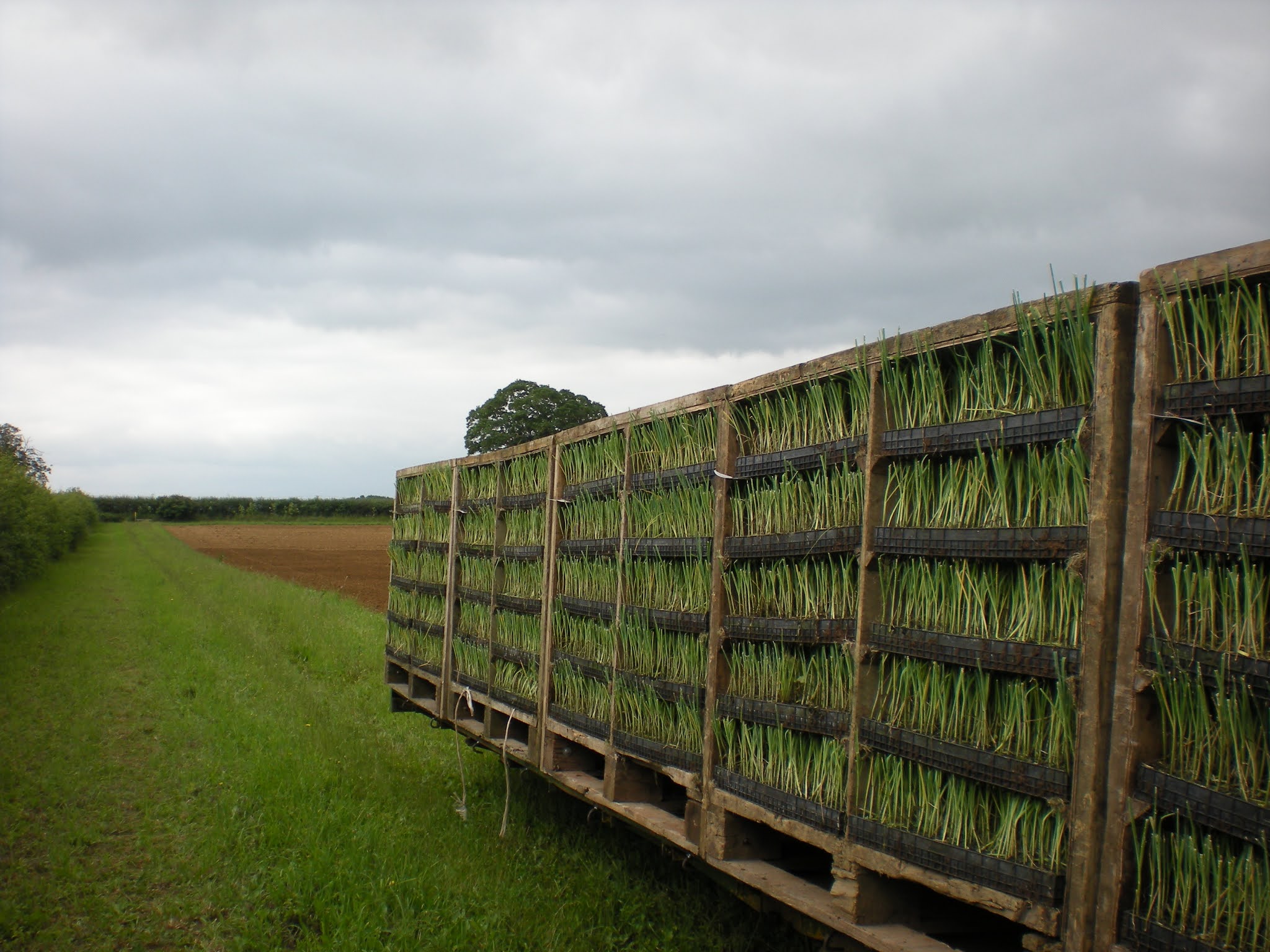
There are a couple of scratch-head moments along the way. Why is that portaloo set up in the middle of nowhere beside a large plot of newly-harrowed earth, just next to a large cart which appears to have a large number of spring onions ready to plant? (Sue later opines that these may have been baby leeks destined to obtain full adulthood in the field).

And why is a large open sided iron canister secured with blue plastic ties hanging twelve feet up in that tree?  Bats? (I’m rather mindful of the needs of bats at the moment: at home we have dusk and dawn visits scheduled with the ecologists to see whether/how many/what sort of bats we have roosting in the crevices of our outbuildings).

I guess there was a once a monastic foundation at Southorpe. Or a ‘lost’ village.  Or a one-time Big House.  The OS map marks fishponds to the south, and the field by the road is full of unusually varied and prominent lumps and bumps. Since Ermine Street runs through Southorpe, I suppose it’s even possible that some of those contours might be very ancient in origin. We were asking ourselves the other day what the name of Ermine Street means. Wikipedia suggests that it may be a reference to a tribe called the ‘Earningas’ who had their stamping grounds around modern day Royston. On today’s walk I cross the line of the Roman road a number of times. Just south of Southorpe its ditches are very obvious in the Paddock nature reserve, which is so ‘wilded’ that entry is currently more or less impossible – but then there’s no parking provision here, and it sits beside a straight, modern lane along which I now have to walk, dodging speedy commuter traffic. To their credit, many of the motorists acknowledge my presence by giving me a wide berth and a cheery wave as I take to the (overgrown) verge. I wonder if during the pandemic there’s been an improvement in driver behaviour in this respect?  Earlier on in the blog I noted that there were often problems, but post-Covid perhaps drivers are more used to sharing road space with walkers and (especially) cyclists. Or maybe it’s all just good Rutland manners.

Eventually, after a long slog along the metal, I turn off onto another lane towards Upton, which is accurately named – it’s very definitely oop, at the beginning of a ridge which at Castor is locally known as ‘The Hanglands’. There’s something apparently not right at Upton. Entering the village/hamlet, one is greeted by a sign which requests the viewer not to let ‘The Highwaymen’ take away their road. On the sparsely used village noticeboard, the familiar Kitchener image is subscribed by a caption which suggests that Upton needs me. In Church Walk there are a couple of modern-ish houses which are unoccupied, one of which veers towards the derelict. The thatch on the cottages might be approaching the end of its life. There’s a vague smell of drains. The little church of St. John the Baptist is away across a field, a chapel of ease for Castor, with a single eucharist per month as its worship-power. Maybe the Milton Estate is finding upkeep of its resources a financial stretch – though that’s a very tentative thought. What I subsequently learn is that the Council wants to close one of the two roads into the village (the one which runs directly and conveniently from the A47) because the ‘A’ road is about to be dualled and they’d like to avoid building a roundabout which would both interrupt the traffic flow and incur high costs.

It’s wrong to read too much into a single visit on a particular day – I may be importing a pre-set emotion from my own psyche, but certainly Upton was giving off a disturbing aura on this occasion. On the other hand, if you want to know more about the place, please go to https://www.thearchive.org.uk   (Chapter 14) where there’s a very good, full description of the village’s buildings and history. On my way back towards the car, I’m particularly intrigued to pass ‘Model Farm’ which dates to 1685. What’s the story there? Where the lane drops down to Lower Lodge Farm, close to the trunk road, an embarrassed man is trying to re-start the noisiest quad-bike in the world. I’m more interested in the fact that on the lane’s tarmac, there’s still even now a discernible bump in the road, like that left by the level crossing of a defunct railway. It’s Ermine Street again, once busy with travellers moving supplies to the north country for the garrison in York or packing up to return home in the hope of shoring up the imperial regime. They were everywhere, those Romans. I’ve never believed the low population estimates for Britain in their time, all that farming, industry and administration.

                                                                  Model Farm Upton

I enter Sutton by the same route as on the previous walk, past the new (or heavily restored?) cream stone of the Georgian pile at its eastern limit, along the grassy verge, peering down over the railway bridge to the green depths of the old cutting, smiling at the rabbits playing on the lawns. Familiarity can so easily slip into the neglected commonplace, don’t you think, despite our wishes that it shouldn’t be so? Habituation is apparently programmed into our human character. Though we may thus be provided a rest our from relentless scanning of the horizon for threats and danger, we stop properly looking altogether, and so cease to understand.

 Fossils in the gravel:  13.5 km.  3.5 hrs. Dry but mostly cloudy with only occasional glimpses of sun. 16 degrees. Three stiles. Ten gates. Three bridges. One church. Sore hips from too much road walking.

 Lord

My attention span…

I get bored

So quickly

When I’m worshipping

Or supposed to be.

It’s frightening to think

You must have access

To my random thoughts

(Otherwise how does silent prayer work?)


How do you feel about this boredom?

Do you say:

‘Well, it’s difficult

And why should it be easy?’

Or do you tut and shake your head

As I would in a similar circumstance

(If I was teaching someone…)


Or is it (dare I say it)

That we have made worship

Tedious and human-centred?

A place for parading

Our cleverness

A medium for displaying

Our power

A vector for achieving influence

By our own stratagems.


Is my prayer and worship

Best displayed

In my inarticulate and instant

Intake of breath

At the beauty of a flower

The grace of a deer

The love that wells up

Among my family?

Is it enough?


Lord, as so often

I don’t know.

Please forgive me where I fail

And help me find ways

To make my relationship with you

More constant and active.

Amen.