Wednesday, 14 December 2016
Winter Break
By Weston Favell church 2011
Regular followers may have spotted that I've not been stomping around the diocese recently. I'm missing it! Normal service should be resumed in January. I'm doing what Premier League footballers are all lobbying for - which is to have a winter break. In their case this seems to be because their poor little knees get an itsy bit cold in the nasty weather, tho' personally I think that if they're being paid gazillions of quid each year it's the very least they deserve. (I hope I'm not giving a hostage to fortune here and bringing on us all a 1962/3 style winter wonderland which will have me trudging through foot high snow until Easter!)
If you'd like to see what we've been doing this December, and don't know already, please have a look at http://www.adventstpetersdailyupdate.blogspot.com which will tell you far more than you probably want to know.
And if I don't catch you beforehand, have a lovely,joyful, peaceful Christmas and New Year!
Check in with me again somewhere around January 12th!
Tuesday, 29 November 2016
Such a perfect day...
The hardest frost of the winter so far, evident on the grass and windscreens, but absolutely no wind, so in the sun it's comfortable to walk under a beautiful ideal of blue sky.
I park for free near Waitrose in Towcester, and rather than confront the possibility of their café surreptitiously adding strychnine to my tea ( see previous post!) I try the Towcester Tea Rooms, which (immediately!) serve me a nice cup of coffee and a piece of Bakewell Tart. Two men in dayglo jackets are trying to pretty up the outside of the café Christmas-style, but their cables fail to reach the power points by a metre. The two other customers, ladies of a certain age, flirtatiously add a running commentary to the affair. 'Will it stretch? No, it never will. Isn't that a shame...'
I walk south beside the A5 up the hill out of town, peeking through a side gate at the race course, and then enjoying a full view of the facilities through the main entrance. I've never been to a meeting and really should sometime: it's a lovely airy situation with a long down slope towards the rest of the estate. From my right comes the sound of another kind of race track. The Formula 1 season may have ended yesterday, but the noise of Silverstone is very, very disturbingly obvious through the dry, quiet air.
I open a black door in the wall and follow a fence down to a road, before turning right into Heathencote. As so often, please someone, tell me the story! Who were the heathen who used to live here, and what did they do to be so labelled? Or was this merely a settlement of cottages situated on a piece of heathland?
It's a great walk over to Alderton from here, or at least it is today, because the frost has made the going firm (after the race course I'm thinking 'osses) I'm glad I bought a replacement compass yesterday, because the paths are particularly sketchy, and I just have to keep bearing east rather than trying to interpret the few uncertain waymarks. At one point the journey is enlivened by the loud rat-a-tatting of a hovering chopper. The level of noise rises markedly and then an Army Chinook appears, skimming the trees, flying off purposefully to the south. I don't know what that was all about.
Alderton looks lovely in the sunshine, but little St. Margaret's church is firmly double padlocked. There's a small consolation to be seen in an alcove to the left of the south door which I can't understand...guerrilla decoration? A green man? Some unknown contemporary pagan ritual?
Alderton figured in a 2001 Time Team, and opposite the church is the occasion of their interest. It's a motte and bailey earthwork, known as 'The Mount'. I climb the steps and nose around. It's an evocative spot, probably originally more of a status symbol than a defensive structure. Eventually there may have been a stone building of some sort before it all fell into disrepair and disuse in the 14thC. The Black Death was a terrible scourge on medieval society and no doubt it affected the powerful as well as the powerless. I remember that Alderton is an arty place. It's hard to imagine in deepest November, but the rather overgrown and nettly top of the mound has been used as a venue for summer theatre productions in recent years, courtesy of its owner, Derek Batten. I still miss Time Team, but the repeats on outlying TV channels don't do it for me. Like many people, the idea of archaeology appeals to me though I haven't the energy or stamina for the real thing, unlike our friend Ruth who writes Roman fiction, and has actually taken the trouble to do some hard yards of digging to make herself more acquainted with her subject matter. That's dedication to your writer's craft! To go back to Time Team, the production team managed the trick of making you feel that Mick, Carenza, Stewart, Phil, Tony and the gang were all friends you saw occasional Sunday afternoons. Clever and informative television, even if the archaeological fraternities were at times sniffy about 'three days to discover...'
Away from Alderton, I'm beset again by iffy waymarking, particularly by one landowner who's gone in for solar in a big way. But I make it to the A5 in the right place, opposite the turn to Paulerspury which is where I'm going next. Not far up the lane, I see a sign which says 'Keep Paulerspury rural', and I can see the concern. There's the threat from the possible north-south Towcester by-pass whicih I mentioned in the previous post and the Great Maw of Milton Keynes isn't so far distant. And Paulerspury already straggles in the way some East Anglian villages do, lengthwise, with a lot of modern infilling. The church is at the far end, overlooking the still separate community of Pury End. It's dedicated to St. James the Great, who was the other son of Zebedee, a Son of Thunder, though I don't think we know whether the presumed fiery temperament was the sons' or the dad's. I can't get in, so sit on a handy bench and read the beginning of Psalm 37, which tells me to be patient, the evildoers will get their comeuppance, and getting angry and confrontational with them rarely works. I know the sense in the last part of that: 65 years of experience leaves me unconvinced about the previous bit. We all like to believe that cheats and bullies never prosper, but, ooh, hello Donald, and how are you today?
I associate Paulerspury with the Vine House Restaurant, which I'm glad to see is still going strong. I also have a notion that accordion player/multi-instrumentalist Jaye Woodfield, once of the Celebrated Ratliffe Stout Band also lived here for a while. And in Pury End is the house of old friend Elizabeth who we haven't seen for decades. I knock on the door, but she's not in, so I leave a card to say hello. Truth to tell, I'm now so disgustingly muddy from the walk that I'm not in a fit state to stand on anyone's carpet: you did well to miss me Liz - I look more like I've just been caving. She and John live in Careys Road, where the famous missionary William Carey, who's cropped up in this blog before, was born. I have my only conversation of the day hereabouts, with an Irish chap who's looking for somewhere I can't see on my map. 'She sends me to these peculiar places...', he says plaintively, without explanation of the identity of 'she'. All in all it's a thoroughly Irish dialogue, because my opening gambit (at about two o'clock) has been 'Good morning,no, sorry, it should be good afternoon...' to which he replies 'Well it depends which world you're in...'
St. James the Great: Paulerspury
From Paulerspury back to Towcester is mostly on the Grafton Way, which if it still counts as a long-distance path at all, must surely rank as the poorest specimen in Britain. There's no point, you see. Either there's got to be riveting historical interest, or special scenic beauty, or some other great idea, and really this footpath has none of that. So few people walk it, and the cash-strapped farmers can't be given a reason why they should mend stiles and fences and waymarks, so it just goes from bad to worse. Can one also sense a lessening of enthusiasm within local authorities for supporting countryside amenity projects (which could also be to do with 'belt-tightening')?
But I mustn't carp. If one was ever going to tread the Grafton Way, this is the day to do it, when even the rather tedious traverse of Towcester's housing estates is lent a golden glow by the late, low afternoon sun, as I follow the Silverstone Brook back to Waitrose. I tell you something though, If I lived here, the incessant 3k sonic interference of tuned engines changing gear and accelerating around the Burcote corner on the race track would drive me ab-so-flipping-ly potty. Triple glazing essential.
Stats man: 19 km. 5 hrs. 2-4 degrees C. No wind. 5 stiles, 8 gates, 8 footbridges big and small. One buzzard. A flock of starlings. But the Irishman apart, no one to talk to apart from the beautiful clear-blue sky.
Father
Here I am
With all this weight of history around me:
The Romans:
The Saxons:
The Black Death:
The Civil War:
I know the dreadful things that happened in the past.
I can read it in the landscape.
I can see it in the buildings.
I am so fearful of what may happen to us next:
Of what our children may face.
May our lives continue to be
As blessed as they have been so far.
If it is possible, Father,
Let this cup pass from us.
But whatever,
I will try to do the thing I find so difficult,
And put my trust in You.
Amen.
Thursday, 24 November 2016
Slithy Tove
After two days of nearly continuous rain everywhere is oozing and squelching - as it should be in late November. I park up outside the Post Office in Greens Norton (Wow! They have a Post Office!), and cross the green to the Bradden Road, before turning left up the lane towards the seventeenth century house known as 'Bengal'. A couple of bored horses are sitting by a large puddle the other side of the first stile, but can't be bothered to stir themselves as I clamber past. As I always do, I say hello, to reassure myself as much as to make new equine friends. The path leads on through a newly planted copse (good on you, landowner!) and out onto sheep fields, crossing the just discernible line of an old railway, until I'm forced to muddy myself thoroughly in a soft loamy sog which takes me to a second disused line - the one which used to chug from Towcester to Banbury via Wappenham. To my left is the River Tove, and in front of me is Abthorpe. St John the Baptist's church is on on a mound, dead centre of the lovely village green: a mystery of a building really, because it's very obviously largely Victorian, although the siting speaks of a long history. I divest myself of my caked boots and spend twenty minutes inside, eating my sandwiches at a craft table laid out behind the organ.
I notice that very early in his clerical career, during the nineteen fifties, the Reverend Pat Hamerton was an incumbent here. I knew him when he was in charge at Abington, and for the craic used to invite him into my classroom from time to time, not because he was particularly riveting in what he said about being a vicar, but because he was the living spitten image of Ronnie Corbett, visually and in voice tone. The kids were inevitably stunned by my apparent show-biz contacts, which was always very childishly gratifying. At least it got me half an hour's peace while they worked out what was going on. Later on, my friend Liz Legge was in panto with the real Ronnie who was exemplarily delightful and chivalrous. And since they had to dance together (she principal girl, he, inevitably, Buttons), he was perfectly matched to Liz's diminutive stature.
Another Abthorpe resident, still evidently going strong, is John Riches, who writes up the village news on-line. John was the headteacher of Emmanuel church school in the era when Northampton boasted Middle Schoools as part of a three-tier system. I was one of his governors for a while. Amusingly contrasted to Hamerton/Corbett, John is immensely tall - probably six feet ten in his prime. If we were both standing up, I remember conversations were always a strain on the neck muscles. Avery nice and good man.
Beyond Abthorpe, attempts at maintaining the footpaths in the direction of Towcester seem to have been abandoned. There are occasional vague waymarks but it seems no one walks the fields hereabouts, so no one bothers to help the few of us who do. Rather than give my quads a work-out treading the tilth, somewhat in the manner of a knight on a chess board I use the field margins to make my way to Handley Park Farm and then onto Mileoak. This is a land of horsey-culture, with many horse boxes and much electrified fencing('busbars' seem to be the name for the familiar fabric 'hot' boundary markers) and the occasional show-jumping course arranged around a paddock. But in the nineteen fifties Mileoak was celebrated as the site of a huge Roman villa, possibly built in three storeys like the more famous one at Chedworth. Since then, several other better preserved villas have been found in the West Country, and now there's nothing on the surface to betray the existence of Mileoak mansion, not even a reference on the OS map.
As any schoolgirl would guess from the name, Towcester is an ancient Roman town ('Lactodorum'). The pronunciation of the modern name is perhaps eccentric though well-known to many British people because of the adjoining race course, but for any readers from further afield, please show your local savoir-faire by saying it as 'Toaster'. The Electricity Board pulled down the last bits of free standing Roman wall in the nineteen eighties, which they should never have been allowed to do, but there's lots of archaeology close to the surface here, and of course Watling Street, now the A5, runs slap bang through the middle of town.
I go to Towcester from time to time in my capacity as Bishop's Visitor to the splendid C. of E. primary school. The school is a joyful place, buzzing with good endeavour and humour. It's losing its excellent headteacher, Richard Camp, next summer, but I'm hopeful the school will survive the loss and go on brightly into the future. I've never been into St. Lawrence's church before, and when I do, I'm hugely impressed by the building and its atmosphere. It's an imposing, even stately edifice in the Perpendicular Style, built on a Roman site which may itself have been a temple. As Peter Ackroyd has observed, there's often a very persistent continuity in the use to which geographical sites are put. As at Earls Barton, there's a bury very close to the church, both of them lying on the very edge of town because of the contiguity with Easton Neston Park. Inside the church I read a psalm, and say hello to two casual visitors and a lady tending the flowers, whose name I forget to ask (the lady, not the flowers!)
I have a coffee at the Waitrose which is tucked behind the first row of shops on Watling St., near the rather good museum, and have a brief, annoying spat with the woman serving me. The details are unimportant, but once more raise questions for me about the willingness or otherwise of supermarkets to employ sufficient staff, and therefore how hard those that are employed have to work, and what one should expect in terms of courtesy when a business makes special play of how wonderful their people are. I come away alarmed by how angry I am, particularly when I'm ignored. It doesn't take much to get me going.
I'm sorry if I've rabbited on about this before, but I wonder how widespread such anger is among us all now. It's in me, because I'm the age I am, and therefore dealing with the disappointments of late middle-age and incipient old age. I also feel powerless in the face of local and national forces beyond my control, and my constant awareness of what's going on through the various media. It's one thing to feel shocked when I hear from nice Jackie my hairdresser of yet another audacious but un-nerving burglary in the village by a gang of men, but then there's the knowing how often this pattern has been repeated and being able to see on the net pictures of masked individuals attempting the same thing in another local garden last year. And then of course there's the grim, relentless litany of international events. None of this excuses bad behaviour on my part, but in order to improve, I have to understand.
Does any of this ring bells with you?
As a town, Towcester, odi et amo. I love the history, but deplore some of what I see, without having much of a solution. On the northern edge, the A43 by-pass is being upgraded, but it's taking an age to complete, and woe to any pedestrian attempting entry to the town by the route I took today, There's new development on the fringes and bits in the town centre too: I hope it'll be sensitively done. The town exists because of the road, but the A5 is often congested, and hopelessly so when used as a diversion because of trouble on the M1. There's talk of a north-south by-pass too, but if that happens, as can be seen elsewhere, it'll give the planners carte-blanche to infill and develop inside the new road, which will further devalue the town's character as surely as it may superficially boost its economy.
And when I try to leave town today to return to Greens Norton, it turns out to be rather difficult to achieve. I can see a path on the map which might do the job: it turns out to be footpath S30 or some such. The entrance is elusive but eventually I find a waymark beside the fire station pointing through a piece of waste ground, In a hundred metres or so the path peters out round the back of Sponne School. I retrace my steps and see a notice attached to the fence. The path has been stopped, by order of the Council. No reason given. I attempt an exit another way, but am confronted by a locked gate. I walk back to the crossroads, fuming, and go west on the road until I see a sign to the Pocket Park. The map shows another path taking me where I want to go, but the signs give out in the middle of a new-ish housing estate. Before engaging with this problem, I catch sight of a second notice attached to a lamp-post. This repeats that S30 has been stopped (quite recently - only this autumn) but also gives me a reason. It is apparently 'unnecessary'. Out loud I cry 'Well it's pretty (expletive deleted) necessary to me right now' , but fortunately there's no one to hear. Necessity, it seems to me, is not always an appropriate quality of footpaths.
One last thing. In order to finally escape the clutches of Towcester, when I eventually locate the vestiges of S30, it deposits me on the verge of the A43, where yet again I have to risk life and limb to gain the fieldpath beyond. How very American. There is now no need (official!) nor reasonable possibility of safely walking the two miles from Towcester to Greens Norton except in the face of oncoming traffic up the main road. So, go by car.
Stats man. 16 km. 5 hours. 6-8 degrees C. Dry. Weak but chilly occasional easterly breeze. Two open churches. Nineteen stiles, ten gates, three footbridges across the Tove. One green woodpecker. One particularly cheeky young male blackbird. Three unsolicited happy greetings en route. One apparently demagnetised compass (how did that happen?)
Dear Lord
I am struggling with the idea:
This 'Kingdom of Heaven'.
I don't relate to our royal family.
I mean, I like the Queen, I think.
But even then I can't imagine
Her sitting down to tea at our house
Or sharing a joke about Alexander Armstrong.
And with one or two exceptions
Her predecessors were a rum bunch
Bad, mad or incompetent.
I like the idea of a perfect King
And if there were such a thing
Maybe I'd be happy to be a loyal subject
Although knowing how stroppy I am
Maybe not.
So what do I do
with this powerful Kingdom metaphor?
Back to the Bible I suppose.
The kingdom of heaven is like...
Fill in the gaps.
I'm sorry this is more of a letter than a prayer.
Expecting your answer.
Yours
Vince
Missed on a previous walk: St. Augustine's: Caldecote.
I notice that very early in his clerical career, during the nineteen fifties, the Reverend Pat Hamerton was an incumbent here. I knew him when he was in charge at Abington, and for the craic used to invite him into my classroom from time to time, not because he was particularly riveting in what he said about being a vicar, but because he was the living spitten image of Ronnie Corbett, visually and in voice tone. The kids were inevitably stunned by my apparent show-biz contacts, which was always very childishly gratifying. At least it got me half an hour's peace while they worked out what was going on. Later on, my friend Liz Legge was in panto with the real Ronnie who was exemplarily delightful and chivalrous. And since they had to dance together (she principal girl, he, inevitably, Buttons), he was perfectly matched to Liz's diminutive stature.
Another Abthorpe resident, still evidently going strong, is John Riches, who writes up the village news on-line. John was the headteacher of Emmanuel church school in the era when Northampton boasted Middle Schoools as part of a three-tier system. I was one of his governors for a while. Amusingly contrasted to Hamerton/Corbett, John is immensely tall - probably six feet ten in his prime. If we were both standing up, I remember conversations were always a strain on the neck muscles. Avery nice and good man.
Beyond Abthorpe, attempts at maintaining the footpaths in the direction of Towcester seem to have been abandoned. There are occasional vague waymarks but it seems no one walks the fields hereabouts, so no one bothers to help the few of us who do. Rather than give my quads a work-out treading the tilth, somewhat in the manner of a knight on a chess board I use the field margins to make my way to Handley Park Farm and then onto Mileoak. This is a land of horsey-culture, with many horse boxes and much electrified fencing('busbars' seem to be the name for the familiar fabric 'hot' boundary markers) and the occasional show-jumping course arranged around a paddock. But in the nineteen fifties Mileoak was celebrated as the site of a huge Roman villa, possibly built in three storeys like the more famous one at Chedworth. Since then, several other better preserved villas have been found in the West Country, and now there's nothing on the surface to betray the existence of Mileoak mansion, not even a reference on the OS map.
As any schoolgirl would guess from the name, Towcester is an ancient Roman town ('Lactodorum'). The pronunciation of the modern name is perhaps eccentric though well-known to many British people because of the adjoining race course, but for any readers from further afield, please show your local savoir-faire by saying it as 'Toaster'. The Electricity Board pulled down the last bits of free standing Roman wall in the nineteen eighties, which they should never have been allowed to do, but there's lots of archaeology close to the surface here, and of course Watling Street, now the A5, runs slap bang through the middle of town.
I go to Towcester from time to time in my capacity as Bishop's Visitor to the splendid C. of E. primary school. The school is a joyful place, buzzing with good endeavour and humour. It's losing its excellent headteacher, Richard Camp, next summer, but I'm hopeful the school will survive the loss and go on brightly into the future. I've never been into St. Lawrence's church before, and when I do, I'm hugely impressed by the building and its atmosphere. It's an imposing, even stately edifice in the Perpendicular Style, built on a Roman site which may itself have been a temple. As Peter Ackroyd has observed, there's often a very persistent continuity in the use to which geographical sites are put. As at Earls Barton, there's a bury very close to the church, both of them lying on the very edge of town because of the contiguity with Easton Neston Park. Inside the church I read a psalm, and say hello to two casual visitors and a lady tending the flowers, whose name I forget to ask (the lady, not the flowers!)
I have a coffee at the Waitrose which is tucked behind the first row of shops on Watling St., near the rather good museum, and have a brief, annoying spat with the woman serving me. The details are unimportant, but once more raise questions for me about the willingness or otherwise of supermarkets to employ sufficient staff, and therefore how hard those that are employed have to work, and what one should expect in terms of courtesy when a business makes special play of how wonderful their people are. I come away alarmed by how angry I am, particularly when I'm ignored. It doesn't take much to get me going.
I'm sorry if I've rabbited on about this before, but I wonder how widespread such anger is among us all now. It's in me, because I'm the age I am, and therefore dealing with the disappointments of late middle-age and incipient old age. I also feel powerless in the face of local and national forces beyond my control, and my constant awareness of what's going on through the various media. It's one thing to feel shocked when I hear from nice Jackie my hairdresser of yet another audacious but un-nerving burglary in the village by a gang of men, but then there's the knowing how often this pattern has been repeated and being able to see on the net pictures of masked individuals attempting the same thing in another local garden last year. And then of course there's the grim, relentless litany of international events. None of this excuses bad behaviour on my part, but in order to improve, I have to understand.
Does any of this ring bells with you?
As a town, Towcester, odi et amo. I love the history, but deplore some of what I see, without having much of a solution. On the northern edge, the A43 by-pass is being upgraded, but it's taking an age to complete, and woe to any pedestrian attempting entry to the town by the route I took today, There's new development on the fringes and bits in the town centre too: I hope it'll be sensitively done. The town exists because of the road, but the A5 is often congested, and hopelessly so when used as a diversion because of trouble on the M1. There's talk of a north-south by-pass too, but if that happens, as can be seen elsewhere, it'll give the planners carte-blanche to infill and develop inside the new road, which will further devalue the town's character as surely as it may superficially boost its economy.
And when I try to leave town today to return to Greens Norton, it turns out to be rather difficult to achieve. I can see a path on the map which might do the job: it turns out to be footpath S30 or some such. The entrance is elusive but eventually I find a waymark beside the fire station pointing through a piece of waste ground, In a hundred metres or so the path peters out round the back of Sponne School. I retrace my steps and see a notice attached to the fence. The path has been stopped, by order of the Council. No reason given. I attempt an exit another way, but am confronted by a locked gate. I walk back to the crossroads, fuming, and go west on the road until I see a sign to the Pocket Park. The map shows another path taking me where I want to go, but the signs give out in the middle of a new-ish housing estate. Before engaging with this problem, I catch sight of a second notice attached to a lamp-post. This repeats that S30 has been stopped (quite recently - only this autumn) but also gives me a reason. It is apparently 'unnecessary'. Out loud I cry 'Well it's pretty (expletive deleted) necessary to me right now' , but fortunately there's no one to hear. Necessity, it seems to me, is not always an appropriate quality of footpaths.
One last thing. In order to finally escape the clutches of Towcester, when I eventually locate the vestiges of S30, it deposits me on the verge of the A43, where yet again I have to risk life and limb to gain the fieldpath beyond. How very American. There is now no need (official!) nor reasonable possibility of safely walking the two miles from Towcester to Greens Norton except in the face of oncoming traffic up the main road. So, go by car.
Stats man. 16 km. 5 hours. 6-8 degrees C. Dry. Weak but chilly occasional easterly breeze. Two open churches. Nineteen stiles, ten gates, three footbridges across the Tove. One green woodpecker. One particularly cheeky young male blackbird. Three unsolicited happy greetings en route. One apparently demagnetised compass (how did that happen?)
Dear Lord
I am struggling with the idea:
This 'Kingdom of Heaven'.
I don't relate to our royal family.
I mean, I like the Queen, I think.
But even then I can't imagine
Her sitting down to tea at our house
Or sharing a joke about Alexander Armstrong.
And with one or two exceptions
Her predecessors were a rum bunch
Bad, mad or incompetent.
I like the idea of a perfect King
And if there were such a thing
Maybe I'd be happy to be a loyal subject
Although knowing how stroppy I am
Maybe not.
So what do I do
with this powerful Kingdom metaphor?
Back to the Bible I suppose.
The kingdom of heaven is like...
Fill in the gaps.
I'm sorry this is more of a letter than a prayer.
Expecting your answer.
Yours
Vince
Missed on a previous walk: St. Augustine's: Caldecote.
Friday, 4 November 2016
Who won?
Banbury Lane, the old drover's road, crosses Watling Street at Foster's Booth, which these days is pretty much a single settlement with Pattishall. Who was Foster? And why did he have a booth? (It conjures up the image of someone handing out tickets to A5 travellers: 'This way for the amusement park', and actually I suppose it may just have been the site of an early toll booth!) Disappointingly for some, Foster's has nothing to do with lager. It's probably just a corruption of 'foresters', and a 'booth' is a bothy. This was once an important crossroads as people driving animals on the east-west route met with the traffic travelling from London to Holyhead and-all-points-between. The inns hereabout must have done great business if they were up to snuff. And the bothy was probably a bit intimate and smelly!
A couple of short field paths to the west lies the hamlet of Cold Higham. St. Luke's church has an attractive saddleback tower, and as I'm sitting on a churchyard bench contemplating it, I get a cheery wave from Pauline the churchwarden. She's done the job for quite a few years now. She invites me inside, which is something you do if you're proud of your church. And quite right too: it's lovely. Because it's the Saturday morning before the fifth Sunday of the month, she's making preparations for the service tomorrow, which will be the only one in the benefice - which as you'll recall includes Pattishall, Gayton and Tiffield. I ask her if there'll be lots of worshippers from those other parishes. She thinks perhaps not many: people tend to stay put, particularly if they're more elderly. I wonder to myself if, when the benefices were designed (not just here, but more widely) there was too great a spirit of optimism that parishioners would embrace the full range of worshipping options. It's not going to suit everyone, being peripatetic. Since Cold Higham is as compact as it is, children don't figure largely in its ministry: there are virtually none. Here I especially like the cosy southside 'Potcote Chapel', complete with its oak effigy of one time Lord of the Manor, Sir John De Pattishull.
I strike out across the field, which has until recently hosted a crop of maize. Now cut to about six inches, the rigid, bamboo-like stalks are a considerable hazard when walking through them. I stumble and curse. Needless to say the right of way isn't matched by a path on the ground. I eventually avoid the issue at the expense of a few hundred extra metres and enter Grimscote by road. Grim it may be by name, but Grim reality it isn't: the little village is very pleasant. The name 'Grim' crops up a great deal across the Home Counties and East Anglia, and one can find various explanations of its meaning. Does it refer to a person, or series of persons, or does it have a theological, pre-Christian religious significance? I know 'Grimsdyke' on the Harrow Weald, which as a house is now a relatively fancy Best Western hotel, though it was once the home and nemesis of W.S.Gilbert. But the reference is to the ancient earthworks which meander across the Weald with no clear constructional purpose. There are similar ones hidden among the woodland near my old family home in Bexley, Kent. The suggested dates for them range from 300 B.C. to 800 A.D., and most likely they mark territory rather than having any defensive function. In Norfolk one can visit the Neolithic flint mines which are called 'Grimes Graves'.
From Grimscote there's a straight westerly path which climbs gently out of an impressively deep 'hollow way' until it becomes a broad track crossing between fields of brassica with (today) a beautifully grey view of the village of Stowe-Nine-Churches to the north. In a while I turn right onto the Towcester Road into delightful Litchborough. St. Martin's sits amid a number of highly desirable properties. It's open. Inside I discover I'm in a church of the 'Lambfold Benefice' (nice name!). I'm writing a version of the 'Mak the Sheep Stealer' Mystery Play at the moment, so I'm thinking a lot about sheep. St. Martin of Tours was a good European. He was born in Hungary, served in the Roman army, and ended up in France, and here he is with a church dedication in Northamptonshire. Pick the bones out of that, Brexiteers!
Litchborough church seems very well organised. On one wall there's a comprehensive selection of photographs showing the important people of the parish, lay and clergy. Many of the lay representatives are women, and many appear to be over fifty, and quite a few have titles which suggest specific training for their roles. Is this 'credentialism' always a good idea? Could it be argued that it amounts to a colonisation of the (approved) laity by the clergy? As a trend is it more or less pronounced in evangelical circles, and if so why? And how do our concerns about safeguarding interact with all this? As I leave I notice that a previous rector here was John Knight who succeeded Michael Glover as Team Rector of Emmanuel, Northampton. I'm sure John wouldn't mind me characterising him as a formidably, and sometimes fiercely evangelical priest.
Litchborough cricket club used to hold a regular Boxing Day match, but I don't think it's played any more - what a shame! I loved the Dada-ist eccentricity and enthusiasm of that. Afterwards they used to retire to the Red Lion for winter warmers, which is where I go for a sit down and a ginger beer.
From Litchborough I pick up the Knightley Way, walking roughly south-east towards Greens Norton. I remember walking the northern section of this supposed long-distance path many years ago and not being much impressed. It's named after a famous Northamptonshire family, and I'm sure they were worth more than this succession of notional field paths, ignored by both the farmers through whose land they pass, and sensible walkers who can find better ways of spending their time. Half way to Greens Norton the path skirts the manor house on which was centred the Caswell Research facility. Caswell has an honoured place in the history of computing. If I was a conspiracy theorist I'd observe that it's quite an out of the way situation for a 'research facility', but far be it from me...I wonder what else went on there?
As the spire of St. Bartholomew's appears ahead of me, I recall I once wrote a Morris tune called 'Greens Norton' for a library album of 'folk music'. It featured the splendid melodeon playing of folk celebrity Simon Care, who was born in Moulton. (A 'library album' contains incidental music designed to be used in advertising and on the telly: the users pay a royalty, some of which is passed on to the composer. If you get lucky, and your tune is picked up to be, say, the theme for all BBC snooker programmes - which happened to one composer for the same record company - then you get very rich. 'Greens Norton' has thus far only earned me a few quid over twenty years, but it's still out there, and who knows, one day it may make my fortune. But I'm not holding my breath.)
Before I make my way up the rise to the church, I try for a coffee at the Butchers Arms, but the best they can do is instant, though to be fair they only charge me a pound. It's Hallowe'en weekend and the pub is festooned with cobwebs. There are creepy Victorian-style reversing portraits on the walls, prim ladies and gentlemen from one angle, skeletons from the other. The door to the gents is unmarked except for a covering of ghostly ephemera. Further up the hill past the church a bloke with green and mauve face paint scuttles out of his house and gives me an embarrassed wave. He knows he looks an idiot.
I wasn't expecting it in such a busy village, but St. Bartholomew's is open too. I stand in the church on my own and for the first time in this series of walks feel how I miss the presence of other people in there with me. Maybe it's something about the fading afternoon light: the clocks fall back this evening. On the stand at the back of the church, there's a good leaflet drawing attention to features of churches in general (organs, pulpits etc.) and the quirks of this one - a stained glass window with a set of cricket stumps, a heavy old parish chest, and so on. And the Black Death is mentioned, as it was in Litchborough. There it carried off three incumbents in 1349 alone.
On the way back to Pattishall, almost at the top of the rising ground I pass Astcote Thorns, a large rectangular stand of trees with thicket in between, and am curious about its position. I suppose anyone with a historical interest always surveys the two sides of Watling Street anywhere between St. Albans and Wolverhampton and wonders where exactly the enraged Boudicca made her last stand against the Romans. Up to then she had been winning the battles. Now she lost the war and her life.
With the American presidential election looming, I'm thinking a lot about winning and losing. It feels as if there are significant seismic shifts occurring in public life, including religion, as people begin to absorb the implications of the internet and the nature of contemporary communications. In particular no one under the age of thirty really understands how profound the change since 1980. Maybe one could once easily discern the winners and losers in any social contest. Not now I think. The rapid movement of ideas, and the asserted right of each individual to their entitlement (whatever they think that might be) has complicated the issues which confront us to a massive, possibly an ungovernable extent. No one knows what to do, and the first step to our recovery might be to admit it.
The Church appears to be losing all its arguments hands down - which is partly why I'm walking and writing this blog. But never bet against 'Revival' in a spiritual sense, though whether that would necessarily have beneficial effects might be open to question. Think of the inquisition, or Salem. If we began to win the moral and spiritual war, would we oppress and persecute those who disagreed, just as surely as the Daesh have done in Syria/Iraq?
Stats man: 19km s hrs. 15C. Little or no wind. 22 stiles. 12 gates. 53 names in the St. Martin's visitors' book for 2016 so far. They came from Finland, Poland, and Australia amongst others, as they walked the Knightley Way (poor things!) or repaired the loo, or researched their ancestors, or just enjoyed a beautiful place.
Father
You are our strength and salvation.
We pray for this divided world;
For what we will become;
That individual desire
May not Trump the common good.
That nationally and locally
In and out of church
We can grasp
That we are members of one another.
We ask it in Jesus name
Amen.
A couple of short field paths to the west lies the hamlet of Cold Higham. St. Luke's church has an attractive saddleback tower, and as I'm sitting on a churchyard bench contemplating it, I get a cheery wave from Pauline the churchwarden. She's done the job for quite a few years now. She invites me inside, which is something you do if you're proud of your church. And quite right too: it's lovely. Because it's the Saturday morning before the fifth Sunday of the month, she's making preparations for the service tomorrow, which will be the only one in the benefice - which as you'll recall includes Pattishall, Gayton and Tiffield. I ask her if there'll be lots of worshippers from those other parishes. She thinks perhaps not many: people tend to stay put, particularly if they're more elderly. I wonder to myself if, when the benefices were designed (not just here, but more widely) there was too great a spirit of optimism that parishioners would embrace the full range of worshipping options. It's not going to suit everyone, being peripatetic. Since Cold Higham is as compact as it is, children don't figure largely in its ministry: there are virtually none. Here I especially like the cosy southside 'Potcote Chapel', complete with its oak effigy of one time Lord of the Manor, Sir John De Pattishull.
I strike out across the field, which has until recently hosted a crop of maize. Now cut to about six inches, the rigid, bamboo-like stalks are a considerable hazard when walking through them. I stumble and curse. Needless to say the right of way isn't matched by a path on the ground. I eventually avoid the issue at the expense of a few hundred extra metres and enter Grimscote by road. Grim it may be by name, but Grim reality it isn't: the little village is very pleasant. The name 'Grim' crops up a great deal across the Home Counties and East Anglia, and one can find various explanations of its meaning. Does it refer to a person, or series of persons, or does it have a theological, pre-Christian religious significance? I know 'Grimsdyke' on the Harrow Weald, which as a house is now a relatively fancy Best Western hotel, though it was once the home and nemesis of W.S.Gilbert. But the reference is to the ancient earthworks which meander across the Weald with no clear constructional purpose. There are similar ones hidden among the woodland near my old family home in Bexley, Kent. The suggested dates for them range from 300 B.C. to 800 A.D., and most likely they mark territory rather than having any defensive function. In Norfolk one can visit the Neolithic flint mines which are called 'Grimes Graves'.
From Grimscote there's a straight westerly path which climbs gently out of an impressively deep 'hollow way' until it becomes a broad track crossing between fields of brassica with (today) a beautifully grey view of the village of Stowe-Nine-Churches to the north. In a while I turn right onto the Towcester Road into delightful Litchborough. St. Martin's sits amid a number of highly desirable properties. It's open. Inside I discover I'm in a church of the 'Lambfold Benefice' (nice name!). I'm writing a version of the 'Mak the Sheep Stealer' Mystery Play at the moment, so I'm thinking a lot about sheep. St. Martin of Tours was a good European. He was born in Hungary, served in the Roman army, and ended up in France, and here he is with a church dedication in Northamptonshire. Pick the bones out of that, Brexiteers!
Litchborough church seems very well organised. On one wall there's a comprehensive selection of photographs showing the important people of the parish, lay and clergy. Many of the lay representatives are women, and many appear to be over fifty, and quite a few have titles which suggest specific training for their roles. Is this 'credentialism' always a good idea? Could it be argued that it amounts to a colonisation of the (approved) laity by the clergy? As a trend is it more or less pronounced in evangelical circles, and if so why? And how do our concerns about safeguarding interact with all this? As I leave I notice that a previous rector here was John Knight who succeeded Michael Glover as Team Rector of Emmanuel, Northampton. I'm sure John wouldn't mind me characterising him as a formidably, and sometimes fiercely evangelical priest.
Litchborough cricket club used to hold a regular Boxing Day match, but I don't think it's played any more - what a shame! I loved the Dada-ist eccentricity and enthusiasm of that. Afterwards they used to retire to the Red Lion for winter warmers, which is where I go for a sit down and a ginger beer.
From Litchborough I pick up the Knightley Way, walking roughly south-east towards Greens Norton. I remember walking the northern section of this supposed long-distance path many years ago and not being much impressed. It's named after a famous Northamptonshire family, and I'm sure they were worth more than this succession of notional field paths, ignored by both the farmers through whose land they pass, and sensible walkers who can find better ways of spending their time. Half way to Greens Norton the path skirts the manor house on which was centred the Caswell Research facility. Caswell has an honoured place in the history of computing. If I was a conspiracy theorist I'd observe that it's quite an out of the way situation for a 'research facility', but far be it from me...I wonder what else went on there?
As the spire of St. Bartholomew's appears ahead of me, I recall I once wrote a Morris tune called 'Greens Norton' for a library album of 'folk music'. It featured the splendid melodeon playing of folk celebrity Simon Care, who was born in Moulton. (A 'library album' contains incidental music designed to be used in advertising and on the telly: the users pay a royalty, some of which is passed on to the composer. If you get lucky, and your tune is picked up to be, say, the theme for all BBC snooker programmes - which happened to one composer for the same record company - then you get very rich. 'Greens Norton' has thus far only earned me a few quid over twenty years, but it's still out there, and who knows, one day it may make my fortune. But I'm not holding my breath.)
Before I make my way up the rise to the church, I try for a coffee at the Butchers Arms, but the best they can do is instant, though to be fair they only charge me a pound. It's Hallowe'en weekend and the pub is festooned with cobwebs. There are creepy Victorian-style reversing portraits on the walls, prim ladies and gentlemen from one angle, skeletons from the other. The door to the gents is unmarked except for a covering of ghostly ephemera. Further up the hill past the church a bloke with green and mauve face paint scuttles out of his house and gives me an embarrassed wave. He knows he looks an idiot.
I wasn't expecting it in such a busy village, but St. Bartholomew's is open too. I stand in the church on my own and for the first time in this series of walks feel how I miss the presence of other people in there with me. Maybe it's something about the fading afternoon light: the clocks fall back this evening. On the stand at the back of the church, there's a good leaflet drawing attention to features of churches in general (organs, pulpits etc.) and the quirks of this one - a stained glass window with a set of cricket stumps, a heavy old parish chest, and so on. And the Black Death is mentioned, as it was in Litchborough. There it carried off three incumbents in 1349 alone.
On the way back to Pattishall, almost at the top of the rising ground I pass Astcote Thorns, a large rectangular stand of trees with thicket in between, and am curious about its position. I suppose anyone with a historical interest always surveys the two sides of Watling Street anywhere between St. Albans and Wolverhampton and wonders where exactly the enraged Boudicca made her last stand against the Romans. Up to then she had been winning the battles. Now she lost the war and her life.
With the American presidential election looming, I'm thinking a lot about winning and losing. It feels as if there are significant seismic shifts occurring in public life, including religion, as people begin to absorb the implications of the internet and the nature of contemporary communications. In particular no one under the age of thirty really understands how profound the change since 1980. Maybe one could once easily discern the winners and losers in any social contest. Not now I think. The rapid movement of ideas, and the asserted right of each individual to their entitlement (whatever they think that might be) has complicated the issues which confront us to a massive, possibly an ungovernable extent. No one knows what to do, and the first step to our recovery might be to admit it.
The Church appears to be losing all its arguments hands down - which is partly why I'm walking and writing this blog. But never bet against 'Revival' in a spiritual sense, though whether that would necessarily have beneficial effects might be open to question. Think of the inquisition, or Salem. If we began to win the moral and spiritual war, would we oppress and persecute those who disagreed, just as surely as the Daesh have done in Syria/Iraq?
Stats man: 19km s hrs. 15C. Little or no wind. 22 stiles. 12 gates. 53 names in the St. Martin's visitors' book for 2016 so far. They came from Finland, Poland, and Australia amongst others, as they walked the Knightley Way (poor things!) or repaired the loo, or researched their ancestors, or just enjoyed a beautiful place.
Father
You are our strength and salvation.
We pray for this divided world;
For what we will become;
That individual desire
May not Trump the common good.
That nationally and locally
In and out of church
We can grasp
That we are members of one another.
We ask it in Jesus name
Amen.
Saturday, 15 October 2016
Allotments
'The rich man in his castle/The poor man at his gate/God made them high and lowly/And ordered their estate...'
I walk out of Gayton on the Eastcote Road, passing the allotments on the left, marvelling at the industry of those who tend them, thinking of the evident pleasure that's shown by some of our friends who have one. Gardening isn't really for me, but I love that it's still deep in our nation's psyche. John Arlott once said that he'd only met one professional cricketer who was a 'wrong-un' (he didn't name a name!) and sadly he might have to revisit his opinion now, but one feels something of the same about the community of gardeners.
Everywhere I've driven in the last couple of months, there seem to have been temporary traffic-lights and diversions as the councils try to get the roads in shape for winter. Walking up the little lane, the tarmac's breaking up at the sides, and if you're a cyclist you'd better beware. However insignificant the highway, it inevitably gets a terrible battering from heavy farm vehicles, HGVs misled by their satnavs and increased traffic. At a certain point the Eastcote Road makes a right angle turn, but the lane goes straight on, now a single path bridleway without a surface, although in the undergrowth to my right I can see the ditch continuing so that the 'real' width of the road is as it was before. There's a certain randomness to the way country roads are. In half a mile the metalled lane swings in again from the right. People move. Needs change. But the half mile of good honest dirt between the close hedgerows was very nice.
Just before Tiffield, I cut a diagonal across a lumpy field towards the old Stratford railway line encountered two walks ago, here on a short embankment. Perhaps the lumps are the ghostly remains of houses long gone, or maybe it's spoil from the old railway workings. Apparently, when the line was built in 1869, an 'experimental' railway station was put in, but because this was the 'summit' of the line with a relatively steep gradient either side, there was an alleged tendency for the halted trains to break away, so by 1871 the experiment was deemed a failure and the makeshift wooden platforms removed. More likely there weren't enough passengers from Tiffield even then and lack of profit was the motive for the closure.
Tiffield isn't a large place, although it straggles a bit, rather as if two communities were crashed together and told they'd better just get along. St. John the Baptist's church is roughly in the middle. I sit, read a psalm and pray for Marion the priest, and for the people of the village. Whenever I drive past the Tiffield turning from the A43, my brain automatically flashes up 'Approved School', because in my time as a teacher in Northampton that was where all the really bad boys were sent in the hope of repentance, or cure, or just to keep them off the mean streets until their hormones had settled down. Originally it had been a Victorian reformatory, with what I imagine to have been an even harsher regime. Now in more thoughtful and kindlier times, there's still a residential special needs unit here, in a setting away from the pressures of urban life. Today, head in pocket bible, my imagination is arrested by the musical information to be gleaned from the beginning of Psalm 33: 'Praise the Lord with the lyre, make melody to Him with the harp of ten strings. Play skilfully on the strings...with loud shouts.' And I think fondly of my friend and colleague Robin whose 12-string guitar has often, for all the right reasons of excitement and approval, made me want to give issue to 'loud shouts'.
I pick my way out of the village, up a hill and over an earthy field, skirting some light woodland and down to the dual carriageway, the new Towcester Road. Having girded my loins, checked my shoes for slippery mud and chosen my moment, I make the far side safely, and follow the signs to Hulcote.
At first I'm walking up the Old Towcester Road, which is not the same as Ye Olde Olde Towcester Road which was diverted centuries ago, when the Lords of Easton Neston cleared the land of any minor inconveniences like peasant villages, roads etc. etc. to make way for their Lovely Dwelling. What Hulcote was like then I don't know, but today it's mostly a collection of neat, Gothicky, late Victorian workers' houses, which to be fair would have been extremely superior places to live by the standards of their time. All I can get from the web is that the church of St. Mary's, Easton Neston is somewhere at the back of the great Hawksmoor house: all I have to do is to follow the signs.
I feel like a trespasser, but telling myself I've been thrown out of better places than this, and adopting the attitude one is suppose to strike when confronting a bear i.e. make yourself look as big and imposing as you can, I stride up the various nicely laundered drives in the direction I think I should go. In fact I encounter no red-faced Wodehousian lairds with twelve-barrelled shotguns in the crook of their arms, just an elderly Chinese couple who look as if they might just have stepped off a sightseeing coach. I say 'Good afternoon'. They mumble a puzzled, incomprehensible reply.
I'm out of date. I had the owner of the lovely Hall as Alexander Hesketh, he of the James Hunt, sex and champagne era of yesteryear's Formula 1. He still retains ownership of Towcester Race Course, although Easton Neston is now the property of Leon Max, Russian-American fashion entrepreneur. I don't meet him either which is perhaps a good thing, He might have at his disposal weaponry even more deadly than a shotgun to stave off unwelcome intruders. Were the Chinese couple house guests, buying clothes for export? Or independent travellers like me? Or did they miss the bus? The Hall is a wonderfully proportioned building, not ridiculously large: just big enough to impress.
I find sylvan St. Mary's. It's closed, which is a shame because I've read that there are some beautiful, ancient box pews inside. Its parish now includes a small housing estate on this side of Towcester, and there are regular services. It even contributes to the Tove Benefice's Parish Share - just under 4k of the total £77k. So I suppose from that we can deduce that Mr. Max doesn;t put his hand in his pocket to any great extent, although of course he may donate to the church's upkeep and well-being in other ways, which so he should, because after all, this is a holy building mostly for the benefit of the estate, if only for historical reasons. The priest is Father Ben Phillips, whose principal care is for St. Lawrence's, Towcester. He's a sort of colleague of mine, although oddly we haven't yet met. He has responsibility for the excellent C. of E. primary school in the town, for which I'm the Bishop's Visitor. More of them anon!
As I walk back through the autumn leaves and past the gorgeous shrubbery, I try to put myself in the shoes of someone who owns all this. You probably know the verse at the top of this post. It's from Mrs Alexander's original version of 'All things bright and beautiful', and has long since been erased from every right-thinking hymn book version. As I walk, I'm in a state of naïve confusion, thinking back to those allotments in Gayton. How can there still be such huge divisions in wealth - which have by all accounts become greater since the year 2000? And of course, like me, the allotment holders are themselves among the rich of the world, comparatively speaking. It doesn't help to have the bad examples of Donald Trump and Phillip Green so often before us in the news, in all their pomp and contempt for the rest of humanity. Mrs. Alexander's view was that the rich were entitled in more ways than one, but I don't think most of today's Christians would agree with her, if what she meant was that this was the 'proper' order of creation. I used to see bright green Porsche 911s screech to a halt outside our studios and wonder 'which rules is he bending?'
So whether by accident or design, I'm glad that Easton Neston parish comprises the housing estate with its young families, although I wonder how messy church works in ancient box pews! If lovely St. Mary's were just a decorative adjunct to the Hall ('we have our own church, you know...') I'd have to be lobbying for its closure, for reasons of historical symbolism if nothing else. The fact that the Queen is head of our Church already stamps us as allied to the rich and powerful in the minds of many: we have to be the Church of all people, notwithstanding.
The path away from the hall is very pleasant, woody and pastoral by turns. Beyond the 'new' houses I have to cross the A43 again, even more perilously this time. My chosen route on to Pattishall takes me initially by fieldpaths running and rising parallel with Watling Street towards the collection of small Saxon villages that flank the Roman road. There's Caldecote and Asctcote, Eastcote and Dalscote, and on the far side of the road, Grimscote and even Potcote. The paths are a bit obscure at first, and at one point, not spotting an inordinately green shade of grass, I carelessly advance into a small mere, retreating as squelch and ooze begins to overwhelm and suck my boots. It's much colder today, with a stiff easterly breeze whipping in over the open fields. As people around here have been apt to remark, there's nothing between us and the Urals. I'd never asked the question before, but 'Watling' may be related to the Saxon word for wattle: 'waecelinga'. Perhaps it grew by the slowly decaying road, or could be easily gathered there, or the experts at wall-making lived beside it.
At Pattishall, Holy Cross, my third church of the day, is also shut. Traffic speeds through the thirty limit down the old drover's road, 'Banbury Lane', here briefly 'Butcher's Lane'. I return to Gayton, surprised by the number of small hills I have to ascend and descend. Marion Reynolds has to shepherd the flocks at Gayton, Tiffield, Pattishall and Cold Higham. I ask again 'How does she do it?'
Dusk falls over the allotments.
Stats man: 20km. 12 degrees C., with an easterly breeze gusting up to 25kph. Occasional spots of rain, but a mixed sky with some sunny periods. 5.5 hrs walking. One water vole. One buzzard. Two kites. One yaffle. Countless game birds: I'd be a good 'beater'. One conversation - with Jim, just out of hospital. He walked two miles today and was justly proud.
Health warning: These crossings of the A43 really weren't fun, particularly coming back at OS reference 695499 (Explorer 207). If you're silly enough to follow in my footsteps, what you need to know is that on the far side the path is hidden up the embankment over a stile approximately 20 metres to your left once you've crossed the road. But really, a second time I'd avoid the issue and go the long way round by road.
Lord
In her ecstasy
Mary sang your exaltation of
The humble and meek
And your dismissal of the rich
Empty-handed;
Radical
Even by the standards of J. Corbyn.
Forgive me that
Often I'm not at all humble or meek.
And I can be ridiculously proud
Of my puny riches.
Help me not to make this
A routine confession
But one that truly touches my heart.
Help me not to be envious
Of the self-made or high-born,
But to understand
That only from
Knowing my creatureliness
Can I see and follow you.
Amen.
I walk out of Gayton on the Eastcote Road, passing the allotments on the left, marvelling at the industry of those who tend them, thinking of the evident pleasure that's shown by some of our friends who have one. Gardening isn't really for me, but I love that it's still deep in our nation's psyche. John Arlott once said that he'd only met one professional cricketer who was a 'wrong-un' (he didn't name a name!) and sadly he might have to revisit his opinion now, but one feels something of the same about the community of gardeners.
Everywhere I've driven in the last couple of months, there seem to have been temporary traffic-lights and diversions as the councils try to get the roads in shape for winter. Walking up the little lane, the tarmac's breaking up at the sides, and if you're a cyclist you'd better beware. However insignificant the highway, it inevitably gets a terrible battering from heavy farm vehicles, HGVs misled by their satnavs and increased traffic. At a certain point the Eastcote Road makes a right angle turn, but the lane goes straight on, now a single path bridleway without a surface, although in the undergrowth to my right I can see the ditch continuing so that the 'real' width of the road is as it was before. There's a certain randomness to the way country roads are. In half a mile the metalled lane swings in again from the right. People move. Needs change. But the half mile of good honest dirt between the close hedgerows was very nice.
Just before Tiffield, I cut a diagonal across a lumpy field towards the old Stratford railway line encountered two walks ago, here on a short embankment. Perhaps the lumps are the ghostly remains of houses long gone, or maybe it's spoil from the old railway workings. Apparently, when the line was built in 1869, an 'experimental' railway station was put in, but because this was the 'summit' of the line with a relatively steep gradient either side, there was an alleged tendency for the halted trains to break away, so by 1871 the experiment was deemed a failure and the makeshift wooden platforms removed. More likely there weren't enough passengers from Tiffield even then and lack of profit was the motive for the closure.
Tiffield isn't a large place, although it straggles a bit, rather as if two communities were crashed together and told they'd better just get along. St. John the Baptist's church is roughly in the middle. I sit, read a psalm and pray for Marion the priest, and for the people of the village. Whenever I drive past the Tiffield turning from the A43, my brain automatically flashes up 'Approved School', because in my time as a teacher in Northampton that was where all the really bad boys were sent in the hope of repentance, or cure, or just to keep them off the mean streets until their hormones had settled down. Originally it had been a Victorian reformatory, with what I imagine to have been an even harsher regime. Now in more thoughtful and kindlier times, there's still a residential special needs unit here, in a setting away from the pressures of urban life. Today, head in pocket bible, my imagination is arrested by the musical information to be gleaned from the beginning of Psalm 33: 'Praise the Lord with the lyre, make melody to Him with the harp of ten strings. Play skilfully on the strings...with loud shouts.' And I think fondly of my friend and colleague Robin whose 12-string guitar has often, for all the right reasons of excitement and approval, made me want to give issue to 'loud shouts'.
I pick my way out of the village, up a hill and over an earthy field, skirting some light woodland and down to the dual carriageway, the new Towcester Road. Having girded my loins, checked my shoes for slippery mud and chosen my moment, I make the far side safely, and follow the signs to Hulcote.
At first I'm walking up the Old Towcester Road, which is not the same as Ye Olde Olde Towcester Road which was diverted centuries ago, when the Lords of Easton Neston cleared the land of any minor inconveniences like peasant villages, roads etc. etc. to make way for their Lovely Dwelling. What Hulcote was like then I don't know, but today it's mostly a collection of neat, Gothicky, late Victorian workers' houses, which to be fair would have been extremely superior places to live by the standards of their time. All I can get from the web is that the church of St. Mary's, Easton Neston is somewhere at the back of the great Hawksmoor house: all I have to do is to follow the signs.
I feel like a trespasser, but telling myself I've been thrown out of better places than this, and adopting the attitude one is suppose to strike when confronting a bear i.e. make yourself look as big and imposing as you can, I stride up the various nicely laundered drives in the direction I think I should go. In fact I encounter no red-faced Wodehousian lairds with twelve-barrelled shotguns in the crook of their arms, just an elderly Chinese couple who look as if they might just have stepped off a sightseeing coach. I say 'Good afternoon'. They mumble a puzzled, incomprehensible reply.
I'm out of date. I had the owner of the lovely Hall as Alexander Hesketh, he of the James Hunt, sex and champagne era of yesteryear's Formula 1. He still retains ownership of Towcester Race Course, although Easton Neston is now the property of Leon Max, Russian-American fashion entrepreneur. I don't meet him either which is perhaps a good thing, He might have at his disposal weaponry even more deadly than a shotgun to stave off unwelcome intruders. Were the Chinese couple house guests, buying clothes for export? Or independent travellers like me? Or did they miss the bus? The Hall is a wonderfully proportioned building, not ridiculously large: just big enough to impress.
I find sylvan St. Mary's. It's closed, which is a shame because I've read that there are some beautiful, ancient box pews inside. Its parish now includes a small housing estate on this side of Towcester, and there are regular services. It even contributes to the Tove Benefice's Parish Share - just under 4k of the total £77k. So I suppose from that we can deduce that Mr. Max doesn;t put his hand in his pocket to any great extent, although of course he may donate to the church's upkeep and well-being in other ways, which so he should, because after all, this is a holy building mostly for the benefit of the estate, if only for historical reasons. The priest is Father Ben Phillips, whose principal care is for St. Lawrence's, Towcester. He's a sort of colleague of mine, although oddly we haven't yet met. He has responsibility for the excellent C. of E. primary school in the town, for which I'm the Bishop's Visitor. More of them anon!
As I walk back through the autumn leaves and past the gorgeous shrubbery, I try to put myself in the shoes of someone who owns all this. You probably know the verse at the top of this post. It's from Mrs Alexander's original version of 'All things bright and beautiful', and has long since been erased from every right-thinking hymn book version. As I walk, I'm in a state of naïve confusion, thinking back to those allotments in Gayton. How can there still be such huge divisions in wealth - which have by all accounts become greater since the year 2000? And of course, like me, the allotment holders are themselves among the rich of the world, comparatively speaking. It doesn't help to have the bad examples of Donald Trump and Phillip Green so often before us in the news, in all their pomp and contempt for the rest of humanity. Mrs. Alexander's view was that the rich were entitled in more ways than one, but I don't think most of today's Christians would agree with her, if what she meant was that this was the 'proper' order of creation. I used to see bright green Porsche 911s screech to a halt outside our studios and wonder 'which rules is he bending?'
So whether by accident or design, I'm glad that Easton Neston parish comprises the housing estate with its young families, although I wonder how messy church works in ancient box pews! If lovely St. Mary's were just a decorative adjunct to the Hall ('we have our own church, you know...') I'd have to be lobbying for its closure, for reasons of historical symbolism if nothing else. The fact that the Queen is head of our Church already stamps us as allied to the rich and powerful in the minds of many: we have to be the Church of all people, notwithstanding.
The path away from the hall is very pleasant, woody and pastoral by turns. Beyond the 'new' houses I have to cross the A43 again, even more perilously this time. My chosen route on to Pattishall takes me initially by fieldpaths running and rising parallel with Watling Street towards the collection of small Saxon villages that flank the Roman road. There's Caldecote and Asctcote, Eastcote and Dalscote, and on the far side of the road, Grimscote and even Potcote. The paths are a bit obscure at first, and at one point, not spotting an inordinately green shade of grass, I carelessly advance into a small mere, retreating as squelch and ooze begins to overwhelm and suck my boots. It's much colder today, with a stiff easterly breeze whipping in over the open fields. As people around here have been apt to remark, there's nothing between us and the Urals. I'd never asked the question before, but 'Watling' may be related to the Saxon word for wattle: 'waecelinga'. Perhaps it grew by the slowly decaying road, or could be easily gathered there, or the experts at wall-making lived beside it.
At Pattishall, Holy Cross, my third church of the day, is also shut. Traffic speeds through the thirty limit down the old drover's road, 'Banbury Lane', here briefly 'Butcher's Lane'. I return to Gayton, surprised by the number of small hills I have to ascend and descend. Marion Reynolds has to shepherd the flocks at Gayton, Tiffield, Pattishall and Cold Higham. I ask again 'How does she do it?'
Dusk falls over the allotments.
Stats man: 20km. 12 degrees C., with an easterly breeze gusting up to 25kph. Occasional spots of rain, but a mixed sky with some sunny periods. 5.5 hrs walking. One water vole. One buzzard. Two kites. One yaffle. Countless game birds: I'd be a good 'beater'. One conversation - with Jim, just out of hospital. He walked two miles today and was justly proud.
Health warning: These crossings of the A43 really weren't fun, particularly coming back at OS reference 695499 (Explorer 207). If you're silly enough to follow in my footsteps, what you need to know is that on the far side the path is hidden up the embankment over a stile approximately 20 metres to your left once you've crossed the road. But really, a second time I'd avoid the issue and go the long way round by road.
Lord
In her ecstasy
Mary sang your exaltation of
The humble and meek
And your dismissal of the rich
Empty-handed;
Radical
Even by the standards of J. Corbyn.
Forgive me that
Often I'm not at all humble or meek.
And I can be ridiculously proud
Of my puny riches.
Help me not to make this
A routine confession
But one that truly touches my heart.
Help me not to be envious
Of the self-made or high-born,
But to understand
That only from
Knowing my creatureliness
Can I see and follow you.
Amen.
Friday, 7 October 2016
Hobby Horse
In mid-morning Moulton, the blue and grey primary school children are distributing harvest produce to the town's houses. I say 'town' because Moulton has a complicated and quite congested street layout, which makes it feel bigger than it is. As I try to park in a residential street, the kids have just been knocking vainly at the front door next to me. The owner of the house is 'out' and they turn to look expectantly. But no, I'm sorry, I'm not the intended recipient of their apples and carrots. Up and down the streets mini-crocodiles of children with their assigned helpers continue criss-crossing, laughing and pointing, and doing a little local geography. An autumn Breughel.
After no more than a couple of hundred metres I'm passing the JGallery and am drawn in by the chalk-board blandishments to drink their coffee and eat what turns out to be very splendid cake. I've not been in before. It's a great space with pictures upstairs and downstairs. From the current exhibition I'm quite taken with Lee Burrows' work. There are some lovely low-lit evening pastoral images of Northamptonshire, particularly one of Nobottle and another of Harlestone. They make me think of some of the early dusky work of Piet Mondriaan before he started to break down his landscapes into the building blocks which eventually became his primary colour trademark. Then suddenly I realise I have company: it's Graham and Donna. Graham's a guitarist/singer with 'The Prince of Wales Rattlers', Moulton's very own folk group, and has recently had a triple heart by-pass. He looks very well, and good conversation is added to my coffee. The last time I saw Graham was when amongst others we played a very noisy gig just before his op. He really shouldn't have been doing it. Anyway, we all survived, though I was deaf for a couple of days afterwards.
Out of Moulton, having passed the Carey Baptist Church, the road winds past the site of 'The Hollies', where children with behavioural difficulties were once sent more or less under lock and key, and where once I foolishly applied for a job (didn't get it, and good thing too: they'd have eaten me alive!) There are houses there now, and up the lane much else has changed as Moulton Agricultural College has expanded and expanded. The verges of the lane are broad, although not as extensive as they are beside one of the other ways out of Moulton. I love these reminders of what the roads were once like before they were properly surfaced, with a wide track so that carts and carriages could find purchase among the cloying winter mud.
After the road has forked at Boughton Fair Lane, there's a straight stretch and then I turn right along a field path in the direction of Pitsford. Opposite me is 'Spectacle Lane' which the books suggest is called that because one of a number of follies in this area is built across it further down, an arch between two towers, which is said to resemble a 'spectacle'. There are seven follies in all, including the castellated 'Fox Covert Hall', now a private house. As a family we visit Stowe regularly, and Boughton is chicken feed compared with the assorted eccentricities to be found there, but these have their own Gothic charm. However, and I'm probably quite wrong, since Spectacle Lane leads down towards the site of the ancient fair, I wonder if its name doesn't have an alternative meaning. It would have afforded a good view of the goings-on.
Across the fields I reach Pitsford and am reminded what a gracious village it is. The church is in the care of the Rev. Stephen Trott, whose other place of worship I encountered in Boughton. There's a nice view down towards the reservoir and sailing club. In his younger days, Stephen was instrumental in providing the possibility of unionisation for clergy and church workers through the MSF, now absorbed into Amicus. Churchgoers will think differently about this idea, I fancy. All I'll say is that perhaps it's good if clergy are aware of union and labour issues, and maybe a good way in is through consideration of their own rights and privileges. Now with all due respect to my excellent friend and colleague Ralph Salmins, my own union, the M.U. (musicians, not mothers!) has done very little for me personally apart from being a source of cheap musical instrument insurance, but I suppose unions only come into their own when the chips are down, and the case for musicians is always difficult to make. Society could probably do with a better balance between Labour and Capital, if that doesn't sound too Galsworthy. Oh yes, to quote Billy Bragg, 'there is power in the union', which of course on occasion will be abused by the likes of the RMT. But we need that power, nonetheless.
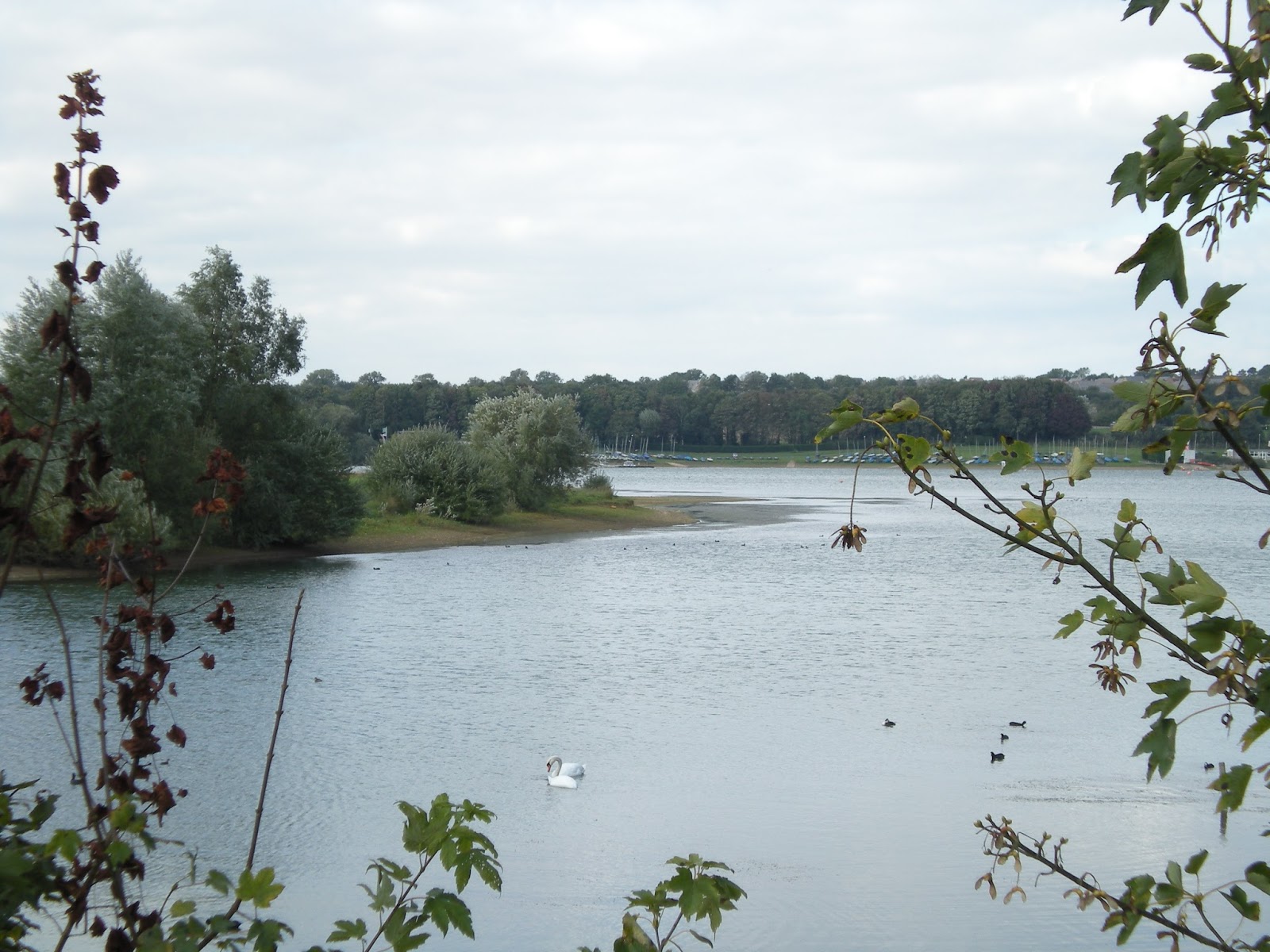
On the way down the hill to the water, I'm passed at speed by two hottish-hatches filled with twenty-somethings, and don't understand why. But there they are again in the reservoir car park, spliffing up, which they surreptitiously hide from me, like Year 10s with their ciggies behind the bike sheds. In a way it's rather charming. Do they come here regularly to indulge their mildly illegal pastime? Or like man, the water, the dancing sunlight, those trees, it's all so...spacey, y'know...and so...beautiful! Maybe they're just enhancing their appreciation of the countryside.
The paths around Pitsford Water, which I haven't walked for fifteen years, have been suitably tarted up. You can ramble dryfoot or cycle, as if in an urban park, and there are frequent benches from which to enjoy the long views of the lake. In a while I'm seduced by a sign on a footpath to the right which promises me Holcot in a mile. I hesitate, and then follow it. But then there's a deviation, and I eventually find myself beside a beautifully appointed cricket ground, and then the path's direction becomes uncertain and I have to trudge the long way around a big field to emerge, as others have done, not far from the Holcot village limits sign. The cricket ground is 'Northfields', laid out by building entrepreneur and philanthropist Lynn Wilson, who met an untimely death in a 2008 car accident. Apparently it's used a lot for 'age-group cricket', and what a nice airy place it is to learn the game, with what looks like a flat wicket and a cultured outfield.
I don't know whether there still is, but there used to be something called the 'Holcot Hobble' which was an annual walk roughly around Pitsford Water, covering something approaching marathon distance, so hiking's in the village blood. But actually, I'm a bit underwhelmed by Holcot today. The pub is shut, and I could do with a drink, though the website tells me it should be open. Like many country pubs it's perhaps finding the lack of lunchtime trade problematic. The millennium memorial stone has a legend which hasn't been cleaned in yonks and I can't read it. The church is shut and there's scant information on the notice board. And in the churchyard of St. Mary's with All Saints, there are many plastic flowers around the more recent graves.
I see the virtue of artificial flowers. But when they become tired as eventually even they will do in the wind and rain, who will dare remove them? And if plastic flowers, why not other ornaments, teddy bears, pictures and so on? These modern day grave goods can quickly become tawdry. And even at their best they compete and shout at each other, and in the end subtract I think from what most people want of a graveyard, which is quiet serenity and peacefulness.
But Dora and David live in Holcot: lovely people who when we worshipped there enlivened the URC in Northampton's Abington Avenue with a powerful social conscience and an enterprising attitude to life and faith. I'm glad to see David's still involved in Holcot's Tennis Club. From the lane in which they live I strike out around a barn and follow the field edge south east before turning south-west at Rectory Farm towards Moulton again. I'm annoyed with the farmers today, and that probably includes the owners of Rectory Farm. There've been too many ploughed out fields, and lack of signs when there's clearly a right-of-way somewhere to be found. Farmers, we want to support you, so give us some incentive! Near Moulton there's a huge field with an ominously scrappy strip of fallow at its eastern side next to where a new development of houses is just being completed. It feels uncomfortably as if another slice of greenfield is about to be sold off for phase 2 of the project.
Sorry, I may have gone off on this one before: back on a hobby horse! According to the BBC, there are 25 million homes in the UK. Let's say that there are 65 million people. So that's an average of 2.6 people per home. So considering all the other factors involved, yes, all the single people, but also all those homes with multiple children, and seniors' homes and so on and so forth, what possible justification is there for the rhetoric which talks of government failure and a need to build 300,000 homes per year for the next 20 years, or whatever the next inflated claim is? Isn't there a case to answer that this is about reviving the economy by boosting the building trade rather than actually giving people what they need. Particularly when there are lots of empty homes not being used.
What may be meant is that we have lots of the wrong sort of properties. Everyone wants their four bedroom with ensuite, even if they're essentially single, divorced, and seeing the kids at the weekend. I know. Just saying it makes me sound crusty, anti-liberal, anti-aspirational, fascist even. And Sue and I own...a four bedroom, more or less detached house with ensuite. Hypocrite!
And on the other hand, doesn't Brexit, hard, soft or runny in the middle, show us that we need to think about our own national food production? If we're so concerned with getting fracking going in the UK so that we don't import gas, why aren't we equally concerned not to import farm produce by growing our own? But as Holcot David would remind me, the world is wider than just Europe...
And the role of the church in this should be? Hmm, I really don't know. What should we be saying and to whom?
FTSE Report: some gains approaching record levels as the pound falls. Footie Report: Wales manage a good draw away against a strong Austrian team. Footsie Report: back in Berghaus boots again for the winter, but blisterless so far, from using elastic tape wound tight round the ankle. Nice one!
Stats man: 17 km. 17C. Wind: 25 kph (gusting higher). 2 churches, both shut. Game birds a-plenty. A flock of Canada geese. Three cyclists by reservoir, one walker other than me, earnest and head down. Don't talk to people in a Country Park!
Lord God
About speaking out...
When I was younger:
You remember that?
Well, in a time of student protest
I said I was a moderate.
What I might have meant
is what I now see
which is that
making a lot of noise about something
sometimes has the undesirable effect
of making the thing you don't want
paradoxically more likely.
And this is true
at work
at home
and in The Church.
These days everyone
does P.R. and spin.
I now confess
that sometimes I'm simply scared
to raise my voice.
And sometimes I don't know
how to speak effectively.
I expect Amos felt the same
(not that I'm putting myself in his class of beard, you understand!)
and the courage of Jesus
humbles me.
That strength;
That humour;
That love.
Revive in us the gift of prophecy, Lord,
Together with charity.
Amen.
After no more than a couple of hundred metres I'm passing the JGallery and am drawn in by the chalk-board blandishments to drink their coffee and eat what turns out to be very splendid cake. I've not been in before. It's a great space with pictures upstairs and downstairs. From the current exhibition I'm quite taken with Lee Burrows' work. There are some lovely low-lit evening pastoral images of Northamptonshire, particularly one of Nobottle and another of Harlestone. They make me think of some of the early dusky work of Piet Mondriaan before he started to break down his landscapes into the building blocks which eventually became his primary colour trademark. Then suddenly I realise I have company: it's Graham and Donna. Graham's a guitarist/singer with 'The Prince of Wales Rattlers', Moulton's very own folk group, and has recently had a triple heart by-pass. He looks very well, and good conversation is added to my coffee. The last time I saw Graham was when amongst others we played a very noisy gig just before his op. He really shouldn't have been doing it. Anyway, we all survived, though I was deaf for a couple of days afterwards.
Out of Moulton, having passed the Carey Baptist Church, the road winds past the site of 'The Hollies', where children with behavioural difficulties were once sent more or less under lock and key, and where once I foolishly applied for a job (didn't get it, and good thing too: they'd have eaten me alive!) There are houses there now, and up the lane much else has changed as Moulton Agricultural College has expanded and expanded. The verges of the lane are broad, although not as extensive as they are beside one of the other ways out of Moulton. I love these reminders of what the roads were once like before they were properly surfaced, with a wide track so that carts and carriages could find purchase among the cloying winter mud.
After the road has forked at Boughton Fair Lane, there's a straight stretch and then I turn right along a field path in the direction of Pitsford. Opposite me is 'Spectacle Lane' which the books suggest is called that because one of a number of follies in this area is built across it further down, an arch between two towers, which is said to resemble a 'spectacle'. There are seven follies in all, including the castellated 'Fox Covert Hall', now a private house. As a family we visit Stowe regularly, and Boughton is chicken feed compared with the assorted eccentricities to be found there, but these have their own Gothic charm. However, and I'm probably quite wrong, since Spectacle Lane leads down towards the site of the ancient fair, I wonder if its name doesn't have an alternative meaning. It would have afforded a good view of the goings-on.
Across the fields I reach Pitsford and am reminded what a gracious village it is. The church is in the care of the Rev. Stephen Trott, whose other place of worship I encountered in Boughton. There's a nice view down towards the reservoir and sailing club. In his younger days, Stephen was instrumental in providing the possibility of unionisation for clergy and church workers through the MSF, now absorbed into Amicus. Churchgoers will think differently about this idea, I fancy. All I'll say is that perhaps it's good if clergy are aware of union and labour issues, and maybe a good way in is through consideration of their own rights and privileges. Now with all due respect to my excellent friend and colleague Ralph Salmins, my own union, the M.U. (musicians, not mothers!) has done very little for me personally apart from being a source of cheap musical instrument insurance, but I suppose unions only come into their own when the chips are down, and the case for musicians is always difficult to make. Society could probably do with a better balance between Labour and Capital, if that doesn't sound too Galsworthy. Oh yes, to quote Billy Bragg, 'there is power in the union', which of course on occasion will be abused by the likes of the RMT. But we need that power, nonetheless.
On the way down the hill to the water, I'm passed at speed by two hottish-hatches filled with twenty-somethings, and don't understand why. But there they are again in the reservoir car park, spliffing up, which they surreptitiously hide from me, like Year 10s with their ciggies behind the bike sheds. In a way it's rather charming. Do they come here regularly to indulge their mildly illegal pastime? Or like man, the water, the dancing sunlight, those trees, it's all so...spacey, y'know...and so...beautiful! Maybe they're just enhancing their appreciation of the countryside.
The paths around Pitsford Water, which I haven't walked for fifteen years, have been suitably tarted up. You can ramble dryfoot or cycle, as if in an urban park, and there are frequent benches from which to enjoy the long views of the lake. In a while I'm seduced by a sign on a footpath to the right which promises me Holcot in a mile. I hesitate, and then follow it. But then there's a deviation, and I eventually find myself beside a beautifully appointed cricket ground, and then the path's direction becomes uncertain and I have to trudge the long way around a big field to emerge, as others have done, not far from the Holcot village limits sign. The cricket ground is 'Northfields', laid out by building entrepreneur and philanthropist Lynn Wilson, who met an untimely death in a 2008 car accident. Apparently it's used a lot for 'age-group cricket', and what a nice airy place it is to learn the game, with what looks like a flat wicket and a cultured outfield.
I don't know whether there still is, but there used to be something called the 'Holcot Hobble' which was an annual walk roughly around Pitsford Water, covering something approaching marathon distance, so hiking's in the village blood. But actually, I'm a bit underwhelmed by Holcot today. The pub is shut, and I could do with a drink, though the website tells me it should be open. Like many country pubs it's perhaps finding the lack of lunchtime trade problematic. The millennium memorial stone has a legend which hasn't been cleaned in yonks and I can't read it. The church is shut and there's scant information on the notice board. And in the churchyard of St. Mary's with All Saints, there are many plastic flowers around the more recent graves.
I see the virtue of artificial flowers. But when they become tired as eventually even they will do in the wind and rain, who will dare remove them? And if plastic flowers, why not other ornaments, teddy bears, pictures and so on? These modern day grave goods can quickly become tawdry. And even at their best they compete and shout at each other, and in the end subtract I think from what most people want of a graveyard, which is quiet serenity and peacefulness.
But Dora and David live in Holcot: lovely people who when we worshipped there enlivened the URC in Northampton's Abington Avenue with a powerful social conscience and an enterprising attitude to life and faith. I'm glad to see David's still involved in Holcot's Tennis Club. From the lane in which they live I strike out around a barn and follow the field edge south east before turning south-west at Rectory Farm towards Moulton again. I'm annoyed with the farmers today, and that probably includes the owners of Rectory Farm. There've been too many ploughed out fields, and lack of signs when there's clearly a right-of-way somewhere to be found. Farmers, we want to support you, so give us some incentive! Near Moulton there's a huge field with an ominously scrappy strip of fallow at its eastern side next to where a new development of houses is just being completed. It feels uncomfortably as if another slice of greenfield is about to be sold off for phase 2 of the project.
Sorry, I may have gone off on this one before: back on a hobby horse! According to the BBC, there are 25 million homes in the UK. Let's say that there are 65 million people. So that's an average of 2.6 people per home. So considering all the other factors involved, yes, all the single people, but also all those homes with multiple children, and seniors' homes and so on and so forth, what possible justification is there for the rhetoric which talks of government failure and a need to build 300,000 homes per year for the next 20 years, or whatever the next inflated claim is? Isn't there a case to answer that this is about reviving the economy by boosting the building trade rather than actually giving people what they need. Particularly when there are lots of empty homes not being used.
What may be meant is that we have lots of the wrong sort of properties. Everyone wants their four bedroom with ensuite, even if they're essentially single, divorced, and seeing the kids at the weekend. I know. Just saying it makes me sound crusty, anti-liberal, anti-aspirational, fascist even. And Sue and I own...a four bedroom, more or less detached house with ensuite. Hypocrite!
And on the other hand, doesn't Brexit, hard, soft or runny in the middle, show us that we need to think about our own national food production? If we're so concerned with getting fracking going in the UK so that we don't import gas, why aren't we equally concerned not to import farm produce by growing our own? But as Holcot David would remind me, the world is wider than just Europe...
And the role of the church in this should be? Hmm, I really don't know. What should we be saying and to whom?
FTSE Report: some gains approaching record levels as the pound falls. Footie Report: Wales manage a good draw away against a strong Austrian team. Footsie Report: back in Berghaus boots again for the winter, but blisterless so far, from using elastic tape wound tight round the ankle. Nice one!
Stats man: 17 km. 17C. Wind: 25 kph (gusting higher). 2 churches, both shut. Game birds a-plenty. A flock of Canada geese. Three cyclists by reservoir, one walker other than me, earnest and head down. Don't talk to people in a Country Park!
Lord God
About speaking out...
When I was younger:
You remember that?
Well, in a time of student protest
I said I was a moderate.
What I might have meant
is what I now see
which is that
making a lot of noise about something
sometimes has the undesirable effect
of making the thing you don't want
paradoxically more likely.
And this is true
at work
at home
and in The Church.
These days everyone
does P.R. and spin.
I now confess
that sometimes I'm simply scared
to raise my voice.
And sometimes I don't know
how to speak effectively.
I expect Amos felt the same
(not that I'm putting myself in his class of beard, you understand!)
and the courage of Jesus
humbles me.
That strength;
That humour;
That love.
Revive in us the gift of prophecy, Lord,
Together with charity.
Amen.
Thursday, 29 September 2016
One step enough for me
As Barn Lane exits Milton Malsor towards Blisworth, I pass one of many 'No Rail Freight' signs to be seen around the village (local land is about to be lost to a huge new commercial hub), and quickly find myself walking between sheepy fields under threat of extinction. The sheep get me thinking about the Latin word 'grex'. (This is the kind of nerdy thing that happens when you walk on your own and all the oxygen is going into your legs, not your brain!) I suppose sheep are quite gregarious insofar as they mostly seem to prefer the company of others to being on their own. (Though 'Shaun the Sheep' suggests they get occasionally grumpy or solipsistic like the rest of us). But would humans who think of themselves as gregarious like to be characterised as 'flocky' in a sheepy way? Perhaps not. And then there's the word 'egregious', which I've always assumed means 'out of the flock', therefore 'obvious' or 'outstanding' or 'pre-eminent'...even in a bad way as in 'egregious offender'. Thus does the countryside continue to make its linguistic presence felt, even in the biggest cities...truly 'rus in urbe'!
A side path takes me diagonally across a field which had wheat growing in it six weeks ago towards a high footbridge spanning the main Euston railway line. When I was eleven I would have loved this. The bridge affords a fantastic trainspotter's resource - if you could be fagged to walk that far, which I think only pretty fanatical trainspotters would. I stand and watch a few trains thunder past: the privileged Virgin expresses and a punier, clattering London Midland job. On the far side the path has been ploughed so there's a trudge over thankfully still quite friable soil to the Blisworth Football Club. Their pitches are quite hard too. You wouldn't want to be a goalkeeper diving around on them at the moment.
There's a funeral at St. John the Baptist's church, which from a friendly sign outside I deduce would otherwise have been open. Four undertakers are standing near the porch - the service is in progress, and I can hear the sound of the organ playing what I think is 'Abide with me'. In a generation, only diehard football fans will be requesting this: surely it's destined to be replaced with 'My heart will go on'. Organists, get practising! One of the undertakers is talking into his mobile. The others are chatting, sharing a quiet joke. What a funny job - being professionally serious most of the time, and then clocking off to talk about footy or Bake-Off or for a moan about the boss. I think of actors who knit or read or gossip before assuming their 'game face' and going on to give their Hamlet or Hedda.
I've been to a lot of funerals over the last few years, playing the organ, singing in the choir, mourning those I've known and those I haven't. I missed one this last Monday for a lady who we saw married only a few weeks earlier; David our Rector took the instructions for the wedding at the hospice. And last night I was rehearsing the Northampton Chamber Choir in Henry Purcell's 'Funeral Sentences': 'In the midst of life we are in death...'
I find walking useful in dealing with all this, the immediacy of putting one foot in front of another, of having the next small objective in front of me, of being made to appreciate each scene as I become part of it, and then leaving it behind me.
Blisworth Mill has been gentrified, but at least it's been preserved, a handsome building towering above the canal. A path crosses a long field above a tiny stream, but again the path has been ploughed and it's a tough, gently uphill half-mile to the far fence. No one has walked this way for a while and no wonder. The next obstacle is the A43 dual carriageway, a bit like crossing the Silverstone track while there's a Grand Prix is in session. 'In the midst of life...'
I scramble through the gap on the far side. Across the field is Gayton Woods Farm and beyond the farm some angling lakes, ringed by earnest fisherfolk on this lovely September day. I pick up the Northampton Round Path, conspicuously waymarked. In a little copse, I'm astonished to see what I at first think is a deep disused quarry. Then I realise the precipitous drop is into the cutting of the railway which once ran from Blisworth to Towcester. It was part of a network of lines whose prime purpose was the transfer of ironstone from Northamptonshire to South Wales during mid-Victorian times. Demand fell away drastically and there was never any prospect of substantial east-west passenger traffic so by 1952 the line was closed. The gradient up from Blisworth across 'the summit' was steep, so they cut as deep as they could to ease matters.
I'm now in the 'Gayton Wilds', according to the map, though it doesn't look exactly untamed. When I did my stint with 'Beltane Fire', looking for a record deal c.1988 as a sort of English U2, my favourite number was lead singer Clint' s 'Southern Wild', the reference being the New Forest where Clint had been brought up. The New Forest isn't exactly the outback either, though perhaps a tiny bit less domesticated than Gayton.
The church at Gayton is dedicated to St. Mary the Virgin. As I've walked, I've been surprised at the number of dedications to both Mary and St. John the Baptist, although I shouldn't have been. Where I was brought up, in Bexley in south-east London, the two Anglican churches are dedicated to...Mary and John. Just asking - but why aren't there more Anglican churches with Jesus in their monikers? Is that a stupid question? I mean, I know John was 'the forerunner' and all that, but he was just a family member doing a job, wasn't he? And in some small sense, actually pre-Christian, so an oddity among the saints...or perhaps we should say 'special'.
Gayton has a strikingly large number of big houses for such a small village. Perhaps the reason for this is the unique balcony view down towards Northampton. Here be Coppocks, numbered among the more kindly teachers of Matt during his time at Weston Favell Comp, including David, who's churchwarden at St. Mary's. I remember accompanying the Faure 'Requiem' here some years ago on a wing and a prayer (I think the regular accompanist had dropped out at short notice...)
My path follows the high ground for a while through fields of beautiful red-brown soil, then drops to the railway and the canal, and I walk the towpath until the Grand Junction meets the Northampton Arm, near the point where the railway branch to Northampton is visible while the main line is still audible. When we came to Northampton forty-three years ago, we were incomers and viewed with suspicion by Northampton society as fifth-column agents of change and decay (or at least, that's what it often felt like!). The Northampton of that era and several before was detached and wary. Many of the kids had never been to London, and were scared of escalators. You'll think I'm exaggerating, but I'm not. That branch-line attitude has changed completely over the last twenty years, but nothing's a given. With all the talk of Hard and Soft Brexit, of freedom of movement and the open market, of wanting in other words to have our cake and eat it, of just plainly irreconcilable desires, what's the future for this town and the country?
Stats man: 15km. 4 hours. 23C. No kingfishers on the canal. Undertakers: four and jovial. Ploughed-up paths: at least three. Churches: two. Railways: two. Buzzard: one, hovering purposefully. Defunct pedometer: one.
Father God
Do I really matter to you?
When I consider
The grains of sand on the beach
The specks of soil I crush underfoot
And the boffins tell me
There are more stars in the expanding skies than that,
Then what am I?
I hear you Jesus.
I hear you say
Our Father sees the sparrow fall.
I try to mitigate my mortality;
To be present in the moment;
To make each second an eternity,
But still I'm afraid.
I doubt.
I will rest in the loving arms
And trust.
One step enough for me.
Amen.
A side path takes me diagonally across a field which had wheat growing in it six weeks ago towards a high footbridge spanning the main Euston railway line. When I was eleven I would have loved this. The bridge affords a fantastic trainspotter's resource - if you could be fagged to walk that far, which I think only pretty fanatical trainspotters would. I stand and watch a few trains thunder past: the privileged Virgin expresses and a punier, clattering London Midland job. On the far side the path has been ploughed so there's a trudge over thankfully still quite friable soil to the Blisworth Football Club. Their pitches are quite hard too. You wouldn't want to be a goalkeeper diving around on them at the moment.
There's a funeral at St. John the Baptist's church, which from a friendly sign outside I deduce would otherwise have been open. Four undertakers are standing near the porch - the service is in progress, and I can hear the sound of the organ playing what I think is 'Abide with me'. In a generation, only diehard football fans will be requesting this: surely it's destined to be replaced with 'My heart will go on'. Organists, get practising! One of the undertakers is talking into his mobile. The others are chatting, sharing a quiet joke. What a funny job - being professionally serious most of the time, and then clocking off to talk about footy or Bake-Off or for a moan about the boss. I think of actors who knit or read or gossip before assuming their 'game face' and going on to give their Hamlet or Hedda.
I've been to a lot of funerals over the last few years, playing the organ, singing in the choir, mourning those I've known and those I haven't. I missed one this last Monday for a lady who we saw married only a few weeks earlier; David our Rector took the instructions for the wedding at the hospice. And last night I was rehearsing the Northampton Chamber Choir in Henry Purcell's 'Funeral Sentences': 'In the midst of life we are in death...'
I find walking useful in dealing with all this, the immediacy of putting one foot in front of another, of having the next small objective in front of me, of being made to appreciate each scene as I become part of it, and then leaving it behind me.
Blisworth Mill has been gentrified, but at least it's been preserved, a handsome building towering above the canal. A path crosses a long field above a tiny stream, but again the path has been ploughed and it's a tough, gently uphill half-mile to the far fence. No one has walked this way for a while and no wonder. The next obstacle is the A43 dual carriageway, a bit like crossing the Silverstone track while there's a Grand Prix is in session. 'In the midst of life...'
I scramble through the gap on the far side. Across the field is Gayton Woods Farm and beyond the farm some angling lakes, ringed by earnest fisherfolk on this lovely September day. I pick up the Northampton Round Path, conspicuously waymarked. In a little copse, I'm astonished to see what I at first think is a deep disused quarry. Then I realise the precipitous drop is into the cutting of the railway which once ran from Blisworth to Towcester. It was part of a network of lines whose prime purpose was the transfer of ironstone from Northamptonshire to South Wales during mid-Victorian times. Demand fell away drastically and there was never any prospect of substantial east-west passenger traffic so by 1952 the line was closed. The gradient up from Blisworth across 'the summit' was steep, so they cut as deep as they could to ease matters.
I'm now in the 'Gayton Wilds', according to the map, though it doesn't look exactly untamed. When I did my stint with 'Beltane Fire', looking for a record deal c.1988 as a sort of English U2, my favourite number was lead singer Clint' s 'Southern Wild', the reference being the New Forest where Clint had been brought up. The New Forest isn't exactly the outback either, though perhaps a tiny bit less domesticated than Gayton.
The church at Gayton is dedicated to St. Mary the Virgin. As I've walked, I've been surprised at the number of dedications to both Mary and St. John the Baptist, although I shouldn't have been. Where I was brought up, in Bexley in south-east London, the two Anglican churches are dedicated to...Mary and John. Just asking - but why aren't there more Anglican churches with Jesus in their monikers? Is that a stupid question? I mean, I know John was 'the forerunner' and all that, but he was just a family member doing a job, wasn't he? And in some small sense, actually pre-Christian, so an oddity among the saints...or perhaps we should say 'special'.
Gayton has a strikingly large number of big houses for such a small village. Perhaps the reason for this is the unique balcony view down towards Northampton. Here be Coppocks, numbered among the more kindly teachers of Matt during his time at Weston Favell Comp, including David, who's churchwarden at St. Mary's. I remember accompanying the Faure 'Requiem' here some years ago on a wing and a prayer (I think the regular accompanist had dropped out at short notice...)
My path follows the high ground for a while through fields of beautiful red-brown soil, then drops to the railway and the canal, and I walk the towpath until the Grand Junction meets the Northampton Arm, near the point where the railway branch to Northampton is visible while the main line is still audible. When we came to Northampton forty-three years ago, we were incomers and viewed with suspicion by Northampton society as fifth-column agents of change and decay (or at least, that's what it often felt like!). The Northampton of that era and several before was detached and wary. Many of the kids had never been to London, and were scared of escalators. You'll think I'm exaggerating, but I'm not. That branch-line attitude has changed completely over the last twenty years, but nothing's a given. With all the talk of Hard and Soft Brexit, of freedom of movement and the open market, of wanting in other words to have our cake and eat it, of just plainly irreconcilable desires, what's the future for this town and the country?
Stats man: 15km. 4 hours. 23C. No kingfishers on the canal. Undertakers: four and jovial. Ploughed-up paths: at least three. Churches: two. Railways: two. Buzzard: one, hovering purposefully. Defunct pedometer: one.
Father God
Do I really matter to you?
When I consider
The grains of sand on the beach
The specks of soil I crush underfoot
And the boffins tell me
There are more stars in the expanding skies than that,
Then what am I?
I hear you Jesus.
I hear you say
Our Father sees the sparrow fall.
I try to mitigate my mortality;
To be present in the moment;
To make each second an eternity,
But still I'm afraid.
I doubt.
I will rest in the loving arms
And trust.
One step enough for me.
Amen.
Subscribe to:
Posts (Atom)