Monday, 7 May 2018

Borders

From the Grand Junction Canal near Weedon, a track winds down through a field to Watling Street. I've just crossed the 'West Coast' railway line. For the rest of today's walk I'm very often within sight or sound of these three north-south arterial routes. When King Alfred made peace with and then converted his Viking enemy Guthrum in the late 800s, Watling Street north of the Ouse became the boundary between the Saxons and Danelaw. Was it used as a demilitarised zone by both societies? Or was it a porous border of as much significance and danger as say, that between Northern Ireland and the Republic in the nineteen-seventies?

Borders are Big News. The next two years will tell us how we're going to cope with a changed relationship to Europe. For the life of me, I can't see how the different political positions within the UK on this matter can he resolved harmoniously here or the other side of the Irish Sea. Nor do I see how the structural integrity of the UK can be maintained. Perhaps you can. I'm convinced David Cameron's decisions will be regarded with incredulity by future historians, but that's no comfort. It isn't the first and it won't be the last time a nation's wellbeing has been sacrificed to an interest group's well-being. If you disagree, please stay with me! We may not be at odds about everything. This isn't The Guardian...

The soil on the far side of Watling Street is noticeably sandy. All Saints, Flore dominates the higher ground the far side of the little Nene bridge. The village has a reputation for fertility - crop-wise. I can't speak for the sperm counts of its inhabitants.

If one knows that at least some Romans thought well enough of the place to build a villa here (what's not to like - just off the main road and with a plentiful supply of water?) then you'll have guessed the possible 'floral' derivation of its name. But in Saxon 'flor' means 'floor' (which itself is an alternative ancient spelling for the settlement) and so this could refer to knowledge of the villa's now re-buried tessellated pavement, or the threshing floor which received the fields' abundant harvests.

The church is shut. I sit on a sun-warmed bench and watch a lady tend a grave near the field edge. All Saints' ochre sandstone is particularly weathered. The details of a gargoyle over the south porch and a Norman arch by the chancel are softened and fading with age. As I walk up through Flore's streets, I see the drive to a house called 'Living Stones' and think of friend Maurice Walton, priest and architect, who with his wife Jill made one last home in the village here...but not at 'Living Stones'. This is a community house for the Jesus Army. As at Bugbrooke, I wonder how much contact there is between the Army and the folk at All Saints. Boundaries. Even in the Christian church. And becoming more rather than less marked with time it seems, contrary to my teenage expectations. Does it matter? I believe this. You believe that. Is it too post-modern to think that we can still love one another? See Angela Tilby on a related matter in a recent Church Times.

A lane follows the high ground to the north, and brings me to the by-pass described in the previous post ( 'Gongoozler'), which will perhaps form the future boundary of Northampton/Daventry. I'm surprised by how far advanced the work is. The road surface is laid, and even the white lines are marked. I'll try to be fair. For a few hundred yards I've just followed the road through Flore, and been impressed by the number and size of (mainly logistics) HGVs that rumble through the village, breaking up the road surface and doubtless representing a threat to any residents crossing e.g. from the church to the housing estate opposite.

But the logic of by-passes is that infilling will inevitably occur everywhere between the by-pass and what it's by-passing. Whoever you are, wherever you live, you'll be able to find an example. But let me show you with a few rather poor pictures what that means here:
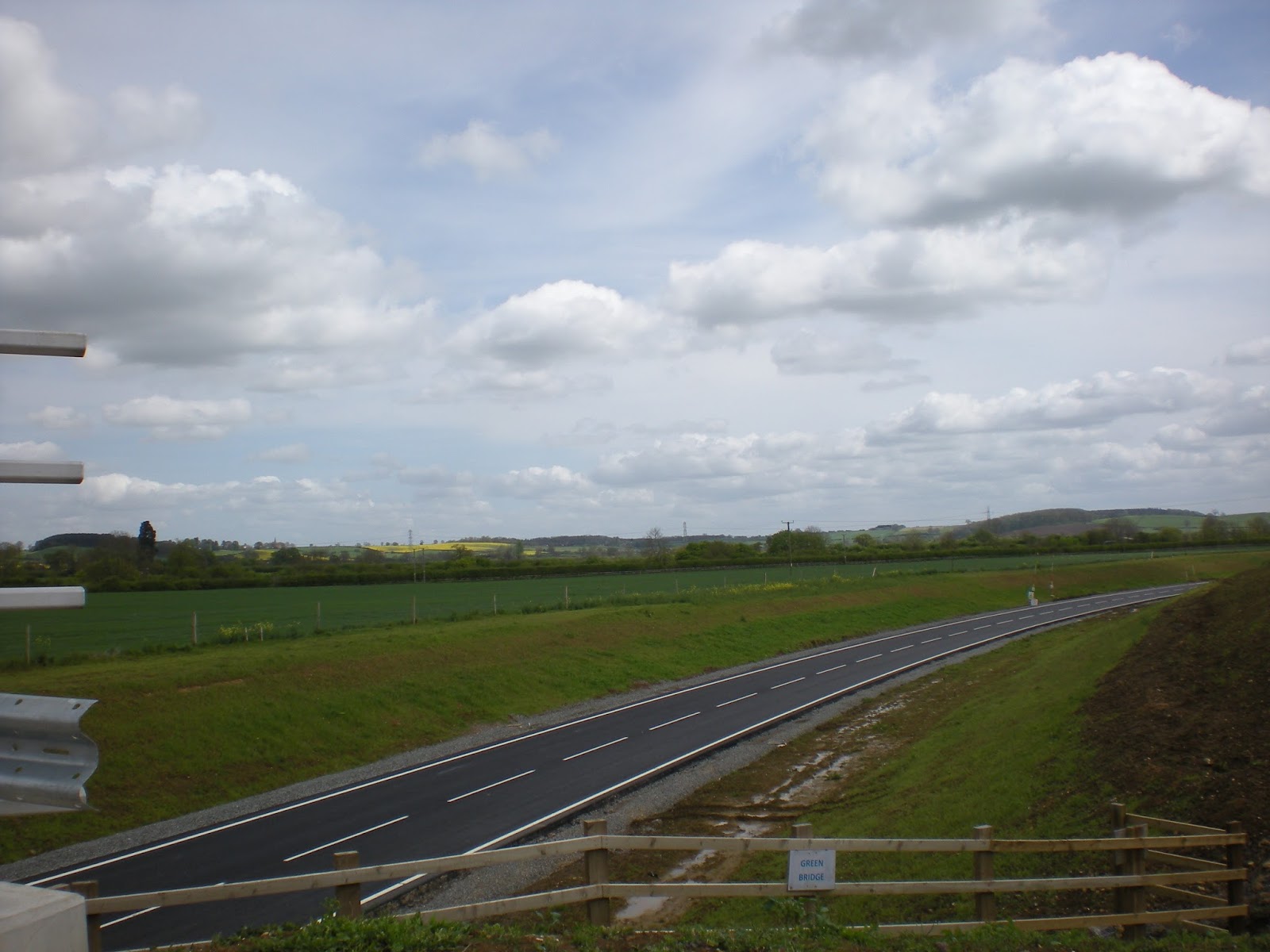

So, all the land to the left will be given over to housing... (we're looking roughly south-west)...


And so will the land that you can see here...(the road from Northampton to Daventry is out of sight but in this direction... this is to the south-east...


And because the M1 lies beyond the trees in the right of this picture, itself forming a boundary, so will this...and here we're looking more or less north...

I don't expect they say this is what will happen. But in time it will...

Near the new by-pass I slip on a patch of mud, and spatter my legs with slurry. I hope it's not the smelly sort or I'll be persona non grata in any pubs or cafes I visit later.The path veers westwards through a spinney close to the M1, and at a ploughed field right beside the motorway there's a choice as to which margins I follow (the path originally went on the diagonal, but I'm in Merrills and I can see it's stickily wet in the middle). I opt for left and then right, but of course make the wrong choice, ending up in mud so sucky it threatens to pull the shoes from my feet. I zigzag through the tilth, trying to find dry land, hoping no one's watching. Sorry, Mr. Farmer. Footprints all over.

Metalled lanes take me above the motorway and on to the delectable hamlet of Brockhall, which don't you think sounds like a place in Wind in the Willows? And since brocc means badger in Saxon that's pretty much right. St. Peter and St. Paul's is an estate church, built no more than twenty yards from the Big House. It's no great surprise to find that it too is locked. Services here will only be occasional: it's in the same benefice as Flore. Going forward the road's gated at either end of a sheep pasture. Gated roads used to be a more common feature of Northamptonshire's landscape, but they've mostly disappeared now: the inconvenience to solo drivers was just too great. On this occasion I have the opportunity to open and close the gate at the far end for a passing motorist. I think she said thank you, though she didn't bother to open her 4x4 window if she did. Perhaps she assumed I was an estate retainer, paid to stand and serve, and she was merely shocked I didn't tip my cap.

Just beyond the crest are the lumps and bumps of the medieval settlement of Muscott, once moved and emptied, I expect, at the behest of some long gone Lord of the Manor. So distressing and inconvenient to have the peasants quite so close to one's nice shiny new Seat. By the wonders of modern science i.e. cell phone I talk to friend Richard Holder as I stroll through a farmyard and then back up and over the M1...the canal...the railway. Richard has written a good song and I shall try to find a piano part worthy of it. All we less-than-famous musicians are now doing what our more celebrated counterparts have been at for years, using our laptops to record together remotely. It's fun, creative, and makes us collectively more than we are individually. Potentially here then, boundary transcendence...

At Watling Street I find myself by the entrance to the Heart of the Shires Shopping Village with a sudden overwhelming urge for Earl Grey. Hey man, I like...I need my fix, ya dig. Ya gotta give me the stuff. Now.  Whatever it takes. Don't be cruel, man. Ya gotta help me... Inside the Village everything's red brick and lavender paintwork. The shoppers are, well, like me really, in their sixties and seventies with the occasional real OAP thrown in. And all, well, quite lavender. Unlike me. A moment of self-awareness intervenes. No one else is sporting ordure-spattered legs, nor do they look like tramps - these are Country Casuals of a different ilk. I try to forget my personal bohemian chic and sit in Darlington's café with as much dignity as I can muster. The chocolate and orange cake is to die for, but I decline the offered accompaniment of ice-cream. You see that old dosser we had in here today? Went for the Blood Orange Gateau bigtime, he did. It's not right you know. I mean...the smell! What I say is, if he can afford that, he can afford a decent pair of trousers. And what about them Big Issue blokes? They take their benefits and manage to run a Merc on the side. Well, that's what I've heard. They should bring back the Workhouses if you ask me...Well, good morning to you, Mr. Willetts. ('Two Brains' David Willetts has been at it again this week, blaming Old People for all the ills of society.)

Pubs are closing but cafes like this are certainly doing a roaring trade among the middle-class retired. However N.B. to the Church (and 'Two Brains' ). Do not imply, when requesting greater donations from elderly parishioners or taxpayers, that this year's suggested increase in giving will only be the price of a Starbuck's coffee per week. Not all pensioners can afford the café lifestyle. Many are still on the breadline, and they too should be made welcome in our pews. And in wider society too.


                       Modern Watling Street. The boundary with Danelaw (to your right!)

The road to Norton curves away expansively from Watling Street at the junction you see above. I talk on the 'bone to stepmum Jean about electricians and days out, occasionally stepping onto the verge to avoid the surprisingly frequent traffic. At tall-towered All Saints' church I meet assistant treasurer Patrick who welcomes me warmly. He's come to check that the church is open (it is!) We chat as we shove our way through the tight-fitting churchyard gate and then walk together up a short avenue of nicely pollarded trees. It's a lovely spring day, but I don't think it's just that which makes the atmosphere of this place so cheerful. Norton's pub is a good 'un too. It doubles as a chippie, and gets very good web reviews - one to remember, if we're out this way and fancy a bit of haddock.

The lane to Dodford takes me up hill and down dale past acres of munchable grass, glittering blue-green in the sun, to a long view from an airy plateau where various bits of WW2 detritus litter the fields, frustrating the efforts of successive farmers to destroy them. In one place slabs of concrete are piled on top of each other so as to resemble a Cornish/Breton menhir - and artistically/historically it kind of works in this elevated setting.

Down the hill, beyond the relics of the old branch line to Leamington, is a little ford whose stream leads me beguilingly into the village. Dodford has associations with travel writer Patrick Leigh Fermor, who yomped his way entertainingly around Europe in the middle of the twentieth century, disregarding the artificialities of political borders.

A reality check. The milk of human kindness was no more widely available a hundred years ago. Ask the Armenians. Ponder on the butchery of the Great War and the Holocaust. But thus far through life, while acknowledging the universality of sin, and frequently rehearsing for my own benefit Luther's formula 'Semper peccator, semper penitens, semper iustus', I've also believed that slowly, oh so slowly, humanity is inching towards an omega-point, that moral and spiritual progress is possible. These days I'm less sure. With the cyber-revolution has come more sharply defined differentiation, a greater tribalism, exploited by knowledgeable oligarchies for financial and political gain. We're happy with our boundaries, safe in our insulation, content only if our walls are high and excluding. There's an upside. The Christian message of sin and salvation, of our being in Christ neither Jew nor Greek, nor bond nor free, was never so relevant. I talk the talk. Am I walking it enough?

And finally, Esther. On my way into Weedon, I catch up with a young African woman (I know she's African and not Caribbean from the accent as she returns my hello). At her side is a prettily summer-dressed three year old who turns, hearing the tap of my stick on the pavement: she finds me hugely amusing. I suppose it's the mud. The woman has another baby in a sling, and she's pregnant. I can't ask, but I want to know: 'what's the story?' She will have crossed, will daily be crossing, borders to be here. But why Weedon?


                                                                 In Norton church

Ticks on the stick:  20 km. Just shy of six hours. 19 deg. C. Slight breeze. Mostly sunny. One stile. Eleven gates. Nine bridges. (Why do I rehearse these stats each time? Because I love the British idiosyncrasy of 'the stile'. And they give some crude indication of the kind of country I'm walking in and the strenuousness of the hike.) Four churches, only one of them open.

No prayer this time.
Sometimes the subjects are too large;
The matters too weighty.
Words fail to meet the requirement.
So I'm afraid you'll have to do the work,
If you wish.
T.S.Eliot said much the same
But infinitely more elegantly.

Saturday, 28 April 2018

Gongoozler


Big Hill


Is everywhere the same as everywhere else?

I've been putting off this walk for a while. It looks like hard work: a slog up the Leamington road into Daventry, and then navigation of the town's Milton Keynes-like periphery: roundabouts, grass verges, commerce, boxy houses and all. In the event it turns out to be less intimidating than a first, careless study of the OS made me think.

The old road out of Staverton soon winds back onto the modern highway. The trees and bushes are bursting into green life on every side. It's that exciting week when winter really turns into spring, although you wouldn't know from the ambient temperature, nearly twenty degrees down on last week's exceptional maximum. I'm swathed in sweaters. The tarmac roadside path takes me past the Staverton Park Hotel and golf resort. It's clearly a favourite with the conference crowd. The large car park is rammed with Sales Rep transport on this Thursday morning, Insignias and Focuses by the score.  I'd have thought the 'De Vere Staverton Estate' would have demanded a re-branding of the prosaically named 'Big Hill' on the opposite side of the road. How about 'Trump's Head' or 'Mount De Vere' or  'FTSE Top'. So much classier.

I leave the main road through a layby and cross to a brief diversion along the remains of the older way out of Daventry, now just a footpath. I pass six or seven individuals walking the other way, perhaps workers at the De Vere. At home we've been watching BBC TV's 'Civilisations' series - with rapture when Simon Schama's presenting, somewhat more desultorily when Mary Beard or David Olusoga have been in charge. From our Gogglebox critical cheap seats we find Olusoga's style anachronistically didactic and his arguments sometimes less than convincing, although great as discussion starters. Oh my, how highbrow life is at the Crosses. Why not drop in sometime for an evening seminar on Derrida or String Theory. Such fun. Anyway...

Last week Olusoga mentioned a painting by Caillebotte neither of us knew: 'Paris Street: Rainy Day'. It shows  people hurrying through the city, heads down and avoiding eye contact, against a striking backdrop of Hausmann architecture. Today none of the people I pass on the road to Daventry want to make eye contact either. This isn't the countryside default. Just a few hundred yards back in the village I'd swapped the cheeriest of greetings with two women on horseback. In towns people are scared, and sometimes with good reason. We too have been burgled, assaulted and sworn at. It was probably always so. Is it just over-close proximity that makes us mean? Or an enhanced awareness of what we have and haven't got?

The old Staverton road takes me across a pedestrian flyover into a traffic-calmed urban street, the houses going increasingly upscale as I approach the town centre, through an underpass to a previous era of building, and then past the old  'Coach and Horses' travellers' inn. It's being gutted, earth movers where the horses once lodged, perhaps for part-refurbishment as a pub, abut also partly because it's soon to be reborn as an apartment complex. As Daventry's road plan changed, the 'Coach and Horses' lost its function as a hostelry. Now it's on a road to nowhere.


Say 'Daventry' and I think 'radio station'. On Bakelite wirelesses of the fifties it was one of the many exotic-sounding locations printed on the dial along with 'Hilversum', 'Sundsvall' and 'Allouis' etc. etc. Until fifteen years ago, going north on the M1, the motorist passed an extensive array of radio masts all now dismantled - tho' I think the town is still a radio marker for Britain's busy air traffic control. Daventry strikes me as a liminal town, looking west more than east, an outlier in Northamptonshire's geography. The town's shops are the usual contemporary mishmash, at least in the older streets. In the arcade by the bus station you can find Boots, Waitrose and Greggs as you would in any comparable place. Elsewhere it's charity emporia, tattoo parlours and takeaways. The buildings are a bit of a jumble too - here a bit of handsome sandstone Georgian, there workaday nineteenth century and nineteen-sixties utilitarian. I order an Earl Grey and a slab of Cherry Bakewell from the cheerful women in the Courtyard Tearoom (alas too sweet even for me!) and fiddle with my latterly unpredictable I-phone to no great effect. I notice a chap with a clerical collar in an adjoining comfy chair. It's Nigel Fry, the incumbent at Barby and Kilsby. I explain myself briefly, and leave him with a card and the threat that I'll be 'down his way' soon. He deserves his peace and quiet (I thought I detected a certain hunted look in his eye when I said hello), although I suspect like me he'll find it hard not to tune into the intimate domestic details being shared with the world by two ladies-who-cake on another near-by table.

Up at Holy Cross church, the front door of the splendid Georgian edifice (1754) is open. I'm welcomed by a be-gowned steward who explains there's a funeral shortly. I'm sorry not to be able to spend more time looking around. Everything about the church's décor and presentation is friendly and enthusiastic in an embracing kind of way. Recorded music is playing quietly in the background. A discreetly positioned sound desk is tucked in behind the back pews. Fe-fi-fo-fum, I smell the amps of a worship band ( but Holy Cross's website begins its 'music' section with a great - and clean - Thomas Beecham quote, and they have a church choir too!) The whole place sparkles with light and warmth. Leaving aside any human element, why wouldn't you want to worship in a place like this?

I follow my nose downhill looking for the Ashby road out of town ( not Ashby-de-la-Zouch: Ashby St. Ledgers!) It's still really chilly, particularly when the sun's hiding. A brisk west wind has got up. I recall the one time I played cricket in Daventry, also in late April, the first game of a season with a rather smart-alick team, all manly exhortation and diving around in the outfield. The wind was positively howling across the ground. It was right in my face as I opened the batting, the pitch soft and wet. I made a big lonely blob, tamely prodding the ball to a waiting catcher in the first over. It was one of the most miserable afternoons I ever spent on a cricket field. I played a few more games in that lot's company without any discernible distinction, sliding down the batting order week by week, confidence shot to pieces, until finally I brushed the dust off my cricket boots and moved on. I have to like the people with whom I'm spending time. The activity is never enough by itself.

After three quarters of a mile I find what I'm looking for, the converted path of the old branch line from Long Buckby, heading north-west, now a green corridor for cyclists and walkers through the housing estates. Daventry is expanding, like all the other Northamptonshire towns, pushing out on all sides. On the way from Northampton out through Weedon, there are roadworks on both flanks of that village, part of the Daventry development plan, as if the countryside in between and beyond will one day soon be quite consumed by housing. And so Daventry will no longer be an 'outlier': it will be one with the Northampton Megalopolis as it pushes forward to Coventry. And Oxford. And Cambridge. The bones of the structure will soon be in place. The detail will follow and nothing now can prevent it, outside economic collapse, and even then, that possible disintegration would be offered as the rationale for the 'necessary' destruction of the countryside. I'm sorry to bang on endlessly about it, but if this blog is to add to the historical record in any tiny way, this has to be recorded as one of the most important national trends of the early twenty-first century.

 I'm looking for a cross-track which I eventually find, but it's running along a viaduct fifty feet above me. I scramble up the steep and slippery sides of the old railway cutting, and walk a newly-made grassy way skirting the farthest extent of the housing. It eventually delivers me to the lane which once carried horses and people over the Braunston Tunnel on the Grand Union Canal. Below them the boats were 'legged' by their operators, who lay on boards and from an inverted position walked them from end to end - in this case through almost a mile and a half of tunnel. Not great for the digestion I wouldn't have thought. Apparently there's a bit of a wiggle in the middle, as there is at Blisworth, either because of difficulties with the soil, or miscalculation. At ground level the spire of Braunston's 'Cathedral of the Canals', All Saints, is dead ahead as I look down the green lane where it descends to meet the tunnel at its western portal.


Braunston is a first real taste of the Midlands as the traveller goes west. There's a lot of nicely weathered red brick, and much less yellow sandstone. The ginnels on the north side of the canal meander pleasantly between the cottages and eventually I gain the High Street, passing the old windmill, and arriving at All Saints to find Pat Milner one of the churchwardens waiting inside, drumming his fingers. A colleague has forgotten a promise to meet. We chat about this and that. They've just been through an interregnum: their new incumbent Nat White will be installed this Saturday. I say that we've just lost our lovely curate Allison who is to be installed this weekend too, and Pat and I get confused about dates. At any rate, the Bishop's working hard ( as I expect, creep, creep, he does every weekend!) Pat and I swap news about Marion and Keith Thomas, our former members at Weston Favell, who many years ago felt a calling to minister to canal folk, and made a temporary new home among them at Braunston, as you would.

I spend a few minutes just sitting in the beautiful breadth of All Saints' nave, looking around me. You could spend hours here, and still find new detail to stimulate and excite. The sheer quantity of symbolism in form, colour, fabric and glass is dazzling. This wealth of suggestion has been taken for idolatry, here in England and more widely around the world. As we know, courtesy of IS et al, wanton destruction is still going on. The Baptist church of my younger days would have been uncomfortable with what I see around me now. But for most of us, finding God in the desert is the hardest thing to do. My soul is relaxed and revived in this forest of images.

I walk back along the south side of the canal. Near to the entrance to the extensive marinas is a narrow boat café, the Gongoozler. I had no idea, but a gongoozler is a person who enjoys watching activity on the canals, but doesn't participate. That's me then! But there's no time for tea today.


                                           Legend on the wall by the Marina at Braunston

Did the people of Braunston not get on with their counterparts in Staverton? The Jurassic Way follows a more or less north-south line from the one village to the other, but it was never metalled, and at times is no more than a one person path. Just to the north of Staverton, two-thirds up a two hundred foot climb from the stream at its bottom, there's a civic seat. It looks out across miles and miles of uninterrupted country patchwork, a glorious view, a national resource of food and emotional sustenance. For how much longer?

So is everywhere the same as everywhere else? (I'm asking myself!) Yes and no, Superficially, all Mozart sounds the same - and some music-lovers never get past this. Superficially all sheep look identical, except perhaps to the farmer. At first glance every town and village look alike to the world-weary traveller. But, as I remind myself, the more we look and listen, the more we identify difference. And then it strikes me, as if a new and revolutionary thought, the only near-clones are those we produce through our own human industrial processes - knives and forks, cars, photo-copies, 3-D printed artefacts, robot-produced books. Or am I still not looking closely enough? And what conclusions should I be drawing from this?

Snoozes on the pews: 19 km. 5.5. hours. 9-14 degrees C. Wind: 15 mph, gusting 25. No stiles, Ten gates. Maybe four bridges. Countless new-born lambs: a shout out to numbers 19 and 13 in a field near Braunston.

Father
Ignite our land
With the gift of discernment
So that we can tell apart
False prophets from truth-tellers;
Disingenuity from integrity.
And then give us courage
And opportunity
To speak as you would have us speak.
Amen.

Sunday, 22 April 2018

TESS

At baptisms, at weddings, at funerals, every organist knows he or she may have to give their own good account of Lord of the Dance. But Syd Carter wrote a lot of other lyrics too and, mischievous and free-thinking chap that he was, they still frequently tend to polarise opinion, none more so than Every star shall sing a carol:

'Who can tell what other cradle/High above the Milky Way/Still may rock the King of Heaven/On another Christmas Day...?'

Some people hate this. Others love it. I'm with the latter group. And I particularly love Donald Swann's recording of the hymn. Donald and Sydney served together in the Friends Ambulance Unit during WW2. We had the great privilege of knowing both these great men, eccentrics and holy doubters both.

As I drive out to Everdon, I ponder again the possible theological challenges raised by TESS (NASA's 'Transiting Exoplanet Survey Satellite'). Well, it's an alternative to considering the relegation woes of Crystal Palace or Southampton as the morning's intellectual exercise. TESS is a Falcon 9 powered launch to replace the Kepler probe. It'll assume an elliptical Earth orbit to allow a survey of stars of relatively close proximity across the full spectrum of sky, with a view to gathering data about their planets, particularly those within the so-called 'Goldilocks Zone' i.e. where distance from their own 'sun' makes the possibility of life - extraterrestrial life - greater. A database will be assembled which scientists can then interrogate for details of atmospheres on those planets and so on. This is amazing and hugely clever stuff.

Well then, Christians of this world, what do you think? Are we humans unique in a universe chock full of galaxies, which in turn, like our Milky Way, are chock full of stars? And if we're not, how do we account for this in our soteriologies? (...which was the problem Sydney was contemplating fifty years ago!) Did Jesus die for the little green men and women too? Some will see this as a fundamental challenge to their faith. Personally I think we may end up with no alternative. We'll just have to embrace it some day, just as we embraced the notion that the Earth isn't the centre of the Universe. (Although strangely, Andrew Flintoff and many others apparently still cling to the notion that the Earth is flat. Stick to fast bowling and TV presenting, Andy!)
As Sydney said:

'Who can tell what other body/He will hallow for his own?/ I will praise the Son of Mary/Brother of my blood and bone...'

Because it's all I can do.


It is, to nick a lyric, such a perfect day, but for the duration of this walk I'm mostly spending it by myself. I take the risk and swap my boots for Merrills, then walk down the main street and over Everdon's stream, before climbing the hill towards Everdon Stubbs. I pass the gated road to Snorscombe, a hamlet whose name is a favourite of mine. The Stubbs are managed by the excellent Woodland Trust, and although my route takes me along its perimeter, I can see dog walkers enjoying the bosky paths in the shade of the trees. Whereas I, out in the open at 10.30, am hot already. There's a charming little fenced viewpoint looking out towards the distant A45 across the expanse of valley. The bench there is new. It's a good place to take on water. A rosette is somewhat randomly pinned to a tree, declaring the cattle who perhaps sometimes graze in this field as 'best in show'. Right at the top of the climb, the path very briefly ducks into the wood before setting out across a field of corn six inches high and growing taller by the minute. A couple are resting on a log. We swap jolly hellos as I try to incompetently reassemble a recalcitrant gate. I say that it's nice to see the bluebells. The gentleman draws my attention to the anemones. He's never seen so many and so large just here (they're locals). For some reason I think of Elvis Costello's 'It's been a good year for the roses'. Has anyone written a song about anemones? Difficult to scan...

I skirt farm buildings and emerge on a lane which follows the ridge towards Upper Stowe. To my left are the Castle Dykes. There was a castle here in medieval times, and the earthworks are well-preserved. Were there the money and opportunity for archaeology a lot more might be discovered (but you can't dig up everything). Antiquarian reports suggest hidden underground rooms, and pre-Roman antecedents of the later fortifications. Given how well it commands the view on both sides, I guess this shouldn't be surprising. Past the divide in the lanes, I come across an elderly gentleman close to the gates of his house at the end of a morning constitutional. He says he wishes he could walk as well as I can, which is a nice compliment since I'm apt to feel pretty decrepit myself at times. I'm forced to admit how lucky I am to be relatively fit and well.

I'm in the vicinity of Stowe Nine Churches, a little collection of small hamlets, but if you come looking for nine places of worship you'll be out of luck. I'm indebted to Mike Rumbold, writing on the village website: the explanations of the name are various and entertaining. If you're into folklore you'll like the idea that there was a little local difficulty in building the church because the Devil came out night, and threw down the building work eight times before God's Workers prevailed at the ninth attempt. An alternative but historical explanation might be that a new church was built on the site of the old one (French: neuve) but that this was misunderstood and corrupted to neuf (i.e. nine). Or how about a geographical interpretation whereby the 'Nine' is a corruption of 'Nene', the river being relatively close by? I think the latter probably gets my vote, Stowe being a common village name.

In Upper Stowe is a Chapel of Ease, St. James. I walk up the path and shelter inside from the sun. My intention to read a psalm aloud is forestalled by the arrival of Patsy and Ann. They're with a coach party the rest of whom are currently finishing morning coffee in the farm café opposite. Patsy and Ann et al are on an outing from Peterborough. They're spending the morning here, then having lunch at a Toby Carvery in Northampton, before giving Corby the once over during the afternoon. Ann attends St. Mary's in Peterborough, Patsy, St. Oswald's (I think that's the right way round). They like the quiet little chapel. They have to be back on the bus promptly so they sign the visitors' book and wend their way. As their companions drag themselves from the tearoom, I enter it and order Earl Grey and a piece of cranberry and orange cake. Delicious.

Behind the farm, the path drops sharply and then rises again to Church Stowe. Away to the right there's a long view to the cream coloured bulk of the Heyford flour mill, and beyond it the Express Lifts Tower. I feel a little tug of regret that the urban is once more poking its way into my lovely rural. Around the corner is a small development of rather elite contemporary homes, but these have been beautifully effected around a 'new' cherry-blossomed village green. I don't want to come on like Prince Charles, but this is an excellent example of harmonious village expansion. Hallelujah!

The church of St. Michael's has a great situation. It hangs over the descent towards Weedon, tall-towered and partly clay-clad. The electoral roll has 26 names on it and they return about £11k to the diocese as their Parish Share. The parishioners are keen on promoting wildlife in the churchyard, and as I sit on the bench there, there's a proliferation of bumble bees foraging in the grass around me, a welcome peculiarity of this unusual Spring - I've seen a lot in the last couple of weeks. Among the papers on the various tables inside St. Michael's is a book about the artist John Piper. I leaf through it, wondering for a moment whether he'd ever used the church as a subject...but I don't think so, though he was certainly active around the other and more famous Stowe; Lord Cobham's one time seat near Buckingham.

The path takes me on through fields of cabbagy rapeseed over the West Coast Main Line and down to the canal. A short totter along the towpath are the steep steps to the road which doubles back under the railway to find the church of St. Peter and St. Paul Weedon, sandwiched betwixt iron horse and barge. Properly this church originally served the community of 'Weedon Bec', now confusingly conflated with the later 'Upper Weedon' and 'Lower Weedon'. It was 'Bec' because after the Norman Conquest the living was given to the Abbey at Bec Hellouin in Normandy, then the most powerful foundation in northern France. When Matt was very small I remember we stopped off at the Auberge de l'Abbaye where the food is now of a gastronomic rather than egalitarian sort (though maybe the Bec Hellouin monks always looked after themselves well, being as influential as they were). Even before Norman times, Weedon generated its own saint, St. Werburgh, daughter of a Mercian chief, c. 700 A.D.. It's said that there was a chantry dedicated to her in a field to the south, Ashards, perhaps near the more recent graveyard? Some confirming archaeology really would be nice here. Ah, my Time Team of long ago, alas, where are you now? Werburgh is buried in Chester, although how she got there, I don't know.

Entering the church one is struck by the generous breadth of the nave, a nineteenth century rebuild courtesy of the fascinating history of Weedon in more modern times. This was the church to which soldiers would come from the garrison whose blocky buildings can still be found half a mile up the hill. I was always told the origins of the military here were the need to establish a final redoubt for the King (George III) during the Napoleonic Wars, when Britain feared imminent invasion. Weedon lay pretty much as far from the sea as you can get in England, and at a convenient halt on Watling Street too, still the M1 of its day seventeen hundred years after the Romans first dictated its line. The little town later became an ordnance depot, and retained military significance until the mid-twentieth century, at its peak doubling in size and accommodating over a thousand personnel. A branch of the canal was built into the facility, and a railway siding too. The Barracks have now become industrial units, home to many small and burgeoning businesses, including a great book shop and art gallery. However it's only a fraction of what it could yet become, given investment and vision. I'm thinking of Manufaktura, the innovative restoration project we encountered in Lodz eight years ago. Whatever may happen in the future, to my mind this is one of Northamptonshire's most resounding places, the ghosts of the past loitering on every street corner.


It's very hot now - one of those days when the forecast has gradually raised the level of the expected temperature - and as I toil along the Nene Way, straggling through Weedon and out into the countryside beyond, I'm failing to cope and wondering about the wisdom of today's excursion. Fortunately I have a hat and good water supplies on board, and the hedge to my left provides some shade. But by the time I reach the outskirts of Everdon Hall, I'm thoroughly cooked and extremely glad the car's near at hand.

Last week I received a charming e-mail from Charles Coaker who's churchwarden at Everdon. When I wrote of the commodiousness of the Hall estate I hadn't realised he was the owner. He thanked me for my kind comments but pointed out that the Hall's cricket ground is no more, superseded by an arboretum, although the pavilion survives. As Charles says with reference to the former owner: you can't live someone else's dream.

There was a certain dream-like state to today's walk, comparing en route the history and people encountered by little old me to the unimaginable vastness of the single galaxy in which we live and which we're just beginning to explore - one galaxy among an infinity of galaxies in our universe - one universe, if we're to believe the late Stephen Hawking, among an infinity of universes. This for me has always been the beginning of my belief in something beyond humanity, guiding and caring for all creation. That's my dream, and I'll go on recommending it for others to share while I have breath.


                                                              Bring your dijeridu...

Notches on the doorpost: 15 km. 5.5 hrs.  1 stile (only one stile!) 19 gates. 1 bridge. 28 degrees C at maximum (national high 29.1 at St. James Park, London = a record for April since 1949, and only 0.3 deg. C away from the all time high for the month.) So it really was hot then!

Father
I am staggered
By the beauty of your creation;
Awestruck
That I find myself in its midst;
Terrified
That we humans may so foul it up
That we wilfully
Destroy what you've seeded here;
Humbled
By the knowledge
That without us
The whirling universes
Will continue to your purpose.

Oh God
I acknowledge you
As the author and finisher
Of all that is.
I thank you
From the depths of my being
For the amazing rollercoaster ride
That is our life.
Amen.

Tuesday, 17 April 2018

Soggy bottoms (and soggy tops too!)


Saturday. Sunny...April...Saturday!  The weekend traffic jostles Blue Audi as I head north-west. At Rothersthorpe Services there's a bit of cheery sub-continent Exchange and Mart. A car of uncertain age and temperament is sold, then kangaroos around the parking lot. Perhaps the purchaser's just learning to drive and the car's a present from a benefactor. Blue t-shirted collectors for Cancer Research UK dominate the entrance to the café: intimidation in a good cause. Two young men in track suit bottoms swagger towards the Gents, hips loose and thrust forward, displaying their procreational possibilities to any passing females the way young men of a certain athletic demographic are apt to do. Further on up the road a Bike Club (of the Electraglide in Blue variety) park their beards in a layby to admire metal and swap stories of Easy Rider derring-do.

All relatively quiet in Hellidon though, except the pub's still being refurbished to the sound of Polish jokes and Radio 1, so there's no morning coffee to be had. A scotty dog wanders out onto the Green to sniff my boots. And this is all very welcome bucolic normality on the morning Allied cruise missiles have struck chemical weapons' facilities in Damascus and Homs. As I drove in, I'd been pondering the odds on a Russian reply in kind against Akrotiri.

Just around here the parishes and their churches are inconveniently grouped for my purposes. First up today I'm retracing my steps in the direction of Badby. The English cricket season has drifted into its wettest start for more than a decade. Match after match is being abandoned because of soggy outfields. The cricket authorities have become complacent about the good April weather of recent years. And just here the fields are sodden too after weeks of regular precipitation. The sheep look ragged and miserable - hard going for them and for me. The gentle drumlin shapes of the hills are softly outlined in the morning light: it's a joyful walk despite the squish and squelch. The sheep are tolerant enough of my presence, but as a microlight passes over (and now I remember there's an airfield close to Hellidon) they scatter. I join a green lane and pass to the south of Arbury Hill. Soon there are lovely views across the valley at what in a grander landscape would be called the 'head of the pass'. Thereafter the line of the old way is for a while marked by scrub trees on both sides. Soil erosion is causing them to slip slowly down the hill. I turn on to the metalled road and greet three walkers, who return my shouted hello with puzzled diffidence. They're in that class of person one encounters in the countryside who for whatever reason at that moment look uncomfortable. Maybe they're lost, though if so they don't ask for directions. Maybe they're up to no good: they're certainly appear ill-assorted for age and equipment. Of course, they may be saying the same about me - muddled old codger, looks like a tramp, might be a bit bonkers, best not to engage etc. etc.


                                                                      Arbury Hill

The entrance to Badby from this side is called Bunkers Hill and I remember a similar name for a lane I used to walk in Kent as a teenager. I suppose these may have been bunkers from which to shoot, or perhaps bothies to which one retired for a sandwich and a nip in between reducing the squire's pheasant population. At the top of the descent is Whetherday's Garden Centre, which like others of its ilk seems to be branching out into 'collectables'. That this is a trend I know from sometime guilty afternoon pleasure Antiques Road Trip.

I think I've observed this before in a previous post, but prolonged or effort-heavy walking induces obsessive or unexpected mental process in me, perhaps due to lack of oxygen. So as I enter the village this fine spring morning I catch myself humming over and over again the verse of a much-loved hymn from distant childhood:

'Glad that I live am I
That the sky is blue
Glad for the country lanes
And the fall of dew
After the sun the rain
After the rain the sun
This is the way of life
Till the work be done...'

It's a bittersweet thing, to rehearse something so meaningful but from so far in the personal past, to know that despite the intensity of the moment's experience how close the work is to being finished in one's own life.

The path onwards to Staverton follows a rushing stream (well, rushing today at any rate) fed from springs which mark one of the sources of the Nene. A little way along is the ruin of a mill, unmarked on the OS. The path goes ahead invisibly over richly brown ploughed fields, but the waymark posts are clear on the far side, so the decent and sensible thing is not to disturb any sowing or clag my boots and I zigzag the margins uphill to a copse which opens onto Staverton's rather sad-looking playing field. No one's playing footie this Saturday afternoon, nor for a few past, judging by the the random distribution of the goalposts and the faintness of the pitch markings. St. Mary's church is over the road presiding over the aura of calm organisation Staverton radiates.

Inside floor heaters are scattered around the four quadrants, and it does feel chilly, but the sanctuary is filled with beautiful light. I love the gargoyle on the back wall, tongue hanging out either lasciviously or in urgent need of a pint. It looks as it it's escaped from an Indian or South American temple. But why just the one? Was the stonemason humoured with this single piece of fun as compensation for his earnest toil on the more regular tasks? But no more than that, Joe! 'Twouldn't be right in God's church...

Less happily there are sundry rather tatty photographs of past incumbents displayed near an unusually large honours board for churchwardens. Would it be cranky of me to suggest that if the photos are going to be there (presumably because they have continued meaning for the congregation) they should be re-framed and freshened up? I notice that one of the portraits shows Rev. Allan Wintersgill, Rector here in the 1980s and father of Andrew, organiser of Northampton's Great Knights Folk Club. Time was, the best folk club in the county was to be found at the Dun Cow in Daventry, just a couple of miles away. I must have sung there in company with Andrew once upon a time.


I eat a happy sandwich in the sun-dappled churchyard and reflect on where I am with the Church and its organisation. For a few months I've been reading St. John's Gospel with growing puzzlement, partly assuaged by the writing of Tom Wright and Richard Bauckham. I've been shocked by the strangeness of the Gospel's language, so elliptical, so dualist, so challenging. Are you in or are you out? it keeps asking, but the in-ness or out-ness is to a relationship not the membership of a body. That only comes later in the New Testament ( ordinally though not chronologically) once Paul's fierce voice comes to the fore. So John's Gospel poses a challenge to me and the Church as it searches, in common with many other institutions, to find 'relevance'. To illustrate what I mean I heard a Radio 5 discussion the other day which forecast the death of Sport as we know it, Jim. The argument runs that Young People are far more interested in video-gaming (which is campaigning to be recognised as a 'sport'), and that football, tennis, cricket etc. etc. are destined to be numerically overwhelmed in the foreseeable future. No, I don't believe it either. But I'm not so sure about organised Christian religion. And I don't know if it's my imagination, but I think I can detect in the increasingly frenetic and shrill yoof-biased presentation of sport on telly that there's a growing insecurity about its cultural hegemony. It's not only Christians who fear the immediate future as a 'remnant'.

I pop into Staverton's Countryman pub where Susanne serves me a GB and has time for a brief natter after a hectic patch in the kitchen and at front of house. She worked in Improvement at Siemens, husband Rob in Safety for an airline. Restructuring provided the opportunity and now here they are in the village with their enviable business background, running a place that's thriving (and perhaps benefiting from the loss of a competitor in Hellidon for the time being!). Seems to me it requires enormous energy and liking for people to do what they do. I'll be coming back.

Over the road the path goes on the diagonal where a notice blatantly fibs that there's a 'Bull in field' (although n.b. for all I know this may not always be a fib, dear fellow-walkers!) and then progresses jauntily up and down, up and down, past Bates Farm ( no Motel available) where despite the fact that this is the Jurassic Way long distance footpath one has to start guessing the way ahead because there ain't no sign of it on the ground. I know. I'm boringly, predictably, grumpy about such matters. Or maybe just dumbed-down. Because the whole point of this section of path is to pass close to the southern end of the Catesby railway viaduct and you'd have to be blind to miss that. The viaduct carried the Great Central high over the River Leam, and provides a wonderful example of the difficulties facing the Victorian railway builders even in lowland Britain. Looking south one can see the rolling edge of the escarpment which entailed the tunnel mentioned in a previous post. To the north the terrain flattens, but avoiding a too steep gradient required the viaduct we still see today. Steaming across it at seventy miles an hour or more, the passenger would have been afforded a quintessential view of a Shire County. I wonder what the local bigwigs thought? Mrs. Gaskell's Cranford in real life.


I walk along the embankment and through the gate guarding the viaduct to enjoy the panorama, then retrace my steps and slosh along to Lower Catesby. You'll know the name, forever associated with the Gunpowder Plot. I'll encounter the family later and more tangibly when I get to Ashby St. Ledgers. Here they're just a medieval memory. The nineteenth-century chapel of St. Mary and St. Edmund is down a straight well-kept drive. There's a gate to a muddy paddock and stepping stones which take one in unorthodox fashion across the dirt to its locked front door. In the foreground two black and be-horned sheep beat a retreat, while a third white sheep of a different breed (sorry folks, my townie ignorance of farm animals is showing badly!) comes and nuzzles me, absolutely tame. Or absolutely starving. A little further back some cattle, also black and be-horned raise a head and sniff in my direction, but thankfully keep their distance.

It's a rather stiff-legged walk from here up the metalled road into Hellidon where the banks beside the back lane have been sown with many clumps of primroses. What a delicate spring glory they are, a re-discovery of recent years in our countryside, as I think, after some decades of decline and neglect; flowers which together with lily-of-the-valley are a direct line into the five year old Vince's perception of what every English woodland garden should be. Glad that I live am I.

Marks on the Park:  15 km. 5 hrs. Wind: minimal. Going: very soft ( Tiger Roll won the Grand National 10-1) 18 degrees C. 18 stiles (some rather high) 21 gates.  8 bridges.  2 cattle grids. Lots of daffs. In the absence of larks, an exaltation of primroses. Two large, bright yellow butterflies. Many solitary bees on the forage. Two churches. One open.


My re-vamped personal website is now live at:  www.vincecross.co.uk and if you click on Blog it will take you straight to the site you're now on. So now you have two ways of finding me!

Lord
I thank you for the memories
About which I write at such length.
When they begin to fade,
Deal with me gently
And give me some grip on the past
So that I can continue to be thankful
For the people I have known,
The places I have seen,
The sheer immensity
Of all that I've been privileged to experience.
May what I share of the past
Be truthful,
Be generous and
Be a witness
To your love and care
For all your creation.
Amen.

Thursday, 22 March 2018

Camino

There's a three-parter on the telly at the moment (BBC 2) using the Camino de Santiago as the hook for a bit of reality/faith TV. Seven celebs toil up the Pyrenean foothills and slog across the northern Spanish plains for the benefit of the cameras, struggling with notions of pilgrimage and faith as they go. At one extreme is comedian Ed Byrne presenting himself as a Northern Irish atheist, and at the other is the Rev. Kate Bottley of Gogglebox fame playing a straight up and down C. of E. vicar. Neil Morrissey and Heather Small ('Look for the hero inside yourself') are in the mix too. It's a bit of a dampener that they're not going the whole hog, just selected sections with intervening automotive assistance before the final 100k hike into Santiago de Compostela, but hey, who am I to carp! We followed the route a couple of decades ago, but elected to do it all by car, Matt being of Middle School age at the time. Even that diluted experience was highly moving and memorable. We still talk about it often.

Emilio Estevez's film 'The Way', with dad Martin Sheen in the lead role, reduced me to emotional tatters when we DVD'd it a few years back. Drop whatever you're doing and buy a copy now! And while the first part of the BBC programme didn't quite do that, it still packed a surprising if intermittent emotional punch.

Now here's an idea for the ultimate in slow television. What about a real-time walk along the Camino? Head cam for the visuals. Endless interesting conversations with people along the way. You could turn everything off at night-time. Or not, if you're Channel 5. Come on someone, what's not to like if you cost it per hour of telecast....?

So anyway.  Here I am back on my own little local pilgrimage after a couple of months' absence because of seasonal afflictions and the interesting weather. I'm walking to Peterborough from my 'home' church in Weston Favell, Northamptonshire via every one of the approximately 400 churches in the diocese. Each walk is a circle. Every circle must touch another one somewhere on its circumference. I'm about half way through the project, and it's nearly two years since I started. When I was younger, oh so much younger than today, I wrote a song called 'Almost half way through' ( three score years and ten and all that) which cheered up friends and family enormously. Not.

Out of Badby I take the path opposite the church and wheeze up the hill across the fields and into the woods. There are patches of dirty snow in the hollows five days after the 'mini-beast from the east' (I like the primary-school referenced nuance of this!) dumped half a foot on the western uplands of Northants. A woodpecker is drilling a tree nearby. Tits are piping the shrill two-tone call that's their speciality. A kite circles and mews. Glossy deep green bluebell plants litter the woodland floor, but spring is late: I imagine it'll be mid-May before we see any flowers. I start to look at the topology around me, and realise that there must have been quarrying here in the past. The ground has a far-from-natural set of contours. Emerging up onto the wide expanse of Badby Down, I rest for a drink and a sandwich before descending to Fawsley, retracing my previous walk. It's a lovely day, but the wind is brisk. It's chilly up on top.


  There are sheep everywhere, surrounded by their new lambs, sometimes twins, sometimes singles. The pairs stick closely to each other, sitting nose to nose, or trotting to a safer viewpoint as I pass. A few singles sprawl inelegantly, dozing under the warming sun. I walk up and then down again to Westbourne Farm and wonder what the story is there? The house is massive, far too big to be feasible for one family, I'd have thought. Why haven't they divided it, and rented out some of the accommodation? Of course it's true that in winter you'd need a 4x4 and a bit of courage to get out and about, and there's no corner shop, but to this naïve outsider it seems like a sensible piece of sustainable development. But then, I think, if I owned such a place, would I want to give up my privacy and seclusion?

The path moves up again, skirting the highest point of Everdon Hill before it drops sharply into the village. I've always thought of Everdon as a rather untidy place, and it's true, it does straggle as the road takes various right angles through the settlement, but today, walking its length for the first time, it seems more gentrified and sophisticated than I'd thought. St. Mary's church is down near the pub after I've passed the much-valued Field Centre which now occupies the old Primary School building. There's a stone-mason's van outside the church. Inside the pews are covered in dustsheets, and there's scaffolding along one wall. The area around the font, now cleared of seating, looks impressively large. A servery and loo are being installed, along the nice oak-panelled lines I'm familiar with from other churches in the diocese. Good for them.

I swig a GB in The Plough next door. I'm addressed as 'young man' by the guy behind the bar (probably younger than me, though he doesn't know it!), so I'll come back again. Actually the food looks worth coming back for, though unless I've missed the dining room I'm slightly puzzled as to where you'd eat it. There are some other noisy walkers occupying most of the space in the bar. They talk football in northern accents, though it would appear London is their usual stamping ground. Well, most people are Man U fans now. Or is there a turn of the tide against 'Mockney' in favour of 'MUckney'? I turn up the lane towards Little Everdon with its spacious Victorian Hall, which after the Second War became the venue for one of the longest lasting vestiges of country house cricket under the ownership of Captain Richard Hawkins. Friend Mark Mason, artist and co-originator of Gophers! Central TV series, one time (still?)fast bowler, used to come to play here on the beautifully appointed little ground on the Weedon side. At this point I join the Nene Way on its way west, and note that everything on the estate seems so much tidier and more beautifully thought through than I remember.

This hedge is just one example: a country craft much less in evidence than used to be the case. On the far side of the house I see many other instances of the same care: a new plantation, stiles and gates kept in good order (one used to have to negotiate a huge pile of farmyard ordure), and the path clearly signed - but on a line away from the Hall, which is fair enough. I wouldn't like people leering through my lounge windows every five minutes either!

Almost immediately the spire of Newnham church is visible on the far side of the newly risen Nene. I bounce up and down the ridged fields and then haul myself up what I know is the penultimate hill of the day, dropping into the lane where a farmer is so engaged with trying to free up a water supply damaged by the last week's cold weather that he doesn't hear me until I rattle the bars of the stile by his right ear. Nice day, I remark, at which he looks askance. Not so good in the wind, he replies with feeling, and that's right. As the cloud cover's increased, the breeze has become more marked and there's nothing to take the edge off it.


                                                         River Nene, near Newnham

St Michael and All Angels, Newnham has a very striking 'hollow' porch on the road. It's a church I've been inside before, and I'm expecting a rather musty, fusty experience, so I'm surprised to find the interior much smartened. Down both wings and at the rear are box pews, which now look polished and loved. It makes me smile that the 'free seats' are right in the middle, the best seats in the house, you'd have thought. Perhaps those who paid for the boxes felt less obtrusively under the beady eye of the preacher, who could more easily wag his finger at the hoi polloi in front of him. In St. Michaels, you step down to the little sanctuary, which I rather like.

From Newnham it's a mile and a half across the wet fields back to Badby, and now the breeze is in my face, sapping the energy, bringing a tear to the eye. It's surprising how much capacity for endurance I've lost in a couple of months. There's work to do. Our local Methodist church has a wayside pulpit which tells the world that prayer is the Christian's training regime (or words to that effect). No, it really isn't. It's the natural conversation one has with one's Maker and Redeemer, not a chore. However, it's something of a puzzle that it's easier to do when out for a walk than in church, and even then, easier to do it in the first couple of hours of a walk, before one gets tired and the legs hurt. I worry that when I'm old and ill and in extremis I shall find it impossible to do. So maybe it's as well to get the hours in now. Is that what the Methodists mean?

Pips on the hip:  12.5 km. 4 hours. (in mitigation, quite a lot of up and down: 700 foot up in total & yes, you've guessed, 700 foot down) 9 stiles. 21 gates. 4 bridges. 9 degrees C. West wind gusting 20 mph. 2 churches. Both open.


                                                                Feed my lambs


Father God
I hear that Millennials
Have no time for religion
Except in Poland and Ireland
(Which don't count of course
Because the Polish and the Irish
Are the butt of everyone's jokes, aren't they!)
Is it our fault?
Have we set bad examples?
Have we failed to make the case?
Have we looked too desperate
In our desire to talk them into the Kingdom?
Or are they just Rich Young Rulers
Who have so much to lose...
Father, look in compassion
On all your children
Young and Old
And bring us together
To build a future here and in heaven
With you at its heart.
Amen

Saturday, 13 January 2018

Mudlarks

February's supposed to be the fill-dyke month, but January's stealing its mud. Everything today is very slippery and squidgy underfoot.

I park outside the Fox and Hounds in Charwelton as the morning murk clears and walk over the three foot wide packhorse bridge (one at a time please...) to pick up the Jurassic Way towards Holy Trinity church. H.T. used to serve the vanished medieval settlement when the current village was 'Over Charwelton' by virtue of about ten extra feet in elevation. Across a field I briefly join the lane which carries traffic above the long-gone Great Central, and just before the bridge, Gordon stops his little blue car to chat. Gordon describes himself as a hillbilly, because he's lived in this Himalayan part of Northamptonshire all his life. He was born in the farm at Ryton Hill, by Arbury Hill, and before coming to Charwelton lived on the Attenborough estate opposite the Red Lion in Hellidon, another lofty place. I say to him that I've found a website which claims Arbury, at 225 metres (738 feet) the highest point in the county, to be the 13909th tallest peak in Britain. Things change, we agree, even if the landscape around here remains much the same as it was. Gordon doesn't use his computer a great deal but the other day, courtesy of Google, he was enjoying a nosey look at his friend's house in Canada. And just this morning I've been watching my son doing his lawyerly thing in a Dutch courtroom in more or less real time, so I'm also in a mood to be amazed. Gordon would talk for far longer - he even offers me a lift - but I explain this would break The Rules, and that I'd better get going if I want to be home before dark.


Avoiding a hopeful group of heifers, I push through the kissing gate at the church and re-trace my November amble towards Fawsley. The light's brilliant now, all traces of mist burnt away, the sky spectacularly caerulean. The view across the broad valley is heart-lifting. I very much enjoy my squelch across the sodden pasture. Outside Lower Fawsley House a young couple are loitering, fag in hand. They make a show of ringing the bell when I shout hello. I wonder to myself if they're casing the semi-derelict mansion with a view to a squat, and then am self-reproachful for being so nasty and suspicious. Behind me there's a fine view of Houseground Clumps, a curving stand of trees set up on the top of a hill. Last year we visited the Paul Nash exhibition. Houseground calls to mind the Wittenham Clumps down near the Thames which fascinated Nash so much both pre- and post-First War, becoming for him totemic of the landscape's antiquity. And there is something altar-like about Houseground too, in the way the bare branches project power in a place 'high and lifted up'.


Near St. Mary's church in Fawsley I turn up the hill towards Badby Down. If you're going to try a bit of the Knightley Way, somewhat abused by me for its lack of waymarking and charitable investment earlier in the Big Walk, then this is definitely the bit to try. The view from the top's excellent, and actually the path is signed very clearly just here. The Down carries a particular memory. Maybe thirty years ago I was out for a walk from Badby, when I started to feel suddenly unwell, so unwell that I began to experience in small measure what I'd only read about in books about e.g. polar explorers. I was instantly so fatigued I could have cheerfully just laid down and given myself up to the elements. I know that all sounds rather melodramatic, but it was an alarming and extraordinary feeling. Somehow I dragged myself through the woods back down to the village where the car was parked, and drove home in a daze. It turned out I had chickenpox. I don't recommend it.

I'd caught the horrible bug from the late Ben Markus, who'd been recording in our studio. Ben was a fireman who'd been retired early on health grounds, which gave him the chance to pursue his passion for the blues. I can't honestly say there was a lot of authenticity about his playing and singing, but Ben gave the music his very all, from a Fender Strat and a frighteningly large Marshall stack. Friend Nigel and I produced a single, which then became an album, and before we knew it there were the three of us posing for a photo shoot beside the Peace Pagoda in Milton Keynes, the proposal being that we market ourselves to a grateful nation under the soubriquet Gastank. I even dressed up in in a rock n'roll hat and appropriate Motorhead black for the occasion. However a few days later both Nigel and I took fright and the gas tank blew up, just another instance of expectations between collaborating musicians differing widely. Nevertheless the album was released and achieved a five-star review from Hi-Fi magazine, though quite how I'm not sure. Ben continued to follow his bluesey star for another couple of decades, but sadly cancer got him a few years ago. His unquenchable enthusiasm is what music-making's all about, whatever the genre.

Badby's a terrific place, but not really very Northamptonshire. It's more like a village you'd find in the lower part of a Yorkshire dale, solid, even slightly rugged. The county's only Youth Hostel was once here, thatched to boot, which is suggestive of the vibe the place evokes. The Nene (remember to rhyme it with 'Len' please and not with Maureen!) rises near here, and the woods are one of the best places locally for bluebells in late April or May. I'd not been in St. Mary's church before, but I like it. The interior is full of light, aided by the fifteenth century clerestory which faces you as you enter. There's a small carillon by the tower - an unusual feature. And by the door is a board which tells of an 18th century bequest by Thomas Coles of bread to the aged, poor and impotent of the parish. Do they still queue up to receive benefit in kind after divine service, I wonder, the impotent of Badby?

I've been re-reading Richard Giles book 'Re-pitching the tent' (Canterbury Press 1996) which was used by our church as a study guide one Lent when Colin Wake was our Rector, hence probably in the early noughties. The book's a game of two halves. The first has as its thesis that we are - or we should be - a 'Pilgrim Church', and that our inheritance of ancient fixed buildings is at best a mixed blessing. The second is a series of suggestions as to how, in spite of our 'plant' we can stay light on our feet. This may involve getting rid of a lot of physical stuff to which we've become too accustomed. To that extent, the drift of Rev. Giles' writing is at times a trifle too Luddite for my taste - or so I was thinking as I was sitting in the pews at Badby. There's so much to love in churches like this, so much to aid worship and inspire action. (I have other criticisms of Re-pitching the tent too. I think it smuggles in a personal aesthetic preference for the spare and the clinical under the guise of objectivity, and it's also a bit muddled in preaching democracy whilst wishing to maintain clerical control - but if you can, find a copy and see whether you think I'm right.)

However.

I pass under the lee of Arbury Hill, fortified in pre-Roman times, and plod my way through a succession of very muddy and wet fields to Hellidon, another favourite village. I'm hoping to be in time for a GB at the Red Lion but it's being refurbished, and though the front door is nominally open, builders' materials litter the yard and I don't think they'll welcome my custom this particular day. So I make do with my bottle of Waitrose spring water (other brands are available) and climb the short hill to the church of St. John the Baptist.

Inside, the experience is the polar opposite to St. Mary's. It's the darkest church interior this side of Byzantium. Even with a few lights on, it's a very dismal, depressing welcome. This was a building 'improved' by various designers during the nineteenth century including Matthew Holding, but somewhere along the line they forgot the usefulness of windows. So why hasn't the lighting been overhauled as a priority? I wouldn't have thought they're short of a bob or two hereabouts.

The visitors' book says it all. Though I'm straining to read it in the gloom, relatively speaking there are only a few entries during the last couple of years, and they're all downbeat and non-committal. A number speak of curiosity in returning to a place folk had known earlier in their lives, though none do so with approval. The notice board implies that services here run at the level of one a month, though the flower rota suggests a renewal every fortnight.

As regular readers may have noticed, as far as possible I try to be positive and constructive about the diocese and its churches, and I know the above is an exception to that rule. I'm sure it's not the fault of the new team vicar, the excellent Canon Mary Garbutt (she's only been in post a couple of months), but the presentation of the church doesn't fit the rest of what I think must be a lively and well-off village. There's a Village Hall, there was carol-singing at Christmas, a recent quiz in church...

So why does St. John the Baptist stay open? It's the residents of Hellidon who'd have to justify that, or else I'd be with Richard Giles on this one, and seek to close it down. Or why not pull down the Village Hall, sell the land, restore the church interior with the profits, and have all village functions, sacred and secular in the one place. That would be the 'missional' thing to do...but there are probably many good reasons why it couldn't happen, in terms of who owns what.

I descend the steps at the back of the churchyard, taking the short cut. A notice bids me beware that they're very steep. I go down slowly, holding on to the handrail. But so slippery and greasy are the stones that two stairs from the bottom my feet go from under me and I slide painfully into an undignified heap on my backside. My legs shoot out horizontally under the gate at the foot of the steps just as the one car an hour that passes through this point of the village drives by. No worry, they'll just have assumed that another drunken vagrant has fallen into a stupor by the church. At any rate they didn't stop to ask if I was OK. Bad karma all round?

With scarred shins but luckily, no broken leg, I climb the hill where I expect Gordon once exercised his dog opposite the pub and trudge back towards Charwelton across the bog. Towards the end of the walk a ploughed field causes me to detour around its edge beside the line of the Great Central close to the opening of the long twin-barrelled Catesby tunnel. Later I find that this is possibly to become a wind tunnel for the testing of Formula 1 cars, a startling apposition of technoflash with the intensely rural. As Gordon agrees, everywhere changes, and deciding whether it's good or not is sometimes almost impossible. Which also applies to questions of church order and fabric.

Splashes on the dashes: 16.5 km. A shade under five hours. Max 7 degrees C. Bright sun after heavy overnight rain. Little wind. Mist returning by mid-afternoon. Bunnies, squiggles and friendly sheep. Cheeky daffs poking through outside Badby church. One sore bum. 11 stiles. 32 (!) gates. 2 bridges.

O God
In your Book
There are mountains everywhere.
People are forever
Goin' up and comin' down
To meet you high in the clouds
Or to tell other people
(More or less)
What you've said.
I can see why.
Israel isn't exactly flat
And anyway
It's easier to imagine you
Sitting on a summit cairn
Dispensing tablets
Than toiling down in the dusty plain
With the rest of us.

I'm a fan of  mountains.
All that space around one.
The magnificent views.
The sense of achievement.
But then I think of the hairier moments.
The sudden mist.
The disorientation.
The cold that so quickly goes to the bones.
The recognition of disaster
Just a mis-step away.
I'm a sucker for a good metaphor too.
Yes, I'm still hauling myself up the rocks
Still a Beginner
As far as Hill-climbing goes.
Help me as I go, O God,
And teach me to look for you everywhere
Among the peaks
...And the troughs.
Amen

'Hill Climbing for Beginners'  was 'Water into Wine Band's first album  (1973 Myrrh Records) Original vinyl very hard to find. CDs still available from the band. Let me know if you want one.
vincecrossmusic@gmail.com


Sunday, 24 December 2017

Winterreise


As regular readers know, I never exaggerate. Much. But with each succeeding moment my lower limbs are falling into a state of atrophy. No yomping, you see. A heavy winter cold, a couple of snowy days and the onrush of the Christmas celebrations have kept me off the fields and out of the churchyards. I'll return to the paths in 2018, but I'm missing it already. I hope you'll continue to share the Walk with me. Come by and see me again sometime soon.

In the meantime, I hope you've found the Christmas you were looking for. Friend Brendan Read Jones and I recorded a sad Christmas song. Brendan ( a talented film-maker) and his crew then shot a video for it which you can find at:

https://m.youtube.com/watch?v=wyR7wVAUrsY&feature=youtu.be

If you like, please use your favourite social media to spread the word. And perhaps even buy the album when it surfaces later in the year ('Old heads and young hearts')?

One of the things we've been all too aware of this year is how many people face loneliness at Christmas. It's a theme which has been picked up countrywide, by the relatives of the late Jo Cox M.P. amongst others. Our own parish has faced some  tragedies of its own: there'll be some who are hurting right now, and maybe you're among them. Everything we say and do as Christians is in the context of a narrow divide between earth and heaven, of passion and redemption. All I can do, rather helplessly, is wish us all peace and the surprise of joy when we need it most.

Crash edit: a reprise of a seasonal poem I wrote last year:

Sprouting for boys (and girls)

Raise three cheers, give up a shout
For the humble, hardy Brussels sprout.
Be you Brexin or be you Brexout
They're cool.

Let's have a British Board to tout
The merits of the Belgian sprout
If Brussels objects, then dare to flout
Their rule.

Gregg Wallace says you shouldn't doubt
The vitamin value of the Flanders sprout
If you say nay, then you learned nowt (or should that be nuffink?)
At school.

Some folk rave over sauerkraut
But cabbage v. sprouts is an absolute rout.
Serve al dente with lardons all about
And drool.

Stave off the 'flu; ward off gout
With the iron-rich, good-for-you EU sprout.
Banish obesity! You won't grow stout on
Sprout fuel.

Kids will moan, kids will pout about
Something, so let it be the put upon sprout.
Tho' it makes them sigh I wish them (and you)
Sprout Yule.

I was very touched that Malcolm and Dot White used the following in their Christmas Letter this year. I wrote it for the 2016 Advent Blog at St. Peter's, Weston Favell.


Joseph on his death bed

One regret?
Always the outsider, me.
Mary and the boy
Like twins.
A family within a family,
Knew what the other was thinking
Before it was ever said,
And me alone on the edge of the room,
Or passing through with a nice piece of wood or two;
Looking in on their world,
Private and mysterious.

It went way back.
I didn't know her
(silly coy word)
Until after he was born.
Thereafter dutiful intercourse
And so along came James and Joses,
Jude and Simon.
But no, I never knew her,
Not really.
However that boy was conceived
I was always an anti-climax.

When he was small,
He helped in the yard,
Watched and asked questions.
In that sense,
Now I'm dying,
The business is safe.
He'll do the accounts,
Manage the difficult clients.
The others will do the work.

There was that moment,
Up in Jerusalem,
The year before his bar mitzvah,
He ran wild with the Zealots,
Pretending he was working for me.
I ask you!
'I must be about my father's business'!
I was incandescent,
Mary emollient,
And after that,
If such a thing is possible,
They were both even more unreachable.
Perhaps he'll end up a rabbi:
It runs in the family.
I suppose that's OK
Provided it doesn't turn his head.

Well, I'm curious to know
What will become of him,
But I'm like Father Moses
Looking over the golden, longed-for land,
The fulfilment of an adolescent exile
Not mine to enjoy.
He and I
We'll never share a pie and a pint
At the close of a profitable day.

The lad has an aura,
A strange unworldly kind of promise.
That's as much as I can say...

                                                                    ******

Lord,
Help me to drain every last drop
From the cup of Christmas;
To relish the singing of every carol;
To be like the child I once was,
Wide-eyed at the Christmas tree magic;
To be properly sentimental
About the family and friends I see,
And those who live only in the memory;
To treasure each moment
Around the manger;
To be grateful that You have let me share
This precious gift of Being.
Amen.

R.I.P. Ian Topp: December 2017.